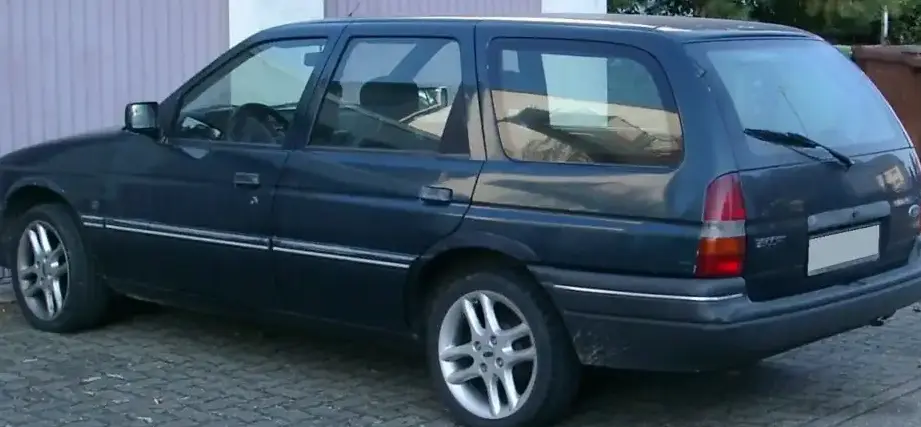
The Ford Escort V Turnier 1.4, produced between 1990 and 1992, represents an entry-level variant within the fifth generation (GAL/AVL) Escort range. This station wagon, known as a “Tournier” in some European markets, offered practical family transport with a focus on affordability and fuel economy. Positioned as the base model, it catered to buyers prioritizing functionality over outright performance. The Escort V generation itself was a significant update for Ford in Europe, introducing a more modern design and improved safety features compared to its predecessor. The Turnier body style, a station wagon, expanded the Escort’s appeal to those needing increased cargo capacity.
Technical Specifications
| Brand | Ford |
| Model | Escort |
| Generation | Escort V Turnier (GAL, AVL) |
| Type (Engine) | 1.4 (71 Hp) |
| Start of Production | 1990 |
| End of Production | 1992 |
| Powertrain Architecture | Internal Combustion Engine |
| Body Type | Station Wagon (Estate) |
| Fuel Type | Petrol (Gasoline) |
| Power | 71 Hp |
| Engine Model/Code | F6F, F6G |
| Engine Aspiration | Naturally Aspirated |
| Engine Oil Capacity | 3.5 l (3.7 US qt | 3.08 UK qt) |
| Coolant Capacity | 7.6 l (8.03 US qt | 6.69 UK qt) |
Powertrain & Engine Architecture
The Escort V Turnier 1.4 utilized the Ford F6F or F6G engine, a 1392cc (84.8 cubic inch) inline-four cylinder petrol engine. This engine was a relatively simple design, featuring a single overhead camshaft (SOHC) operating two valves per cylinder. Fuel delivery was managed by a Bosch fuel injection system, a step up from the carburetors used in earlier Escort models, improving efficiency and reducing emissions. The F6F and F6G engines are largely similar, with minor variations in specification depending on the specific market. The engine’s modest power output of 71 horsepower (at 5,500 rpm) and 88 lb-ft of torque (at 3,500 rpm) was geared towards economy rather than spirited driving. The engine block was constructed from cast iron, while the cylinder head was made of aluminum alloy. The engine was typically paired with a four-speed automatic transmission, although a five-speed manual gearbox was also available on other trims.
Driving Characteristics
The 1.4L engine and automatic transmission combination in the Escort V Turnier resulted in a driving experience focused on practicality and ease of use. Acceleration was modest, with a 0-60 mph time estimated around 14-16 seconds. The automatic transmission, while providing convenience, did detract from the engine’s limited power, often requiring significant throttle input for overtaking maneuvers. Gear ratios were optimized for fuel efficiency, meaning the engine often operated at higher RPMs during highway cruising. Compared to the 1.6L and 1.8L versions of the Escort V, the 1.4 felt noticeably slower, particularly when fully loaded with passengers and cargo. The manual transmission offered in other trims provided a more engaging driving experience and slightly improved performance, but the automatic was favored by buyers seeking a more relaxed driving style.
Equipment & Trim Levels
The Escort V Turnier 1.4 typically represented the base trim level. Standard equipment generally included cloth upholstery, a basic instrument cluster, and manual windows and door locks. Power steering was often an optional extra, as was a radio. The interior was functional and durable, prioritizing practicality over luxury. The Turnier’s rear seats could be folded down to increase cargo space, making it a versatile vehicle for families or those needing to transport larger items. Optional extras included a sunroof, upgraded stereo systems, and central locking. The dashboard layout was relatively simple, with clearly labeled controls. The exterior trim was minimal, typically featuring black plastic bumpers and side moldings.
Chassis & Braking
The Escort V Turnier utilized a MacPherson strut front suspension and a semi-independent twist beam rear suspension. This setup provided a reasonable balance between ride comfort and handling. The 1.4L model typically featured smaller diameter tires and steel wheels, contributing to a softer ride. Braking was typically accomplished with disc brakes on the front wheels and drum brakes on the rear. Anti-lock braking system (ABS) was not standard on the base 1.4 model, but was available as an option. The steering was a rack-and-pinion system, providing reasonably precise control. Stabilizer bars were fitted to both the front and rear axles, helping to reduce body roll during cornering. The suspension was tuned for comfort, prioritizing a smooth ride over sporty handling.
Market Reception & Comparison
The Escort V Turnier 1.4 was generally well-received as an affordable and practical family car. Critics acknowledged its fuel efficiency and spacious interior, but noted its lack of performance. Compared to the higher-spec Escort models, such as the 1.6L and 1.8L versions, the 1.4 offered significantly less power and refinement. However, it was also considerably cheaper to purchase and operate. The 1.9 TDI diesel version, while offering superior fuel economy, was more expensive and lacked the smoothness of the petrol engine. The 1.4L automatic was often seen as a sensible choice for drivers who primarily used the car for commuting or short trips, where performance was less of a concern. Fuel economy was a key selling point, averaging around 30-35 mpg in mixed driving conditions.
Legacy
The Ford Escort V Turnier 1.4, while not a performance icon, remains a relatively reliable and affordable classic car. The F6F/F6G engine is known for its durability, although regular maintenance is essential to prevent issues such as oil leaks and corrosion. The automatic transmission, while not particularly sophisticated, is generally robust if properly serviced. Today, these Escort Turniers are increasingly sought after by enthusiasts and collectors, particularly those looking for a nostalgic reminder of 1990s family motoring. Parts availability is generally good, although some trim-specific components may be difficult to find. The 1.4L automatic variant, while the least powerful in the range, offers a unique driving experience and represents a significant piece of Ford’s European history. Its simplicity and affordability continue to make it an attractive option for those seeking a practical and reliable classic station wagon.