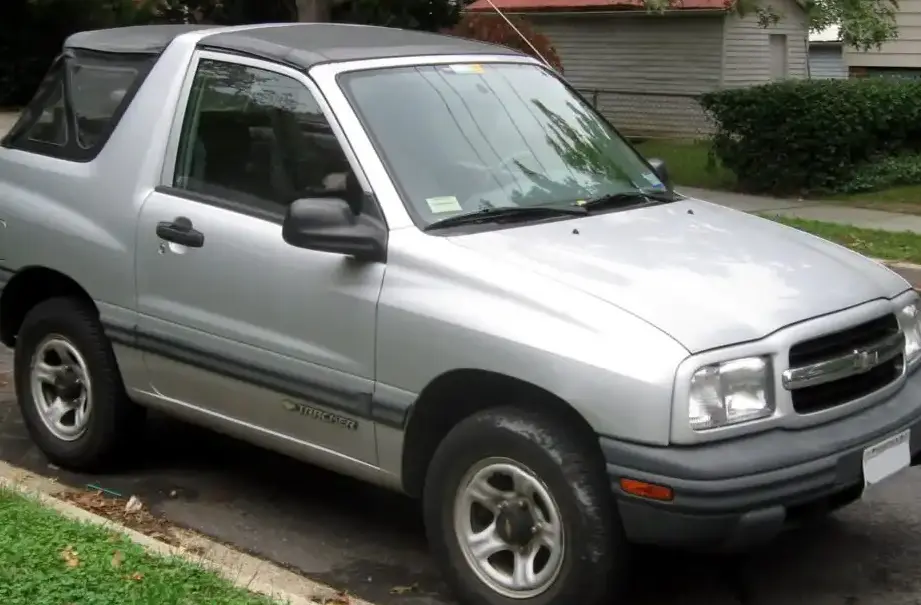
The Chevrolet Tracker Convertible II 2.0 i 16V, produced between 1998 and 2004, represented a unique offering in the compact SUV segment. This variant, powered by the J20A 2.0-liter inline-four engine producing 129 horsepower, was primarily marketed in Latin America and select international markets. It was positioned as a more affordable and accessible entry into the growing SUV category, offering open-air driving enjoyment through its convertible top. The Tracker Convertible II was built upon the GM S-10/Blazer platform, sharing many components with its pickup truck sibling, but distinguished itself with a more car-like driving experience and a focus on recreational use.
Technical Specifications
| Brand | Chevrolet |
| Model | Tracker |
| Generation | Tracker Convertible II |
| Type (Engine) | 2.0 i 16V (129 Hp) |
| Start of production | 1998 year |
| End of production | 2004 year |
| Powertrain Architecture | Internal Combustion engine |
| Body type | SUV |
| Seats | 5 |
| Doors | 3 |
| Fuel consumption (extra urban) | 9.4 l/100 km (25 US mpg, 30.1 UK mpg, 10.6 km/l) |
| Fuel Type | Petrol (Gasoline) |
| Maximum speed | 160 km/h (99.42 mph) |
| Weight-to-power ratio | 9.1 kg/Hp, 109.3 Hp/tonne |
| Weight-to-torque ratio | 6.5 kg/Nm, 154.2 Nm/tonne |
| Power | 129 Hp @ 6000 rpm |
| Power per litre | 64.7 Hp/l |
| Torque | 182 Nm @ 3000 rpm (134.24 lb.-ft. @ 3000 rpm) |
| Engine layout | Front, Longitudinal |
| Engine Model/Code | J20A |
| Engine displacement | 1995 cm3 (121.74 cu. in.) |
| Number of cylinders | 4 |
| Engine configuration | Inline |
| Cylinder Bore | 84 mm (3.31 in.) |
| Piston Stroke | 90 mm (3.54 in.) |
| Compression ratio | 9.5:1 |
| Number of valves per cylinder | 4 |
| Fuel injection system | Multi-port manifold injection |
| Engine aspiration | Naturally aspirated engine |
| Valvetrain | OHC |
| Engine oil capacity | 5.2 l (5.49 US qt | 4.58 UK qt) |
| Coolant | 6.5 l (6.87 US qt | 5.72 UK qt) |
| Kerb Weight | 1180 kg (2601.45 lbs.) |
| Trunk (boot) space – minimum | 290 l (10.24 cu. ft.) |
| Trunk (boot) space – maximum | 680 l (24.01 cu. ft.) |
| Fuel tank capacity | 56 l (14.79 US gal | 12.32 UK gal) |
| Length | 3780 mm (148.82 in.) |
| Width | 1694 mm (66.69 in.) |
| Height | 1689 mm (66.5 in.) |
| Wheelbase | 2200 mm (86.61 in.) |
| Front track | 1460 mm (57.48 in.) |
| Rear (Back) track | 1460 mm (57.48 in.) |
| Drivetrain Architecture | The Internal combustion engine (ICE) drives the rear wheels of the vehicle. |
| Drive wheel | Rear wheel drive |
| Number of gears and type of gearbox | 5 gears, manual transmission |
| Front suspension | Spring Strut |
| Rear suspension | Coil spring |
| Front brakes | Ventilated discs |
| Rear brakes | Drum |
| Assisting systems | ABS (Anti-lock braking system) |
| Steering type | Worm-reduction unit |
| Power steering | Hydraulic Steering |
| Tires size | 195/75 R15 |
Powertrain & Engine Architecture
The heart of the Tracker Convertible II 2.0 i 16V is the Chevrolet J20A engine, a 1.995-liter (121.74 cubic inches) inline-four cylinder powerplant. This engine utilizes a single overhead camshaft (OHC) design with four valves per cylinder, contributing to its relatively efficient breathing. Fuel delivery is managed by a multi-port fuel injection system, providing precise fuel metering for optimal combustion. The J20A engine is known for its durability and relative simplicity, making it a cost-effective choice for Chevrolet. The 129 horsepower output at 6000 rpm and 182 Nm (134.24 lb-ft) of torque at 3000 rpm were considered adequate for the vehicle’s weight and intended use. The engine is longitudinally mounted, driving the rear wheels through a five-speed manual transmission. This rear-wheel-drive configuration was somewhat unusual for a vehicle of this size and class, offering a different driving dynamic compared to more common front-wheel-drive SUVs.
Driving Characteristics
The 2.0-liter engine and five-speed manual transmission combination in the Tracker Convertible II provided a reasonably engaging driving experience. While not a performance-oriented vehicle, the engine delivered sufficient power for everyday driving and occasional highway cruising. The rear-wheel-drive layout contributed to a balanced feel, although traction could be a concern in slippery conditions. The five-speed manual allowed drivers to keep the engine in its optimal power band, maximizing acceleration and fuel efficiency. Compared to potential higher-output versions (which were not commonly available in convertible form), this 129 hp setup prioritized fuel economy and affordability over outright speed. The gear ratios were tuned for everyday usability, with a focus on smooth transitions and comfortable cruising.
Equipment & Trim Levels
The Tracker Convertible II 2.0 i 16V typically came with a fairly basic level of standard equipment. Interior features generally included cloth upholstery, a simple dashboard layout, and manual windows and locks. Air conditioning was often an optional extra, as were features like a radio/cassette player. The convertible top was manually operated, adding to the vehicle’s affordability. Trim levels were often limited, with most models offering a similar set of features. Optional extras could include upgraded sound systems, alloy wheels, and power accessories.
Chassis & Braking
The Tracker Convertible II utilized a body-on-frame construction, inherited from the S-10 pickup truck. Front suspension consisted of a spring strut setup, while the rear employed a coil spring arrangement. Braking duties were handled by ventilated discs at the front and drum brakes at the rear. An anti-lock braking system (ABS) was often included as standard equipment, enhancing safety. The chassis was designed to provide a comfortable ride, but its truck-based origins meant it wasn’t as refined as more modern, unibody SUVs. Stabilizer bars were present, but relatively thin, reflecting the vehicle’s focus on affordability rather than high-performance handling.
Market Reception & Comparison
The Chevrolet Tracker Convertible II 2.0 i 16V received mixed reviews. Critics generally praised its affordability and unique open-air driving experience, but noted its relatively basic interior and somewhat agricultural driving dynamics. Fuel economy was considered reasonable for the time, averaging around 9.4 l/100 km (25 US mpg). Reliability was generally good, thanks to the robust J20A engine and relatively simple mechanical design. Compared to other SUVs in its class, the Tracker Convertible II offered a different proposition – a more rugged and affordable alternative to more refined, but also more expensive, options.
Legacy
The Chevrolet Tracker Convertible II 2.0 i 16V has developed a modest following among enthusiasts, particularly those seeking a unique and affordable open-air SUV. The J20A engine is known for its durability, and well-maintained examples can still provide reliable transportation today. Parts availability can be a challenge in some regions, but many components are shared with other GM vehicles of the era. In the used car market, these Trackers are often sought after for their novelty and relatively low price point. While not a groundbreaking vehicle, the Tracker Convertible II 2.0 i 16V represents a unique chapter in Chevrolet’s history and a testament to the enduring appeal of affordable, open-air motoring.