
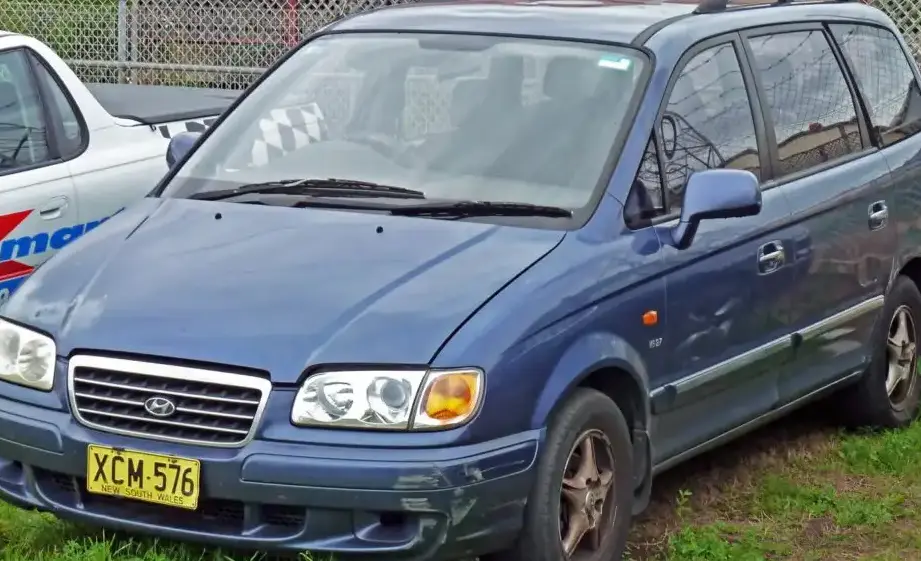
The Hyundai Trajet, introduced in 2000 and produced through 2008, was Hyundai’s entry into the increasingly popular minivan segment. Specifically, the 2.7L V6 model with a four-speed automatic transmission represented a mid-range offering within the Trajet lineup, positioned above the base 2.0L engine and below any potential limited-edition or fully-loaded trims. The Trajet (FO) was primarily aimed at families seeking affordable and spacious transportation, and was sold in markets worldwide, though it saw limited sales success in the highly competitive North American market. This variant aimed to balance performance with fuel efficiency and convenience, appealing to buyers who didn’t require the top-tier features or performance of more expensive minivan options.
Technical Specifications
| Brand | Hyundai |
| Model | Trajet |
| Generation | Trajet (FO) |
| Type (Engine) | 2.7 i V6 24V (173 Hp) Automatic |
| Start of production | 2000 year |
| End of production | 2008 year |
| Powertrain Architecture | Internal Combustion engine |
| Body type | Minivan |
| Seats | 7 |
| Doors | 5 |
| Fuel consumption (economy) – urban | 15.8 l/100 km (14.9 US mpg, 17.9 UK mpg, 6.3 km/l) |
| Fuel consumption (economy) – extra urban | 8.7 l/100 km (27 US mpg, 32.5 UK mpg, 11.5 km/l) |
| Fuel consumption (economy) – combined | 11.3 l/100 km (20.8 US mpg, 25 UK mpg, 8.8 km/l) |
| Fuel Type | Petrol (Gasoline) |
| Acceleration 0 – 100 km/h | 11.5 sec |
| Acceleration 0 – 62 mph | 11.5 sec |
| Acceleration 0 – 60 mph | 10.9 sec |
| Maximum speed | 192 km/h (119.3 mph) |
| Weight-to-power ratio | 10.7 kg/Hp, 93.4 Hp/tonne |
| Weight-to-torque ratio | 7.4 kg/Nm, 135 Nm/tonne |
| Power | 173 Hp @ 6000 rpm |
| Power per litre | 65.1 Hp/l |
| Torque | 250 Nm @ 4000 rpm (184.39 lb.-ft. @ 4000 rpm) |
| Engine layout | Front, Transverse |
| Engine Model/Code | Delta / G6BA |
| Engine displacement | 2656 cm3 (162.08 cu. in.) |
| Number of cylinders | 6 |
| Engine configuration | V-engine |
| Cylinder Bore | 86.7 mm (3.41 in.) |
| Piston Stroke | 75 mm (2.95 in.) |
| Compression ratio | 10:1 |
| Number of valves per cylinder | 4 |
| Fuel injection system | Multi-port manifold injection |
| Engine aspiration | Naturally aspirated engine |
| Valvetrain | DOHC |
| Engine oil capacity | 4.5 l (4.76 US qt | 3.96 UK qt) |
| Coolant | 8.5 l (8.98 US qt | 7.48 UK qt) |
| Kerb Weight | 1852 kg (4082.96 lbs.) |
| Max. weight | 2440 kg (5379.28 lbs.) |
| Max load | 588 kg (1296.32 lbs.) |
| Trunk (boot) space – minimum | 304 l (10.74 cu. ft.) |
| Trunk (boot) space – maximum | 2716 l (95.91 cu. ft.) |
| Fuel tank capacity | 65 l (17.17 US gal | 14.3 UK gal) |
| Length | 4695 mm (184.84 in.) |
| Width | 1840 mm (72.44 in.) |
| Height | 1710 mm (67.32 in.) |
| Wheelbase | 2830 mm (111.42 in.) |
| Front track | 1565 mm (61.61 in.) |
| Rear (Back) track | 1565 mm (61.61 in.) |
| Drivetrain Architecture | The Internal combustion engine (ICE) drives the front wheels of the vehicle. |
| Drive wheel | Front wheel drive |
| Number of gears and type of gearbox | 4 gears, automatic transmission |
| Front suspension | Wishbone |
| Rear suspension | Coil spring |
| Front brakes | Ventilated discs |
| Rear brakes | Ventilated discs |
| Assisting systems | ABS (Anti-lock braking system) |
| Steering type | Steering rack and pinion |
| Power steering | Hydraulic Steering |
| Tires size | 215/65 R15 |
Powertrain & Engine Architecture
The heart of this Trajet variant is the Hyundai Delta 2.7-liter V6 engine, internally designated as the G6BA. This engine is a naturally aspirated, 24-valve (DOHC) powerplant utilizing multi-port fuel injection. The 60-degree V-angle provides a relatively compact engine layout, aiding in packaging within the minivan’s front-wheel-drive configuration. The engine’s 86.7mm bore and 75mm stroke contribute to its responsive nature. The four-speed automatic transmission, while not the most modern by today’s standards, was a common choice for family vehicles of this era, prioritizing smooth operation and ease of use over outright performance. The transmission’s gear ratios were tuned for comfortable cruising and adequate acceleration, though it lacked the efficiency of more advanced transmissions.
Driving Characteristics
The 2.7L Trajet Automatic offered a comfortable, if not particularly sporty, driving experience. With 173 horsepower and 184 lb-ft of torque, acceleration was adequate for everyday driving and highway merging, taking approximately 11.5 seconds to reach 60 mph. The automatic transmission, while smooth, did contribute to a slight loss of responsiveness compared to the available manual transmission. The gear ratios were spaced to prioritize fuel economy and relaxed cruising, meaning the engine often needed to work harder when climbing hills or accelerating quickly. The front-wheel-drive configuration provided predictable handling, but lacked the all-weather capability of an all-wheel-drive system.
Equipment & Trim Levels
The 2.7L Trajet typically came standard with features expected of a family minivan, including air conditioning, power windows and locks, and an AM/FM radio with a CD player. Higher trim levels added features like alloy wheels, upgraded audio systems, and optional leather upholstery. The interior was designed with practicality in mind, offering flexible seating configurations with the ability to fold or remove the second and third-row seats to maximize cargo space. Optional extras included a sunroof, rear entertainment system, and upgraded safety features.
Chassis & Braking
The Trajet utilized a front independent wishbone suspension and a rear coil spring suspension, providing a reasonably comfortable ride. The suspension was tuned for comfort rather than sporty handling. Braking duties were handled by ventilated discs on all four wheels, supplemented by an Anti-lock Braking System (ABS) for improved stopping power and control. The steering was rack-and-pinion with hydraulic power assist, offering light and easy steering feel. The 215/65 R15 tires provided a balance of ride comfort and grip.
Market Reception & Comparison
The Hyundai Trajet faced stiff competition in the minivan segment from established players like the Honda Odyssey, Toyota Sienna, and Dodge Caravan. Critics generally praised the Trajet’s spacious interior and affordable price point, but noted its somewhat unrefined engine and transmission compared to its rivals. Fuel economy was average for its class. Compared to the base 2.0L Trajet, the 2.7L offered a noticeable improvement in performance, making it a more appealing option for buyers who frequently carried a full load of passengers or traveled on highways. However, the 2.7L was more expensive than the 2.0L, and its fuel economy was slightly lower.
Legacy
The Hyundai Trajet, while not a runaway success, played an important role in establishing Hyundai as a credible competitor in the minivan market. The 2.7L V6 engine proved to be relatively reliable, though like any vehicle of this age, regular maintenance is crucial. Today, the Trajet can be found on the used car market at very affordable prices. While it may not offer the latest technology or features, it remains a practical and spacious option for families on a budget. Parts availability is generally good, and the relatively simple mechanical design makes it a reasonably straightforward vehicle to maintain for those with some mechanical aptitude.
