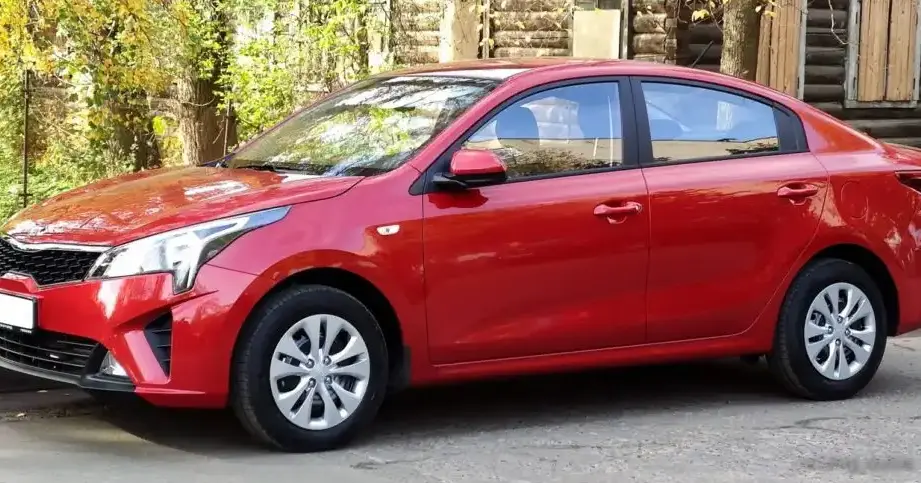
The Kia Rio IV Sedan, specifically the facelifted version introduced in 2020 (FB/UC chassis), offered a 1.4-liter Kappa engine producing 100 horsepower paired with a six-speed automatic transmission. This configuration represented a key entry point into the Rio sedan lineup, targeting buyers prioritizing affordability and ease of use over outright performance. Production of this variant spanned from 2020 onwards, fitting within the fourth generation of the Rio, which debuted in 2017 and received a significant refresh in 2020 with updated styling and technology. The Rio, in general, served as Kia’s subcompact offering, competing with vehicles like the Honda Fit, Toyota Yaris, and Hyundai Accent, primarily in markets outside of North America where subcompact sedans maintain stronger sales figures.
Technical Specifications
| Brand | Kia |
| Model | Rio |
| Generation | Rio IV Sedan (FB/UC, facelift 2020) |
| Type (Engine) | 1.4 Kappa (100 Hp) Automatic |
| Start of production | 2020 |
| Powertrain Architecture | Internal Combustion engine |
| Body type | Sedan |
| Seats | 5 |
| Doors | 4 |
| Fuel consumption (urban) | 8.5 l/100 km (27.7 US mpg) |
| Fuel consumption (extra urban) | 5.1 l/100 km (46.1 US mpg) |
| Fuel consumption (combined) | 6.4 l/100 km (36.8 US mpg) |
| Fuel Type | Petrol (Gasoline) |
| Acceleration 0 – 100 km/h | 12.9 sec |
| Acceleration 0 – 62 mph | 12.9 sec |
| Acceleration 0 – 60 mph | 12.3 sec |
| Maximum speed | 183 km/h (113.71 mph) |
| Emission standard | Euro 5 |
| Weight-to-power ratio | 11.8 kg/Hp |
| Weight-to-torque ratio | 9 kg/Nm |
| Power | 100 Hp @ 6000 rpm |
| Torque | 132 Nm @ 4000 rpm (97.36 lb.-ft. @ 4000 rpm) |
| Engine layout | Front, Transverse |
| Engine Model/Code | Kappa / G4LC |
| Engine displacement | 1368 cm3 (83.48 cu. in.) |
| Number of cylinders | 4 |
| Engine configuration | Inline |
| Cylinder Bore | 72 mm (2.83 in.) |
| Piston Stroke | 84 mm (3.31 in.) |
| Compression ratio | 10.5:1 |
| Number of valves per cylinder | 4 |
| Fuel injection system | Multi-port manifold injection |
| Engine aspiration | Naturally aspirated engine |
| Engine oil capacity | 3.5 l (3.7 US qt | 3.08 UK qt) |
| Coolant capacity | 5.5 l (5.81 US qt | 4.84 UK qt) |
| Kerb Weight | 1182 kg (2605.86 lbs.) |
| Max. weight | 1600 kg (3527.4 lbs.) |
| Max load | 418 kg (921.53 lbs.) |
| Trunk (boot) space | 480 l (16.95 cu. ft.) |
| Fuel tank capacity | 50 l (13.21 US gal | 11 UK gal) |
| Length | 4420 mm (174.02 in.) |
| Width | 1740 mm (68.5 in.) |
| Height | 1470 mm (57.87 in.) |
| Wheelbase | 2600 mm (102.36 in.) |
| Front track | 1516 mm (59.69 in.) |
| Rear track | 1524 mm (60 in.) |
| Ride height (ground clearance) | 160 mm (6.3 in.) |
| Drivetrain Architecture | Front wheel drive |
| Number of gears | 6 |
| Gearbox type | Automatic transmission |
| Front brakes | Ventilated discs |
| Rear brakes | Drum |
| Tires size | 185/65 R15 88H; 195/55 R16 87H; 205/45 R17 88V |
| Wheel rims size | 6J x 15; 6J x 16; 6.5J x 17 |
Powertrain & Engine Architecture
The heart of this Rio variant is the Kia Kappa 1.4-liter inline-four cylinder engine, designated as the G4LC. This engine is a naturally aspirated powerplant featuring multi-point fuel injection and dual continuously variable valve timing (CVVT) on both intake and exhaust camshafts. The CVVT system optimizes valve timing based on engine speed and load, improving both fuel efficiency and power output. The engine produces 100 horsepower at 6000 rpm and 132 Nm (97 lb-ft) of torque at 4000 rpm. The six-speed automatic transmission is a conventional torque converter type, chosen for its smoothness and ease of use, particularly in urban driving conditions. While not offering the sportiness of a manual transmission or the efficiency of a continuously variable transmission (CVT), it provided a comfortable and convenient driving experience for the target demographic.
Driving Characteristics
The 1.4L automatic Rio delivers adequate, but not exhilarating, performance. Acceleration from 0-60 mph takes around 12.3 seconds, making it suitable for city commuting and highway merging with careful planning. The automatic transmission is tuned for fuel economy, resulting in relatively conservative gear ratios. This means the engine often operates at higher RPMs during acceleration, contributing to a noticeable engine note. Compared to the manual transmission version of the same engine, the automatic sacrifices some responsiveness. Higher trim levels with larger engines, such as the 1.6L, offered significantly more power and a more engaging driving experience, but at a higher price point.
Equipment & Trim Levels
The 1.4L automatic Rio typically served as the base or near-base trim level. Standard features generally included air conditioning, power windows and locks, a basic audio system with Bluetooth connectivity, and standard safety equipment like ABS, airbags, and stability control. Higher trim levels added features like alloy wheels, a touchscreen infotainment system, a rearview camera, and advanced safety features. Interior upholstery was typically cloth, with a focus on durability rather than luxury. Optional extras often included upgraded audio systems, sunroofs, and keyless entry.
Chassis & Braking
The Rio IV Sedan utilizes a front-wheel-drive platform with a MacPherson strut front suspension and a torsion beam rear suspension. This setup provides a comfortable ride quality, prioritizing smoothness over sporty handling. The front brakes are ventilated discs, providing adequate stopping power, while the rear brakes are drums, a cost-saving measure common in this segment. Electric power steering is standard, offering light and easy steering feel. The suspension tuning is geared towards comfort, with a focus on absorbing bumps and minimizing body roll.
Market Reception & Comparison
The 1.4L automatic Rio was generally well-received as an affordable and practical subcompact sedan. Critics praised its fuel efficiency and comfortable ride, but noted its lack of power and somewhat basic interior. Compared to other trims in the Rio lineup, the 1.4L automatic offered the lowest price of entry but sacrificed performance and features. Fuel economy figures of around 36.8 US mpg combined were competitive within its class. Reliability was generally good, with the Kappa engine proving to be a durable and dependable unit.
Legacy
The 1.4L Kappa engine paired with the six-speed automatic transmission proved to be a reliable and economical powertrain in the Rio IV Sedan. While not known for its performance, it provided a dependable and affordable transportation solution for many buyers. In the used car market, these Rios are often sought after for their low running costs and relatively simple maintenance requirements. The Kappa engine’s durability and the automatic transmission’s smooth operation contribute to its continued appeal as a budget-friendly option.