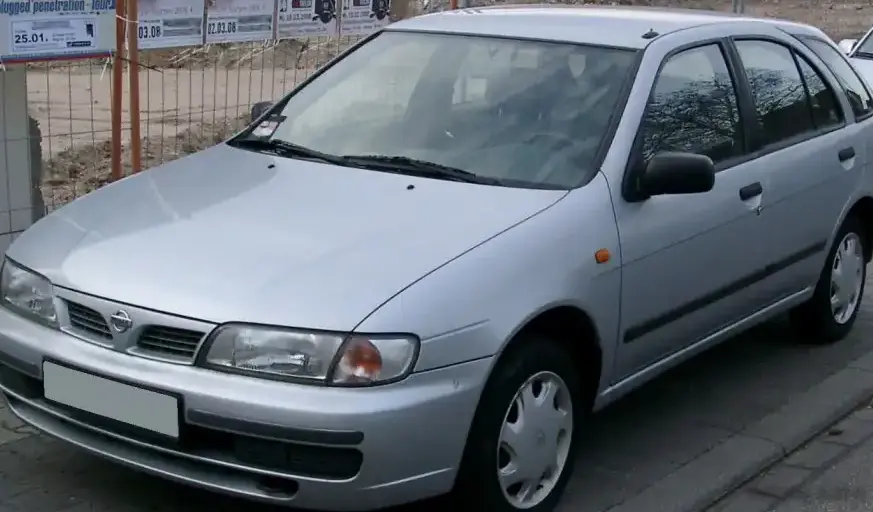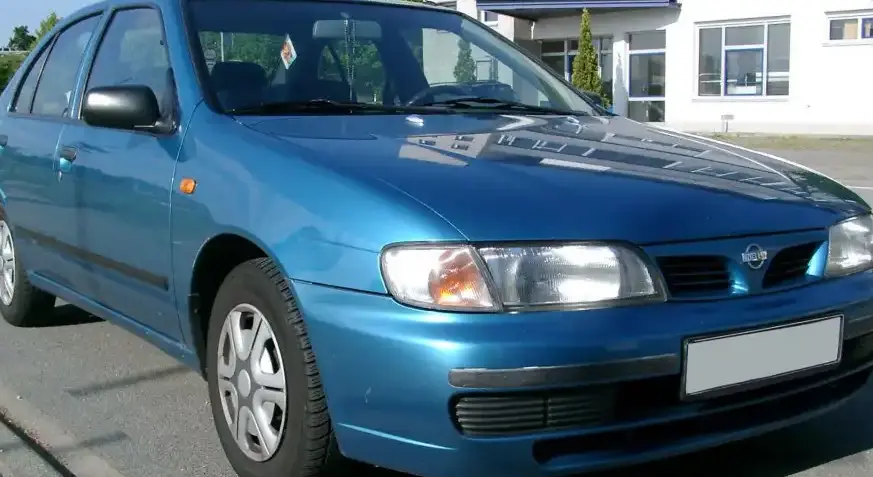
The Nissan Almera I (N15) 1.6 SLX, produced between 1995 and 2000, represented a mid-range offering within Nissan’s compact sedan lineup. Part of the N15 series, which replaced the Sunny, the Almera was designed to appeal to buyers seeking a practical, reliable, and affordable family car. The 1.6 SLX trim, powered by the GA16DE engine and typically paired with a four-speed automatic transmission, aimed to provide a balance between fuel efficiency and acceptable performance. It occupied a position above the base models, offering more features and a slightly more refined driving experience, but remained below the more powerful and sport-oriented variants if offered in specific markets.
Technical Specifications
| Brand | Nissan |
| Model | Almera |
| Generation | Almera I (N15) |
| Type (Engine) | 1.6 SLX (90 Hp) |
| Start of production | 1995 |
| End of production | 2000 |
| Powertrain Architecture | Internal Combustion engine |
| Body type | Sedan |
| Seats | 5 |
| Doors | 4 |
| Fuel consumption (combined) | 7.1 l/100 km |
| Fuel consumption (US mpg) | 33.1 US mpg |
| Fuel consumption (UK mpg) | 39.8 UK mpg |
| Fuel consumption (km/l) | 14.1 km/l |
| Fuel Type | Petrol (Gasoline) |
| Acceleration 0 – 100 km/h | 11.1 sec |
| Acceleration 0 – 62 mph | 11.1 sec |
| Acceleration 0 – 60 mph | 10.5 sec |
| Maximum speed | 178 km/h (110.6 mph) |
| Weight-to-power ratio | 14 kg/Hp |
| Weight-to-torque ratio | 9.3 kg/Nm |
| Power | 90 Hp @ 6000 rpm |
| Power per litre | 56.4 Hp/l |
| Torque | 136 Nm @ 4000 rpm (100.31 lb.-ft. @ 4000 rpm) |
| Engine layout | Front, Transverse |
| Engine Model/Code | GA16DE |
| Engine displacement | 1597 cm3 (97.45 cu. in.) |
| Number of cylinders | 4 |
| Engine configuration | Inline |
| Cylinder Bore | 76 mm (2.99 in.) |
| Piston Stroke | 88 mm (3.46 in.) |
| Compression ratio | 9.8:1 |
| Number of valves per cylinder | 4 |
| Fuel injection system | Multi-port manifold injection |
| Engine aspiration | Naturally aspirated engine |
| Valvetrain | DOHC |
| Engine oil capacity | 3.2 l (3.38 US qt | 2.82 UK qt) |
| Coolant capacity | 5.9 l (6.23 US qt | 5.19 UK qt) |
| Kerb Weight | 1263 kg (2784.44 lbs.) |
| Max. weight | 1595 kg (3516.37 lbs.) |
| Max load | 332 kg (731.93 lbs.) |
| Trunk (boot) space – minimum | 440 l (15.54 cu. ft.) |
| Fuel tank capacity | 50 l (13.21 US gal | 11 UK gal) |
| Length | 4320 mm (170.08 in.) |
| Width | 1690 mm (66.54 in.) |
| Height | 1395 mm (54.92 in.) |
| Wheelbase | 2535 mm (99.8 in.) |
| Front track | 1470 mm (57.87 in.) |
| Rear (Back) track | 1435 mm (56.5 in.) |
| Drivetrain Architecture | Front wheel drive |
| Number of gears | 4 (Automatic) |
| Front suspension | Wishbone |
| Rear suspension | Rigid axle suspension |
| Front brakes | Ventilated discs |
| Rear brakes | Drum |
| Assisting systems | ABS (Anti-lock braking system) |
| Steering type | Steering rack and pinion |
| Power steering | Hydraulic Steering |
| Tires size | 175/65 R14 |
Powertrain & Engine Architecture
The heart of the Almera 1.6 SLX was the GA16DE, a 1.6-liter inline-four cylinder engine. This engine was a staple in Nissan’s lineup during the 1990s, known for its relative simplicity and durability. The GA16DE featured a cast iron block and an aluminum cylinder head, incorporating a dual overhead camshaft (DOHC) valvetrain with four valves per cylinder. Fuel delivery was handled by a multi-port fuel injection system, contributing to improved fuel efficiency and smoother operation compared to earlier carbureted engines. The engine produced 90 horsepower at 6000 rpm and 136 Nm (100.31 lb-ft) of torque at 4000 rpm. The automatic transmission was a four-speed unit, designed for comfortable and convenient driving. While not particularly sporty, it provided adequate performance for everyday commuting and highway cruising.
Driving Characteristics
The Almera 1.6 SLX with the automatic transmission offered a comfortable, if not exhilarating, driving experience. Acceleration from 0-60 mph took around 10.5 seconds, and top speed was approximately 110.6 mph. The four-speed automatic transmission, while smooth, lacked the responsiveness of a manual gearbox. Gear ratios were optimized for fuel economy rather than outright performance. Compared to the manual transmission version of the same engine, the automatic suffered a slight performance penalty. Higher-spec Almeras equipped with larger engines, such as the 2.0-liter variants, offered significantly more power and a more engaging driving experience, but at a higher price point. The suspension was tuned for comfort, providing a relatively soft ride, but this came at the expense of handling precision.
Equipment & Trim Levels
The SLX trim level offered a step up in features compared to the base Almera models. Standard equipment typically included power windows, power steering, central locking, and an upgraded audio system. Interior upholstery was usually cloth, with a relatively simple but functional dashboard layout. Optional extras could include air conditioning, alloy wheels, and a sunroof. The SLX trim aimed to provide a good balance of comfort and convenience without the added cost of the more luxurious options.
Chassis & Braking
The Almera I (N15) utilized a front-wheel-drive layout with a MacPherson strut front suspension and a rigid axle rear suspension. The front brakes were ventilated discs, providing adequate stopping power, while the rear brakes were drums. Anti-lock Braking System (ABS) was included as standard equipment on the SLX trim, enhancing safety. The chassis was designed for comfort and practicality, prioritizing ride quality over sporty handling. Stabilizer bars were fitted to both the front and rear axles to reduce body roll during cornering.
Market Reception & Comparison
The Nissan Almera I (N15) 1.6 SLX was generally well-received by critics as a practical and reliable family car. It offered a good level of equipment for its price and was praised for its fuel efficiency. However, the automatic transmission was sometimes criticized for its lack of responsiveness. Compared to competitors like the Ford Focus, Opel/Vauxhall Astra, and Volkswagen Golf, the Almera offered a competitive package, but often lacked the brand prestige or driving dynamics of some of its rivals. Fuel economy was comparable to other 1.6-liter engines in its class, and reliability was generally considered to be good.
Legacy
The GA16DE engine proved to be a durable and reliable powerplant, and many Almera 1.6 SLX models remain on the road today. While not known for its high performance, the engine’s simplicity and robust construction contribute to its longevity. The automatic transmission, while not the most sophisticated, is generally reliable if properly maintained. In the used car market, the Almera I (N15) 1.6 SLX represents an affordable and practical option for buyers seeking a dependable and economical compact sedan. Its reputation for reliability and low running costs continues to make it a popular choice for first-time car owners and those seeking a budget-friendly vehicle.