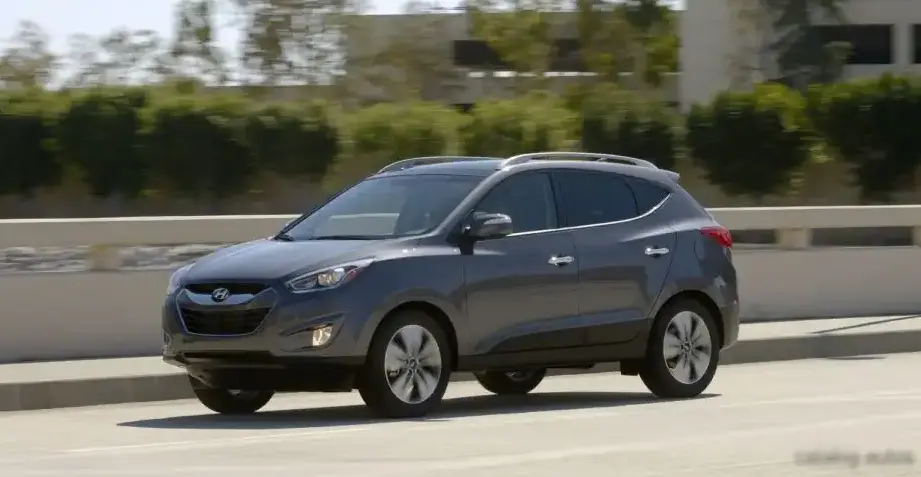
The Hyundai Tucson II (facelift, produced from September 2013 to 2015) represented a significant refresh of Hyundai’s popular compact SUV. The 2.0 GDI (Gasoline Direct Injection) SHIFTRONIC variant, producing 164 horsepower, occupied a middle ground within the Tucson II lineup, offering a balance between fuel efficiency and performance. This model aimed to appeal to buyers seeking a practical and well-equipped SUV without the higher price tag of the top-tier trims. It was positioned as a step up from the base engine options, providing a more responsive driving experience, particularly for highway merging and overtaking.
Technical Specifications
| Brand | Hyundai |
| Model | Tucson |
| Generation | Tucson II (facelift 2013) |
| Type (Engine) | 2.0 GDI (164 Hp) SHIFTRONIC |
| Start of production | September, 2013 |
| End of production | 2015 |
| Powertrain Architecture | Internal Combustion engine |
| Body type | SUV |
| Seats | 5 |
| Doors | 5 |
| Fuel consumption (urban) | 10.2 l/100 km (23.1 US mpg) |
| Fuel consumption (extra urban) | 8.1 l/100 km (29 US mpg) |
| Fuel consumption (combined) | 9.4 l/100 km (25 US mpg) |
| Fuel Type | Petrol (Gasoline) |
| Emission standard | ULEV |
| Weight-to-power ratio | 8.9 kg/Hp |
| Weight-to-torque ratio | 7.2 kg/Nm |
| Power | 164 Hp @ 6200 rpm |
| Power per litre | 82 Hp/l |
| Torque | 205 Nm @ 4000 rpm (151.2 lb.-ft. @ 4000 rpm) |
| Engine layout | Front, Transverse |
| Engine Model/Code | Nu / G4NC |
| Engine displacement | 1999 cm3 (121.99 cu. in.) |
| Number of cylinders | 4 |
| Engine configuration | Inline |
| Cylinder Bore | 81 mm (3.19 in.) |
| Piston Stroke | 97 mm (3.82 in.) |
| Compression ratio | 11.5:1 |
| Number of valves per cylinder | 4 |
| Fuel injection system | Direct injection |
| Engine aspiration | Naturally aspirated engine |
| Valvetrain | DOHC, D-CVVT |
| Engine oil capacity | 4 l (4.23 US qt | 3.52 UK qt) |
| Coolant capacity | 6.7 l (7.08 US qt | 5.9 UK qt) |
| Kerb Weight | 1466 kg (3231.98 lbs.) |
| Max. weight | 2040 kg (4497.43 lbs.) |
| Max load | 574 kg (1265.45 lbs.) |
| Trunk (boot) space – minimum | 728 l (25.71 cu. ft.) |
| Trunk (boot) space – maximum | 1580 l (55.8 cu. ft.) |
| Fuel tank capacity | 58 l (15.32 US gal | 12.76 UK gal) |
| Permitted trailer load (braked) | 907 kg (1999.59 lbs.) |
| Permitted trailer load (unbraked) | 454 kg (1000.9 lbs.) |
| Length | 4400 mm (173.23 in.) |
| Width | 1820 mm (71.65 in.) |
| Height | 1655 mm (65.16 in.) |
| Wheelbase | 2640 mm (103.94 in.) |
| Front track | 1585 mm (62.4 in.) |
| Rear track | 1586 mm (62.44 in.) |
| Ride height (ground clearance) | 170 mm (6.69 in.) |
| Drag coefficient (Cd) | 0.37 |
| Minimum turning circle | 10.6 m (34.78 ft.) |
| Drivetrain | Front wheel drive |
| Number of gears | 6 |
| Gearbox type | Automatic transmission Shiftronic |
| Front suspension | Independent, McPherson with coil spring and anti-roll bar |
| Rear suspension | Independent multi-link with stabilizer |
| Front brakes | Ventilated discs |
| Rear brakes | Disc |
| Assisting systems | ABS (Anti-lock braking system) |
| Steering type | Steering rack and pinion |
| Power steering | Electric |
| Tires size | 225/60 R17 |
| Wheel rims size | 6.5J x 17 |
Powertrain & Engine Architecture
The heart of the 2.0 GDI SHIFTRONIC Tucson II is the Hyundai Nu engine family, specifically the G4NC code. This 1999cc inline-four cylinder engine utilizes Gasoline Direct Injection (GDI) technology, where fuel is injected directly into the combustion chamber, improving efficiency and power output. The engine features a double overhead camshaft (DOHC) valvetrain with Hyundai’s Dual Continuously Variable Valve Timing (D-CVVT) system, optimizing valve timing for improved performance across the rev range. The G4NC engine produces 164 horsepower at 6200 rpm and 205 Nm (151.2 lb-ft) of torque at 4000 rpm. The ‘SHIFTRONIC’ designation refers to Hyundai’s 6-speed automatic transmission, which offered a manual shift mode for greater driver control. This transmission was designed to provide smooth gear changes and contribute to the vehicle’s overall fuel efficiency.
Driving Characteristics
The 2.0 GDI SHIFTRONIC Tucson II offered a comfortable and capable driving experience. While not a performance-oriented trim, the 164 hp engine provided adequate power for everyday driving situations, including highway cruising and moderate acceleration. The automatic transmission, while smooth, wasn’t particularly quick to downshift, which could be noticeable when needing to make a rapid overtake. Compared to the base engine options, the 2.0 GDI offered a more responsive feel. However, it lacked the punch of higher-spec engines. The gear ratios were tuned for fuel economy, prioritizing efficiency over outright acceleration. The SHIFTRONIC manual shift mode allowed drivers to exert more control, but it wasn’t as engaging as a dedicated manual transmission.
Equipment & Trim Levels
The 2.0 GDI SHIFTRONIC trim typically included standard features such as air conditioning, power windows and locks, a touchscreen infotainment system with Bluetooth connectivity, and alloy wheels. Higher trim levels added features like leather upholstery, a sunroof, and advanced safety systems. Interior upholstery was generally cloth, with optional leather upgrades available. The dashboard layout was functional and user-friendly, with a focus on ergonomics. Optional extras included a navigation system, a rearview camera, and a premium sound system.
Chassis & Braking
The Tucson II utilized a front-wheel-drive platform with independent suspension at all four corners. The front suspension employed a McPherson strut design with coil springs and an anti-roll bar, while the rear featured a multi-link setup with a stabilizer bar. This suspension configuration aimed to provide a comfortable ride while maintaining reasonable handling characteristics. Braking duties were handled by ventilated discs at the front and solid discs at the rear, equipped with an Anti-lock Braking System (ABS). The braking system was adequate for the vehicle’s weight and performance, providing sufficient stopping power in most driving conditions.
Market Reception & Comparison
The 2.0 GDI SHIFTRONIC Tucson II was generally well-received by automotive critics as a practical and well-rounded SUV. It was praised for its comfortable ride, spacious interior, and good value for money. Fuel economy was considered competitive for its class, achieving around 25 US mpg in combined driving. Compared to other trims in the Tucson II lineup, the 2.0 GDI offered a good balance between performance and efficiency. It was a more appealing option than the base engine for drivers who frequently drove on the highway or carried passengers and cargo. However, some reviewers noted that the automatic transmission could be slow to respond at times.
Legacy
The Hyundai Tucson II, particularly the 2.0 GDI SHIFTRONIC variant, has proven to be a relatively reliable vehicle in the used car market. The Nu engine family is generally considered durable, although regular maintenance, including oil changes and timing belt replacements (where applicable), is crucial. The automatic transmission has also demonstrated good longevity with proper servicing. Today, these Tucsons represent an affordable and practical option for buyers seeking a used compact SUV. Common issues reported include occasional sensor failures and minor electrical glitches, but these are typically not major concerns. The 2.0 GDI SHIFTRONIC Tucson II remains a popular choice for its blend of practicality, comfort, and affordability.