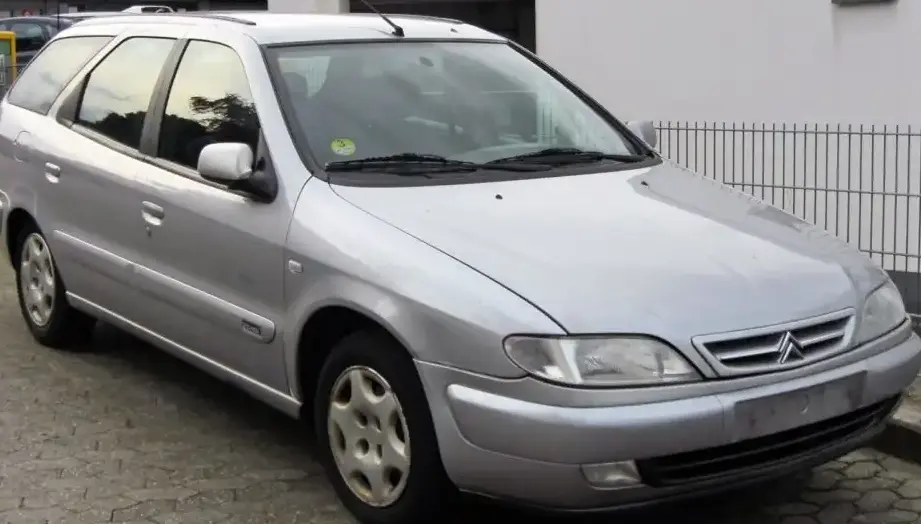
The Citroën Xsara Coupé VTS 1.6i 16V, produced between February 2003 and 2004, represented a sporty iteration of Citroën’s compact coupé. Falling within the N0 Phase III generation of the Xsara, this variant aimed to provide a balance between performance and affordability within the model range. Positioned as a step up from the base 1.4L engine options, the 1.6i 16V offered a noticeable increase in power and a more engaging driving experience, while remaining more accessible than the flagship 2.0L versions. It was primarily marketed in Europe, where the coupé segment held significant appeal, offering a stylish alternative to traditional hatchbacks and sedans.
Technical Specifications
| Brand | Citroen |
| Model | Xsara |
| Generation | Xsara Coupe (N0, Phase III) |
| Type (Engine) | VTS 1.6 i 16 V (109 Hp) |
| Start of production | February, 2003 |
| End of production | 2004 |
| Powertrain Architecture | Internal Combustion engine |
| Body type | Coupe |
| Seats | 5 |
| Doors | 3 |
| Fuel consumption (urban) | 9.3 l/100 km (25.3 US mpg, 30.4 UK mpg, 10.8 km/l) |
| Fuel consumption (extra urban) | 5.5 l/100 km (42.8 US mpg, 51.4 UK mpg, 18.2 km/l) |
| Fuel consumption (combined) | 6.9 l/100 km (34.1 US mpg, 40.9 UK mpg, 14.5 km/l) |
| CO2 emissions | 160 g/km |
| Fuel Type | Petrol (Gasoline) |
| Acceleration 0 – 100 km/h | 10.9 sec |
| Acceleration 0 – 62 mph | 10.9 sec |
| Acceleration 0 – 60 mph | 10.4 sec |
| Maximum speed | 197 km/h (122.41 mph) |
| Emission standard | Euro 3 D4 |
| Weight-to-power ratio | 10.4 kg/Hp, 96.1 Hp/tonne |
| Weight-to-torque ratio | 7.7 kg/Nm, 129.6 Nm/tonne |
| Power | 109 Hp @ 5800 rpm |
| Power per litre | 68.7 Hp/l |
| Torque | 147 Nm @ 4000 rpm (108.42 lb.-ft. @ 4000 rpm) |
| Engine layout | Front, Transverse |
| Engine Model/Code | TU5JP4 |
| Engine displacement | 1587 cm3 (96.84 cu. in.) |
| Number of cylinders | 4 |
| Engine configuration | Inline |
| Cylinder Bore | 78.5 mm (3.09 in.) |
| Piston Stroke | 82 mm (3.23 in.) |
| Number of valves per cylinder | 4 |
| Fuel injection system | Multi-port manifold injection |
| Engine aspiration | Naturally aspirated engine |
| Valvetrain | DOHC |
| Engine oil capacity | 3.25 l (3.43 US qt, 2.86 UK qt) |
| Coolant | 7 l (7.4 US qt, 6.16 UK qt) |
| Kerb Weight | 1134 kg (2500.04 lbs.) |
| Max. weight | 1656 kg (3650.86 lbs.) |
| Max load | 522 kg (1150.81 lbs.) |
| Trunk (boot) space – minimum | 408 l (14.41 cu. ft.) |
| Trunk (boot) space – maximum | 1190 l (42.02 cu. ft.) |
| Fuel tank capacity | 54 l (14.27 US gal, 11.88 UK gal) |
| Max. roof load | 75 kg (165.35 lbs.) |
| Permitted trailer load with brakes (12%) | 1100 kg (2425.08 lbs.) |
| Permitted trailer load without brakes | 570 kg (1256.63 lbs.) |
| Permitted towbar download | 70 kg (154.32 lbs.) |
| Length | 4188 mm (164.88 in.) |
| Width | 1705 mm (67.13 in.) |
| Width including mirrors | 2014 mm (79.29 in.) |
| Height | 1405 mm (55.31 in.) |
| Wheelbase | 2540 mm (100 in.) |
| Front track | 1433 mm (56.42 in.) |
| Rear (Back) track | 1442 mm (56.77 in.) |
| Front overhang | 880 mm (34.65 in.) |
| Rear overhang | 768 mm (30.24 in.) |
| Minimum turning circle | 11.5 m (37.73 ft.) |
| Drivetrain | Front wheel drive |
| Number of gears and type of gearbox | 5 gears, manual transmission |
| Front suspension | Independent, type McPherson with coil spring and anti-roll bar |
| Rear suspension | Torsion |
| Front brakes | Ventilated discs |
| Rear brakes | Disc |
| Assisting systems | ABS (Anti-lock braking system) |
| Steering type | Steering rack and pinion |
| Power steering | Hydraulic Steering |
| Tires size | 195/55 R15 |
| Wheel rims size | 6J x 15 |
Powertrain & Engine Architecture
The heart of the Xsara Coupé VTS 1.6i 16V is the Citroën TU5JP4 engine, a 1.6-liter inline-four cylinder powerplant. This engine is a member of the TU series, known for its robustness and relatively simple design. The ‘JP4’ designation indicates a 16-valve, multi-point fuel-injected configuration. The engine utilizes a double overhead camshaft (DOHC) valvetrain, contributing to improved breathing and higher-end power delivery. Fuel is delivered via a multi-port fuel injection system, managed by a basic engine control unit (ECU). The engine produces 109 horsepower at 5800 rpm and 147 Nm (108 lb-ft) of torque at 4000 rpm. The engine’s transverse mounting and front-wheel drive configuration were standard for vehicles in this class. The transmission is a five-speed manual gearbox, chosen for its affordability and driver engagement. While an automatic transmission was available on other Xsara variants, it wasn’t offered with the 1.6i 16V VTS model.
Driving Characteristics
The 1.6i 16V VTS offered a noticeable step up in performance compared to the lower-spec Xsara Coupé models. While not a particularly fast car by modern standards, the 10.9-second 0-62 mph acceleration time provided adequate performance for spirited driving. The engine felt responsive, particularly in the mid-range, and the five-speed manual gearbox allowed drivers to keep the engine within its optimal power band. Compared to the 2.0L VTS models, the 1.6L felt less powerful, especially at higher speeds, but it offered a more economical driving experience. The gear ratios were well-suited to everyday driving, providing a balance between acceleration and fuel efficiency. The suspension, while firm enough to provide decent handling, wasn’t overly harsh, making it a comfortable daily driver.
Equipment & Trim Levels
The VTS trim level, even with the 1.6L engine, included a number of features aimed at enhancing the driving experience and aesthetic appeal. Standard equipment typically included alloy wheels, sports seats, a leather-wrapped steering wheel, and electric front windows. Air conditioning was often included, but sometimes offered as an optional extra. The interior featured a sporty design with a dark color scheme and unique upholstery. Optional extras could include a sunroof, upgraded audio system, and rear parking sensors. The dashboard layout was typical of Citroëns of the era, with a functional and user-friendly design.
Chassis & Braking
The Xsara Coupé VTS 1.6i 16V utilized an independent McPherson strut suspension setup at the front, providing good handling and ride comfort. The rear suspension employed a torsion beam, a cost-effective solution that offered a reasonable compromise between handling and space efficiency. Braking duties were handled by ventilated discs at the front and solid discs at the rear. Anti-lock Braking System (ABS) was standard, enhancing safety and control during emergency braking situations. The steering was a hydraulic power-assisted rack and pinion system, providing precise and responsive steering feel.
Market Reception & Comparison
The Citroën Xsara Coupé VTS 1.6i 16V was generally well-received by automotive critics as an affordable and stylish coupé. It was praised for its sporty handling, responsive engine, and comfortable ride. However, some critics noted that the 1.6L engine lacked the outright performance of the 2.0L VTS models. In terms of fuel economy, the 1.6L variant offered a significant advantage over the larger-engined versions. Reliability was generally good, with the TU5JP4 engine being known for its durability. Compared to rivals such as the Peugeot 307 Coupé and Renault Megane Coupé, the Xsara offered a unique blend of French flair and practicality.
Legacy
The Citroën Xsara Coupé VTS 1.6i 16V has become a popular choice among enthusiasts looking for an affordable and stylish coupé. The TU5JP4 engine is known for its reliability and relatively low maintenance costs. While not a particularly rare car, well-maintained examples are becoming increasingly sought after. Today, these cars can be found on the used car market at relatively low prices, making them an attractive option for those seeking a classic French coupé with a sporty character. The 1.6L engine, while not the most powerful option, provides a good balance between performance and fuel economy, making it a practical choice for everyday driving.