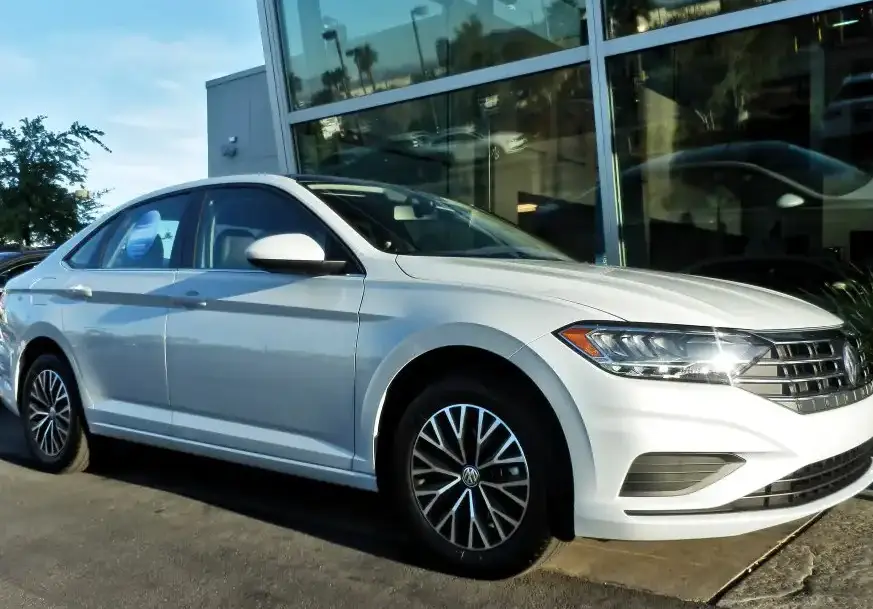
The Volkswagen Jetta VII 1.4 TSI (147 hp) represents a significant iteration in the Jetta lineage, produced from April 2018 to November 2021. Positioned as a mainstream offering within the seventh-generation Jetta (introduced as a 2019 model in the US market), this variant aimed to balance fuel efficiency with adequate performance for everyday driving. It served as a key volume seller, bridging the gap between the base Jetta S and the more performance-oriented trims like the SEL and GLI. The Jetta VII itself was built on the Volkswagen Group’s MQB (Modular Transverse Matrix) platform, a modular architecture designed to underpin a wide range of vehicles, improving manufacturing efficiency and component sharing.
Technical Specifications
| Brand | Volkswagen |
| Model | Jetta |
| Generation | Jetta VII |
| Type (Engine) | 1.4 TSI (147 Hp) |
| Start of production | April, 2018 |
| End of production | November, 2021 |
| Powertrain Architecture | Internal Combustion engine |
| Body type | Sedan |
| Seats | 5 |
| Doors | 4 |
| Fuel consumption (urban) | 7.8 l/100 km (30.2 US mpg, 36.2 UK mpg, 12.8 km/l) |
| Fuel consumption (extra urban) | 5.8 l/100 km (40.6 US mpg, 48.7 UK mpg, 17.2 km/l) |
| Fuel consumption (combined) | 6.9 l/100 km (34.1 US mpg, 40.9 UK mpg, 14.5 km/l) |
| Fuel Type | Petrol (Gasoline) |
| Weight-to-power ratio | 8.9 kg/Hp, 112.2 Hp/tonne |
| Weight-to-torque ratio | 5.3 kg/Nm, 190.1 Nm/tonne |
| Power | 147 Hp @ 5000 rpm |
| Power per litre | 105.4 Hp/l |
| Torque | 249 Nm @ 1400 rpm (183.65 lb.-ft. @ 1400 rpm) |
| Engine layout | Front, Transverse |
| Engine Model/Code | EA211 / DGXA, DJXA |
| Engine displacement | 1395 cm3 (85.13 cu. in.) |
| Number of cylinders | 4 |
| Engine configuration | Inline |
| Cylinder Bore | 74.5 mm (2.93 in.) |
| Piston Stroke | 80 mm (3.15 in.) |
| Compression ratio | 10:1 |
| Number of valves per cylinder | 4 |
| Fuel injection system | Direct injection |
| Engine aspiration | Turbocharger, Intercooler |
| Valvetrain | DOHC |
| Engine oil capacity | 4 l (4.23 US qt | 3.52 UK qt) |
| Coolant | 8 l (8.45 US qt | 7.04 UK qt) |
| Kerb Weight | 1310 kg (2888.06 lbs.) |
| Max. weight | 1840 kg (4056.51 lbs.) |
| Max load | 530 kg (1168.45 lbs.) |
| Trunk (boot) space – minimum | 399 l (14.09 cu. ft.) |
| Fuel tank capacity | 50 l (13.21 US gal | 11 UK gal) |
| Length | 4702 mm (185.12 in.) |
| Width | 1799 mm (70.83 in.) |
| Height | 1458 mm (57.4 in.) |
| Wheelbase | 2686 mm (105.75 in.) |
| Front track | 1543 mm (60.75 in.) |
| Rear (Back) track | 1533 mm (60.35 in.) |
| Ride height (ground clearance) | 141 mm (5.55 in.) |
| Drag coefficient (Cd) | 0.27 |
| Minimum turning circle (turning diameter) | 11.1 m (36.42 ft.) |
| Drivetrain Architecture | The Internal combustion engine (ICE) drives the front wheels of the vehicle. |
| Drive wheel | Front wheel drive |
| Number of gears and type of gearbox | 6 gears, manual transmission |
| Front suspension | Independent, type McPherson with coil spring and anti-roll bar |
| Rear suspension | Torsion |
| Front brakes | Ventilated discs |
| Rear brakes | Disc |
| Assisting systems | ABS (Anti-lock braking system) |
| Steering type | Steering rack and pinion |
| Power steering | Electric Steering |
| Tires size | 205/60 R16 H; 205/55 R17 H |
| Wheel rims size | 6.5J x 16; 7.0J x 17 |
Powertrain & Engine Architecture
At the heart of the Jetta VII 1.4 TSI lies the EA211 engine family, specifically the DGXA or DJXA engine code depending on the production year and market. This is a turbocharged, direct-injection four-cylinder engine displacing 1.4 liters (1395 cc). The engine utilizes a Miller cycle, which optimizes efficiency by reducing pumping losses. Direct injection delivers fuel directly into the combustion chamber, allowing for precise fuel control and improved combustion. The turbocharger, coupled with an intercooler, provides a boost in power and torque. The engine’s valvetrain is a dual overhead camshaft (DOHC) design with four valves per cylinder, enhancing breathing and overall performance. The 6-speed manual transmission was standard, offering a relatively direct and engaging driving experience.
Driving Characteristics
The 147 hp and 183 lb-ft of torque produced by the 1.4 TSI engine in the Jetta VII provided adequate, though not exhilarating, performance. Acceleration from 0 to 60 mph typically took around 8.5-9 seconds. The engine’s peak torque is available from a low 1400 rpm, providing good responsiveness in everyday driving situations. However, compared to the higher-output 1.8 TSI or the diesel options, the 1.4 TSI felt less powerful, particularly when fully loaded or tackling steep inclines. The manual transmission’s gear ratios were tuned for fuel efficiency, meaning the engine sometimes felt strained at higher speeds. The overall driving experience was comfortable and refined, prioritizing practicality over sporty handling.
Equipment & Trim Levels
The 1.4 TSI engine was typically offered on the base Jetta S and mid-range SE trims. The Jetta S came standard with features like a 6.5-inch touchscreen infotainment system with App-Connect, LED headlights, and a rearview camera. The SE trim added features such as keyless access, a larger 8-inch touchscreen, and heated front seats. Optional extras available on both trims included a panoramic sunroof, blind-spot monitoring, and a premium audio system. Interior upholstery was typically cloth, with leatherette options available on the SE trim. The dashboard layout was clean and functional, with a focus on user-friendliness.
Chassis & Braking
The Jetta VII utilized an independent McPherson strut front suspension and a torsion beam rear suspension. This setup provided a good balance between ride comfort and handling. The front brakes were ventilated discs, while the rear brakes were solid discs. ABS (Anti-lock Braking System) was standard. The steering was electric power-assisted, offering light and precise steering feel. The suspension tuning was geared towards comfort, resulting in a relatively soft ride quality. Stabilizer bars were fitted to both the front and rear axles to reduce body roll during cornering.
Market Reception & Comparison
Critics generally praised the Jetta VII 1.4 TSI for its fuel efficiency and comfortable ride. However, some reviewers found the engine to be underpowered, particularly when compared to competitors like the Honda Civic or Mazda3. Fuel economy was a strong point, with the Jetta achieving around 34 mpg combined. The 1.4 TSI was considered a more affordable option than the higher-output 1.8 TSI, but it lacked the latter’s performance. Compared to the diesel Jetta, the 1.4 TSI offered lower maintenance costs but less impressive fuel economy.
Legacy
The EA211 1.4 TSI engine has proven to be generally reliable, although some owners have reported issues with the turbocharger and direct injection system. Regular maintenance, including oil changes and spark plug replacements, is crucial for ensuring long-term reliability. In the used car market, the Jetta VII 1.4 TSI represents a good value proposition for buyers seeking a fuel-efficient and comfortable compact sedan. Its relatively simple engine design and readily available parts contribute to its affordability and ease of maintenance. While not a performance standout, it remains a practical and dependable choice for everyday transportation.