Technical Specifications
| Brand | Ford |
| Model | Ranger |
| Generation | Ranger IV Double Cab |
| Type | Raptor 2.0 EcoBlue (210 Hp) e-4WD Automatic |
| Start of production | March, 2023 |
| Powertrain Architecture | Internal Combustion engine |
| Body type | Pick-up |
| Seats | 5 |
| Doors | 4 |
| Combined fuel consumption (WLTP) | 8.8-10.3 l/100 km (26.7 – 22.8 US mpg, 32.1 – 27.4 UK mpg, 11.4 – 9.7 km/l) |
| CO2 emissions (WLTP) | 230-271 g/km |
| Fuel Type | Diesel |
| Acceleration 0 – 100 km/h | 10.5 sec |
| Acceleration 0 – 62 mph | 10.5 sec |
| Acceleration 0 – 60 mph | 10 sec |
| Maximum speed | 180 km/h (111.85 mph) |
| Weight-to-power ratio | 11.6 kg/Hp, 86.2 Hp/tonne |
| Weight-to-torque ratio | 4.9 kg/Nm, 205.3 Nm/tonne |
| Power | 210 Hp |
| Power per litre | 105.2 Hp/l |
| Torque | 500 Nm (368.78 lb.-ft.) |
| Engine layout | Front, Longitudinal |
| Engine Model/Code | YN2R |
| Engine displacement | 1996 cm3 (121.8 cu. in.) |
| Number of cylinders | 4 |
| Engine configuration | Inline |
| Number of valves per cylinder | 4 |
| Fuel injection system | Diesel Commonrail |
| Engine aspiration | BiTurbo, Intercooler |
| Engine systems | Start & Stop System, Particulate filter |
| Kerb Weight | 2436 kg (5370.46 lbs.) |
| Max. weight | 3280 kg (7231.16 lbs.) |
| Max load | 844 kg (1860.7 lbs.) |
| Permitted trailer load with brakes (12%) | 3500 kg (7716.18 lbs.) |
| Permitted trailer load without brakes | 750 kg (1653.47 lbs.) |
| Length | 5381 mm (211.85 in.) |
| Width | 2015 mm (79.33 in.) |
| Width including mirrors | 2208 mm (86.93 in.) |
| Height | 1922 mm (75.67 in.) |
| Wheelbase | 3270 mm (128.74 in.) |
| Front track | 1710 mm (67.32 in.) |
| Rear (Back) track | 1710 mm (67.32 in.) |
| Front overhang | 885 mm (34.84 in.) |
| Rear overhang | 1225 mm (48.23 in.) |
| Ride height (ground clearance) | 266 mm (10.47 in.) |
| Minimum turning circle (turning diameter) | 13 m (42.65 ft.) |
| Approach angle | 32° |
| Departure angle | 27° |
| Ramp-over (brakeover) angle | 24° |
| Wading depth | 850 mm (33.46 in.) |
| Drivetrain Architecture | The Internal combustion engine (ICE) drives the rear wheels permanently, and the front wheels are driven through an electrically or mechanically operated clutch if necessary. |
| Drive wheel | All wheel drive (4×4) |
| Number of gears and type of gearbox | 10 gears, automatic transmission |
| Front brakes | Ventilated discs |
| Rear brakes | Disc |
| Assisting systems | ABS (Anti-lock braking system) |
| Steering type | Steering rack and pinion |
| Power steering | Electric Steering |
| Tires size | 285/70 R17 |
| Wheel rims size | 17 |
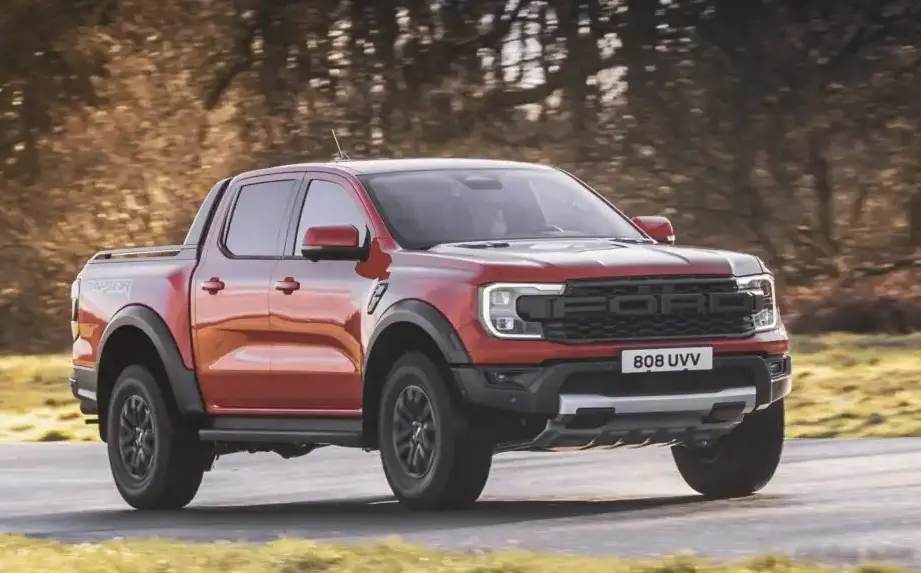
The Ford Ranger IV Double Cab Raptor 2.0 EcoBlue is a derivative of the fourth-generation Ranger (introduced in 2022), specifically designed to offer a more aggressive and capable off-road experience. Built on the T6 platform, the Ranger IV represents a significant upgrade over its predecessor, with a focus on technology, safety, and refinement. The Raptor variant distinguishes itself through unique styling cues, a reinforced chassis, and a specialized suspension system. This 210 horsepower diesel automatic configuration is positioned as a mid-range offering within the Raptor lineup, balancing performance with fuel efficiency and usability.
Powertrain & Engine Architecture
At the heart of the Ranger Raptor 2.0 EcoBlue lies Ford’s YN2R 2.0-liter inline-four cylinder diesel engine. This engine utilizes a sophisticated bi-turbocharger setup – a small turbo for immediate response and a larger turbo for peak power – coupled with an intercooler to enhance efficiency. The engine employs a common-rail direct fuel injection system, delivering fuel at extremely high pressures for optimized combustion. The engine produces 210 horsepower and a substantial 500 Nm (368.78 lb.-ft.) of torque. The engine is paired with a 10-speed automatic transmission, a key component in maximizing both on-road drivability and off-road control. This transmission offers a wide range of gear ratios, allowing the engine to operate efficiently at various speeds and loads. The transmission is electronically controlled, adapting shift points based on driving conditions and driver input.
Driving Characteristics
The 2.0 EcoBlue engine, while not the most powerful option available in the Ranger IV lineup, provides a good balance of performance and fuel economy. The 10-speed automatic transmission helps to keep the engine in its optimal power band, delivering smooth and responsive acceleration. Compared to higher-output engine options, this variant offers a more relaxed driving experience, particularly on the highway. The wide gear ratios of the transmission contribute to lower engine speeds at cruising speeds, reducing noise and improving fuel efficiency. Off-road, the combination of the bi-turbo diesel and the 10-speed automatic provides ample torque for navigating challenging terrain. The automatic transmission simplifies operation in demanding conditions, allowing the driver to focus on steering and obstacle avoidance. While not as overtly aggressive as the gasoline-powered Raptor variants available in some markets, this diesel version offers a capable and refined off-road experience.
Equipment & Trim Levels
The Ranger Raptor 2.0 EcoBlue typically comes well-equipped as standard. Key features include a unique Raptor exterior styling package with flared wheel arches, distinctive grille, and aggressive bodywork. Inside, the Raptor features sport seats with unique upholstery, a leather-wrapped steering wheel, and a digital instrument cluster. Infotainment is typically provided by a large touchscreen display with Ford’s SYNC 4 system, offering navigation, smartphone integration (Apple CarPlay and Android Auto), and a premium sound system. Optional extras can include a panoramic sunroof, adaptive cruise control, lane-keeping assist, and a 360-degree camera system. The Raptor trim level generally represents a significant step up in terms of features and aesthetics compared to lower-spec Ranger models.
Chassis & Braking
The Ranger Raptor’s chassis is significantly reinforced compared to standard Ranger models, providing increased rigidity and durability for off-road use. A key feature is the long-travel suspension system, featuring specially tuned dampers and coil springs. This suspension allows for greater wheel articulation, improving ride comfort and traction on uneven terrain. The front suspension utilizes a double-wishbone design, while the rear features a multi-link setup. Braking is handled by ventilated discs on all four wheels, providing ample stopping power. An Anti-lock Braking System (ABS) is standard, enhancing safety and control during emergency braking situations.
Market Reception & Comparison
The Ford Ranger Raptor 2.0 EcoBlue has been generally well-received by automotive critics, praised for its off-road capability, comfortable ride, and modern technology. Compared to other Ranger variants, the Raptor offers a more focused off-road experience, but at a higher price point. The 2.0 EcoBlue engine provides a good balance of performance and fuel economy, making it a practical choice for everyday use. Some reviewers have noted that the diesel engine lacks the outright excitement of the gasoline-powered Raptor variants, but its superior torque and fuel efficiency make it a compelling option for those who prioritize practicality and capability. Compared to competitors like the Toyota Hilux and Volkswagen Amarok, the Ranger Raptor offers a unique combination of performance, technology, and styling.
Legacy
The Ford Ranger IV Raptor 2.0 EcoBlue represents a significant step forward in the evolution of the Ranger pickup truck. Its combination of a powerful diesel engine, advanced automatic transmission, and specialized off-road suspension system has established it as a popular choice for drivers who demand both capability and refinement. While long-term reliability data is still emerging, Ford’s diesel engines have a generally good reputation for durability. On the used car market, the Ranger Raptor is expected to hold its value well due to its unique features and strong brand appeal. The Raptor variant has helped to elevate the Ranger’s image, positioning it as a serious contender in the competitive mid-size pickup truck segment.