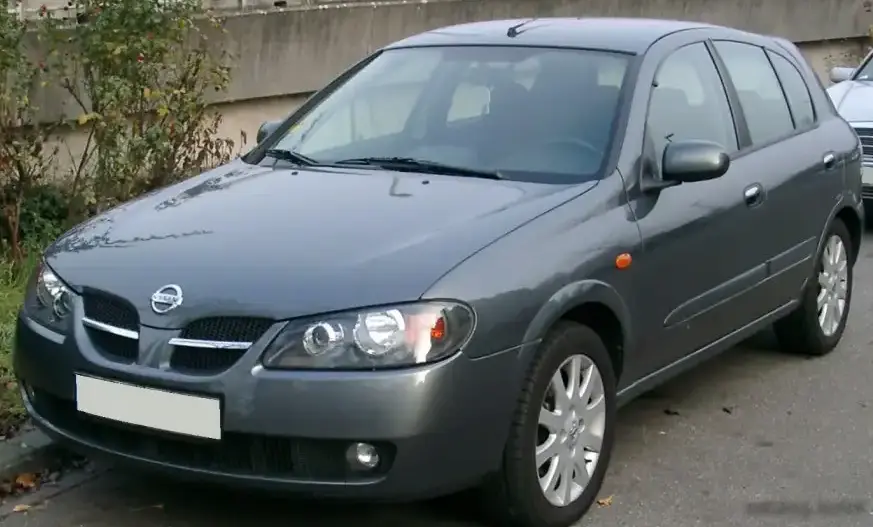
The Nissan Almera II Hatchback, specifically the facelifted version introduced in 2003, represented Nissan’s entry into the competitive European compact hatchback segment. Produced from 2003 to 2006, this generation (N16) aimed to offer practicality and affordability. The 1.8 16V variant, producing 116 horsepower, occupied a mid-range position within the Almera II lineup, offering a step up in performance from the base 1.5L engine while remaining more accessible than the later diesel options. This model was primarily targeted at buyers seeking a balance between fuel economy and usable power for everyday driving.
Technical Specifications
| Brand | Nissan |
| Model | Almera |
| Generation | Almera II Hatchback (N16, facelift 2003) |
| Type (Engine) | 1.8 16V (116 Hp) |
| Start of production | 2003 |
| End of production | 2006 |
| Powertrain Architecture | Internal Combustion engine |
| Body type | Hatchback |
| Seats | 5 |
| Doors | 3/5 |
| Fuel consumption (urban) | 10.2 l/100 km (23.1 US mpg, 27.7 UK mpg, 9.8 km/l) |
| Fuel consumption (extra urban) | 5.9 l/100 km (39.9 US mpg, 47.9 UK mpg, 16.9 km/l) |
| Fuel consumption (combined) | 7.5 l/100 km (31.4 US mpg, 37.7 UK mpg, 13.3 km/l) |
| Fuel Type | Petrol (Gasoline) |
| Acceleration 0 – 100 km/h | 10.8 sec |
| Acceleration 0 – 62 mph | 10.8 sec |
| Acceleration 0 – 60 mph | 10.3 sec |
| Maximum speed | 186 km/h (115.58 mph) |
| Weight-to-power ratio | 9.6 kg/Hp, 103.8 Hp/tonne |
| Weight-to-torque ratio | 6.9 kg/Nm, 145.9 Nm/tonne |
| Power | 116 Hp @ 5600 rpm |
| Power per litre | 65.6 Hp/l |
| Torque | 163 Nm @ 4000 rpm (120.22 lb.-ft. @ 4000 rpm) |
| Engine layout | Front, Transverse |
| Engine Model/Code | QG18DE |
| Engine displacement | 1769 cm3 (107.95 cu. in.) |
| Number of cylinders | 4 |
| Engine configuration | Inline |
| Cylinder Bore | 80 mm (3.15 in.) |
| Piston Stroke | 88 mm (3.46 in.) |
| Compression ratio | 9.5:1 |
| Number of valves per cylinder | 4 |
| Fuel injection system | Multi-port manifold injection |
| Engine aspiration | Naturally aspirated engine |
| Valvetrain | DOHC |
| Engine oil capacity | 2.9 l (3.06 US qt | 2.55 UK qt) |
| Coolant capacity | 6.6 l (6.97 US qt | 5.81 UK qt) |
| Kerb Weight | 1117 kg (2462.56 lbs.) |
| Max. weight | 1735 kg (3825.02 lbs.) |
| Max load | 618 kg (1362.46 lbs.) |
| Trunk (boot) space – minimum | 355 l (12.54 cu. ft.) |
| Trunk (boot) space – maximum | 1020 l (36.02 cu. ft.) |
| Fuel tank capacity | 60 l (15.85 US gal | 13.2 UK gal) |
| Length | 4184 mm (164.72 in.) |
| Width | 1706 mm (67.17 in.) |
| Height | 1448 mm (57.01 in.) |
| Wheelbase | 2535 mm (99.8 in.) |
| Front track | 1470 mm (57.87 in.) |
| Rear track | 1455 mm (57.28 in.) |
| Ride height (ground clearance) | 140 mm (5.51 in.) |
| Drivetrain Architecture | Front wheel drive |
| Drive wheel | Front wheel drive |
| Number of gears and type of gearbox | 5 gears, manual transmission |
| Front suspension | Spring Strut |
| Rear suspension | Rigid axle suspension |
| Front brakes | Ventilated discs |
| Rear brakes | Disc |
| Assisting systems | ABS (Anti-lock braking system) |
| Steering type | Steering rack and pinion |
| Power steering | Hydraulic Steering |
| Tires size | 185/65 R15 |
| Wheel rims size | 15 |
Powertrain & Engine Architecture
The heart of the Almera II 1.8 16V is the QG18DE engine, a 1.8-liter inline-four cylinder gasoline engine. This engine is part of Nissan’s QG series, known for its relatively simple design and reliability. The ‘DE’ designation indicates Nissan’s Dual Elevator variable valve timing system, which optimizes valve timing for improved performance and fuel efficiency across the rev range. The QG18DE utilizes multi-port fuel injection, delivering fuel directly to each intake port. The engine’s 16 valves (four per cylinder) are actuated by a double overhead camshaft (DOHC) configuration. The 116 horsepower and 163 Nm of torque were delivered through a 5-speed manual transmission in most configurations, though a 4-speed automatic transmission was also available. The automatic transmission, while offering convenience, did impact acceleration and fuel economy compared to the manual.
Driving Characteristics
The 1.8L engine provided a noticeable improvement in performance over the base 1.5L Almera II. Acceleration to 60 mph took around 10.3 seconds, making it adequate for everyday driving and highway merging. The engine felt reasonably responsive, with peak torque available at 4000 rpm. However, it wasn’t a particularly sporty engine; power delivery was linear rather than exhilarating. The automatic transmission, when equipped, featured relatively long gear ratios, prioritizing fuel economy over rapid acceleration. The manual transmission offered a more engaging driving experience and allowed the driver to better utilize the engine’s power band. Compared to the later 1.5 dCi diesel variants, the 1.8L offered less torque at lower engine speeds but a smoother, quieter operation.
Equipment & Trim Levels
The 1.8 16V Almera II typically came with a reasonable level of standard equipment. This included power steering, central locking, electric front windows, and an ABS anti-lock braking system. Higher trim levels, such as the ‘Visia’ and ‘Acenta’, added features like air conditioning, alloy wheels, a CD player, and upgraded interior trim. Interior upholstery was typically cloth, with a functional, if somewhat basic, dashboard layout. Optional extras included a sunroof, side airbags, and metallic paint finishes.
Chassis & Braking
The Almera II utilized a relatively conventional chassis setup. Front suspension consisted of MacPherson strut springs, while the rear employed a torsion beam axle. This configuration provided a comfortable ride, but handling wasn’t particularly sharp. The front brakes were ventilated discs, providing adequate stopping power, while the rear brakes were typically solid discs. The steering was hydraulic power-assisted, offering reasonable feel and assistance. The 185/65 R15 tires provided a good balance between comfort and grip.
Market Reception & Comparison
The Nissan Almera II 1.8 16V was generally well-received as a practical and affordable family hatchback. Critics praised its comfortable ride and reasonable fuel economy. However, it was often criticized for its somewhat bland styling and uninspiring driving dynamics. Compared to rivals like the Ford Focus and Volkswagen Golf, the Almera II lacked the same level of refinement and driving engagement. The 1.8L engine offered a good compromise between performance and fuel economy, but the automatic transmission was often criticized for its sluggishness. The diesel variants, while offering superior fuel economy, were often more expensive to purchase and maintain.
Legacy
The QG18DE engine proved to be a reliable unit, and well-maintained examples of the Almera II 1.8 16V continue to be found on the used car market today. While not a particularly sought-after model, its affordability and reputation for reliability make it a viable option for budget-conscious buyers. Common issues include wear and tear on suspension components and potential oil leaks as the engine ages. The availability of spare parts is generally good, and the relatively simple engine design makes it relatively easy to repair. The Almera II 1.8 16V represents a solid, if unremarkable, entry in the compact hatchback segment, offering a practical and dependable transportation solution.