
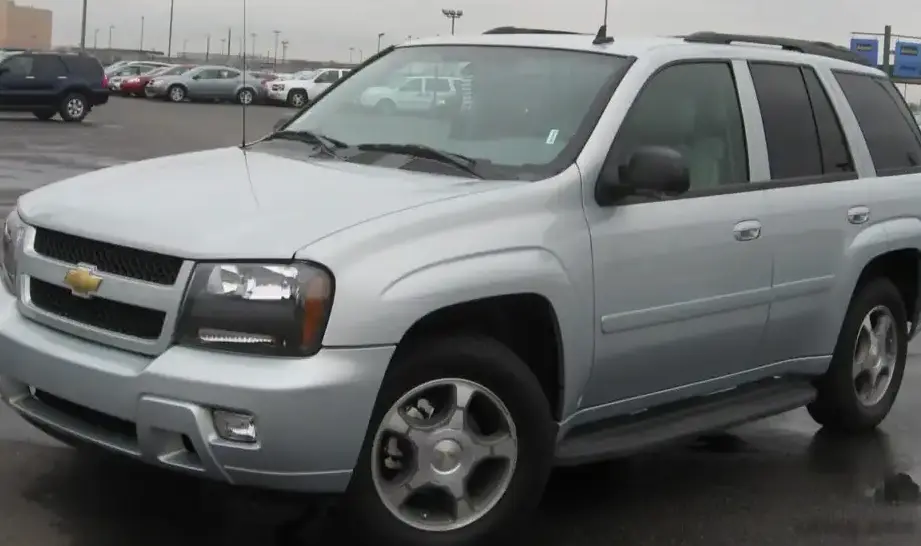
The Chevrolet Trailblazer I, specifically the 5.3i V8 4WD variant, was a full-size SUV produced from 2002 to 2004. Positioned as a more luxurious and capable alternative to the S-10 Blazer it replaced, the Trailblazer aimed to compete with offerings from Ford and Jeep in the burgeoning SUV market. This particular configuration, boasting a 288 horsepower V8 engine paired with a four-speed automatic transmission and four-wheel drive, represented a mid-to-high trim level within the Trailblazer lineup, prioritizing performance and all-weather capability. It was built on the GMT800 platform, shared with the GMC Envoy and Buick Rainier.
Technical Specifications
| Brand | Chevrolet |
| Model | Trailblazer |
| Generation | Trailblazer I |
| Type (Engine) | 5.3 i V8 4WD (288 Hp) |
| Start of production | 2002 |
| End of production | 2004 |
| Powertrain Architecture | Internal Combustion engine |
| Body type | SUV |
| Seats | 5 |
| Doors | 5 |
| Fuel Type | Petrol (Gasoline) |
| Maximum speed | 175 km/h (108.74 mph) |
| Power | 288 Hp @ 5200 rpm |
| Power per litre | 54.1 Hp/l |
| Torque | 440 Nm @ 4400 rpm (324.53 lb.-ft. @ 4400 rpm) |
| Engine layout | Front, Longitudinal |
| Engine Model/Code | LM4 |
| Engine displacement | 5327 cm3 (325.07 cu. in.) |
| Number of cylinders | 8 |
| Engine configuration | V-engine |
| Cylinder Bore | 96 mm (3.78 in.) |
| Piston Stroke | 92 mm (3.62 in.) |
| Compression ratio | 9.5:1 |
| Number of valves per cylinder | 2 |
| Fuel injection system | Multi-port manifold injection |
| Engine aspiration | Naturally aspirated engine |
| Engine oil capacity | 5.7 l (6.02 US qt | 5.02 UK qt) |
| Coolant | 11.6 l (12.26 US qt | 10.21 UK qt) |
| Max. weight | 2880 kg (6349.31 lbs.) |
| Trunk (boot) space – minimum | 631 l (22.28 cu. ft.) |
| Trunk (boot) space – maximum | 2839 l (100.26 cu. ft.) |
| Fuel tank capacity | 96 l (25.36 US gal | 21.12 UK gal) |
| Length | 5279 mm (207.83 in.) |
| Width | 1894 mm (74.57 in.) |
| Height | 1957 mm (77.05 in.) |
| Wheelbase | 3277 mm (129.02 in.) |
| Front track | 1603 mm (63.11 in.) |
| Rear (Back) track | 1577 mm (62.09 in.) |
| Drive wheel | All wheel drive (4×4) |
| Number of gears and type of gearbox | 4 gears, automatic transmission |
| Front suspension | Double wishbone |
| Rear suspension | Coil spring |
| Front brakes | Ventilated discs |
| Rear brakes | Disc |
| Assisting systems | ABS (Anti-lock braking system) |
| Steering type | Steering rack and pinion |
| Power steering | Hydraulic Steering |
| Tires size | 245/70 R16 |
Powertrain & Engine Architecture
The heart of this Trailblazer variant is the LM4 5.3-liter V8 engine. This engine, a member of Chevrolet’s Small-Block family, is a cast-iron block, aluminum-head design. It utilizes a 9.5:1 compression ratio and multi-port fuel injection to deliver its 288 horsepower and 324 lb-ft of torque. The engine’s architecture is relatively simple and robust, contributing to its generally good reliability. The four-speed 4L60-E automatic transmission was the standard pairing for this engine. This transmission, while not known for being particularly fuel-efficient by modern standards, was durable and provided smooth shifts. The 4L60-E features electronic control for shift points and torque converter lockup, optimizing performance and drivability.
Driving Characteristics
The 5.3L V8 and 4L60-E automatic combination provided a comfortable and capable driving experience. Acceleration was brisk, though not sporty, with the Trailblazer capable of reaching 60 mph in around 7.5 seconds. The automatic transmission’s gear ratios were tuned for towing and everyday driving, prioritizing usability over outright performance. Compared to the available inline-six engine, the V8 offered significantly more power and torque, making it a better choice for those who frequently towed trailers or needed extra grunt for off-road adventures. Compared to later Trailblazer models with more advanced transmissions, the 4L60-E felt somewhat dated, with fewer gears and less refined shift quality.
Equipment & Trim Levels
The 5.3L V8 4WD Trailblazer typically came standard with features like air conditioning, power windows and locks, cruise control, and an upgraded audio system. Leather upholstery, heated seats, a sunroof, and a premium Bose sound system were often available as options. The interior design was functional and comfortable, though not particularly luxurious compared to some European competitors. The Trailblazer’s spacious interior and ample cargo capacity were key selling points, making it a practical choice for families.
Chassis & Braking
The Trailblazer I utilized a body-on-frame construction, providing a robust and durable platform. The suspension consisted of an independent double wishbone setup in the front and a coil-spring solid axle in the rear. This configuration offered a good balance of ride comfort and off-road capability. Braking duties were handled by ventilated discs up front and discs in the rear, with ABS standard. The braking system was adequate for the vehicle’s weight, but not particularly powerful. The four-wheel drive system was electronically controlled, allowing the driver to switch between two-wheel drive and four-wheel drive modes as needed.
Market Reception & Comparison
The Chevrolet Trailblazer I, particularly the 5.3L V8 4WD variant, was generally well-received by critics and consumers. It was praised for its spacious interior, comfortable ride, and strong V8 engine. However, some reviewers criticized its fuel economy and somewhat dated interior design. Compared to the smaller S-10 Blazer, the Trailblazer offered more space and refinement. Compared to competitors like the Ford Explorer and Jeep Grand Cherokee, the Trailblazer offered a competitive combination of features, performance, and price. Fuel economy averaged around 14 mpg city and 18 mpg highway.
Legacy
The LM4 5.3L V8 engine proved to be a remarkably durable and reliable powerplant. Many Trailblazers equipped with this engine have surpassed 200,000 miles with proper maintenance. The 4L60-E transmission, while not as robust, is also generally reliable if fluid changes are performed regularly. On the used car market today, the Trailblazer I 5.3L V8 4WD represents a relatively affordable and capable SUV. Its simple mechanical design and readily available parts make it a relatively easy vehicle to maintain. While it lacks the advanced features of more modern SUVs, its ruggedness and dependability continue to appeal to buyers seeking a practical and reliable vehicle.
