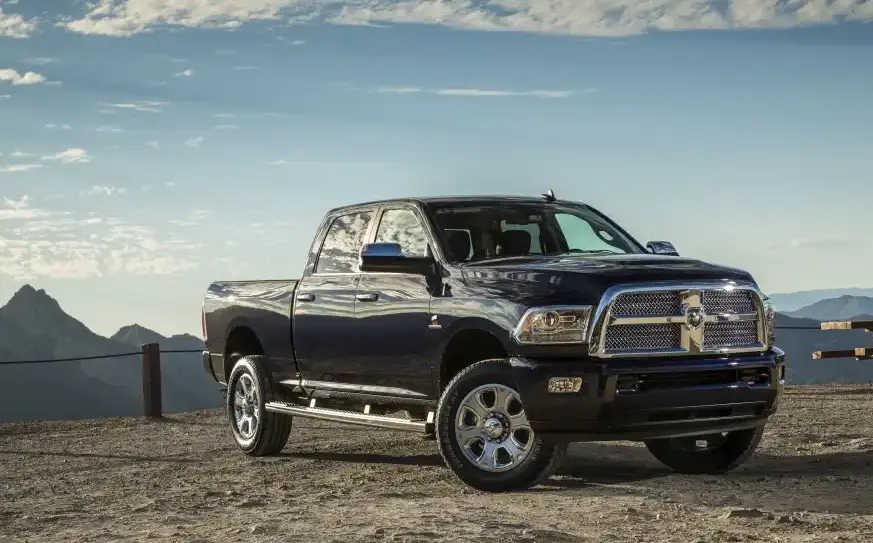
The RAM 2500/3500 Crew Cab I, specifically the 2500 model equipped with the 6.7-liter Cummins turbocharged diesel engine producing 350 horsepower, represented a significant offering in the heavy-duty pickup truck segment from 2010 to 2012. This generation, building upon the foundation of previous models, aimed to provide a balance of robust capability, improved refinement, and modern features for the American truck buyer. Positioned as a workhorse capable of demanding tasks, this variant served as a popular choice for those needing substantial towing and hauling capacity without opting for the highest-tier trims.
Technical Specifications
| Brand | RAM |
| Model | 2500/3500 |
| Generation | 2500/3500 Crew Cab I |
| Type (Engine) | 2500 6.7 Cummins TD (350 Hp) |
| Start of production | 2010 |
| End of production | 2012 |
| Powertrain Architecture | Internal Combustion engine |
| Body type | Pick-up |
| Seats | 5-6 |
| Doors | 4 |
| Fuel Type | Diesel |
| Weight-to-power ratio | 8.7 kg/Hp, 114.6 Hp/tonne |
| Weight-to-torque ratio | 3.7 kg/Nm, 270.9 Nm/tonne |
| Power | 350 Hp @ 3013 rpm |
| Power per litre | 52.3 Hp/l |
| Torque | 827 Nm @ 1400 rpm (609.96 lb.-ft. @ 1400 rpm) |
| Engine Model/Code | ETJ |
| Engine displacement | 6690 cm3 (408.25 cu. in.) |
| Number of cylinders | 6 |
| Engine configuration | Inline |
| Cylinder Bore | 107 mm (4.21 in.) |
| Piston Stroke | 124 mm (4.88 in.) |
| Fuel injection system | Diesel Commonrail |
| Engine aspiration | Turbocharger, Intercooler |
| Engine oil capacity | 11.4 l (12.05 US qt | 10.03 UK qt) |
| Coolant | 21.4 l (22.61 US qt | 18.83 UK qt) |
| Kerb Weight | 3053 kg (6730.71 lbs.) |
| Max. weight | 4082 kg (8999.27 lbs.) |
| Max load | 1029 kg (2268.56 lbs.) |
| Trunk (boot) space – maximum | 1628 l (57.49 cu. ft.) |
| Fuel tank capacity | 129 l (34.08 US gal | 28.38 UK gal) |
| Permitted trailer load with brakes (12%) | 5488 kg (12098.97 lbs.) |
| Length | 6030 mm (237.4 in.) |
| Width including mirrors | 2009 mm (79.09 in.) |
| Height | 1872 mm (73.7 in.) |
| Wheelbase | 3795 mm (149.41 in.) |
| Front track | 1742 mm (68.58 in.) |
| Rear (Back) track | 1732 mm (68.19 in.) |
| Minimum turning circle (turning diameter) | 14.4 m (47.24 ft.) |
| Approach angle | 12.5° |
| Departure angle | 23.7° |
| Ramp-over (brakeover) angle | 15.1° |
| Drivetrain Architecture | The Internal combustion engine (ICE) drives the rear wheels of the vehicle. |
| Drive wheel | Rear wheel drive |
| Number of gears and type of gearbox | 6 gears, manual transmission |
| Front suspension | Double wishbone |
| Rear suspension | Leaf spring |
| Front brakes | Disc |
| Rear brakes | Disc |
| Assisting systems | ABS (Anti-lock braking system) |
| Tires size | 245/70 R17; 265/70 R17; 275/70 R18 |
| Wheel rims size | 7.5J x 17; 8J x 17; 8J x 18 |
Powertrain & Engine Architecture
The heart of this RAM 2500 was the 6.7-liter Cummins inline-six diesel engine, designated with the ETJ code. This engine represented a significant evolution of Cummins’ proven diesel technology. It featured a cast iron block, a 24-valve cylinder head, and a robust crankshaft designed for high torque output. The engine utilized a diesel common rail fuel injection system, delivering highly pressurized fuel directly into the cylinders for optimized combustion. A variable geometry turbocharger with an intercooler further enhanced performance by increasing air intake and reducing intake air temperature. The 6.7L Cummins was known for its durability and longevity, becoming a staple in the heavy-duty truck market. While a six-speed manual transmission was standard, an optional automatic transmission was available, though less common in this configuration.
Driving Characteristics
The 350 horsepower and 827 lb-ft of torque delivered by the 6.7L Cummins provided substantial pulling power. The manual transmission, while offering greater control, demanded more driver involvement. The automatic transmission, while providing ease of use, could feel slightly less responsive, particularly when compared to the manual or higher-output Cummins variants. The gear ratios were optimized for towing and hauling, prioritizing low-end torque over outright acceleration. In real-world conditions, this truck excelled at tasks like towing large trailers, hauling heavy loads, and navigating challenging terrain. However, it wasn’t designed for sporty driving; the focus was squarely on capability and durability.
Equipment & Trim Levels
The 2500/3500 Crew Cab I with the 6.7L Cummins typically came standard with features like air conditioning, power windows and locks, and a basic audio system. The Crew Cab configuration offered spacious seating for up to six passengers, making it a practical choice for families or work crews. Optional extras included upgraded audio systems, leather upholstery, navigation systems, and various towing packages. This specific trim level often served as a base for customers who prioritized functionality and affordability over luxury features. Higher trim levels, such as the Laramie or Longhorn, offered more premium amenities.
Chassis & Braking
The RAM 2500/3500 featured a robust chassis designed to withstand heavy loads. The front suspension utilized a double wishbone setup, while the rear suspension employed leaf springs. This configuration provided a comfortable ride, even when the truck was heavily loaded. Disc brakes were standard on all four wheels, providing ample stopping power. An Anti-lock Braking System (ABS) was also included as standard equipment. The heavy-duty suspension and braking system were crucial for maintaining control and stability when towing or hauling.
Market Reception & Comparison
The 2500/3500 Crew Cab I with the 6.7L Cummins received generally positive reviews from critics. It was praised for its powerful engine, robust construction, and comfortable ride. However, some reviewers noted that the automatic transmission could feel sluggish at times. Compared to other trims in the lineup, such as those equipped with the 5.7L Hemi V8, the Cummins diesel offered significantly more torque and towing capacity, but at a higher price point. Fuel economy, while respectable for a heavy-duty truck, was still lower than that of lighter-duty pickups.
Legacy
The 6.7L Cummins engine has become legendary for its reliability and longevity. Properly maintained, these engines can easily exceed 200,000 or even 300,000 miles. In the used car market, RAM 2500/3500 models equipped with this engine continue to hold their value, particularly those in good condition. The combination of power, durability, and capability has made this truck a favorite among those who need a reliable workhorse. While newer RAM models offer more advanced features and technologies, the 2010-2012 2500/3500 Crew Cab I with the 6.7L Cummins remains a respected and capable truck.