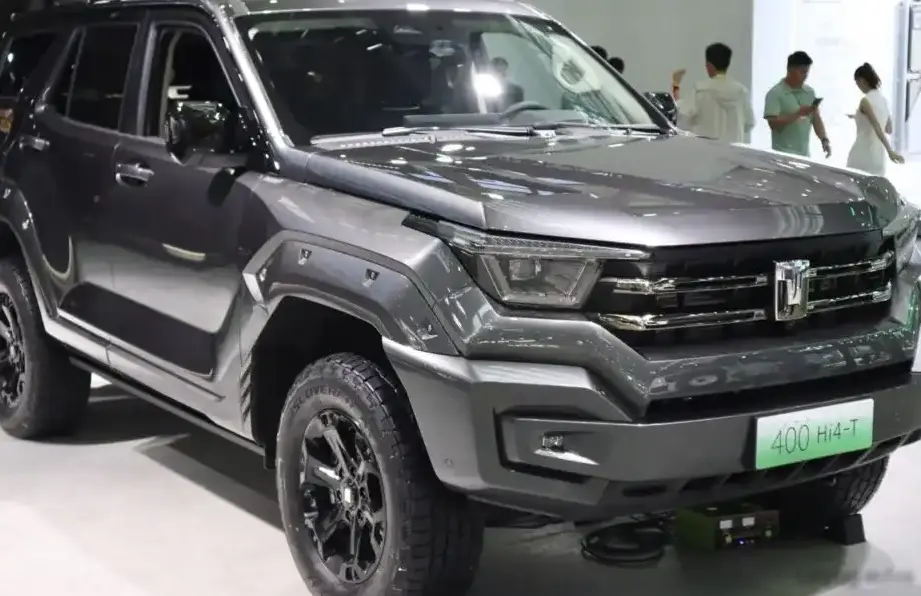
The Tank 400 Hi4-T 2.0T (422 Hp) Plug-in Hybrid 4WD Automatic, introduced in October 2025, represents a significant step in the Tank brand’s expansion into the increasingly competitive mid-size SUV market. As a facelift of the original 400 model, this variant builds upon the established platform (currently designated as the 400 generation) with a focus on enhanced efficiency and performance through the integration of plug-in hybrid technology. Positioned as a premium offering within the Tank 400 lineup, it caters to buyers seeking a blend of off-road capability, luxurious features, and reduced emissions. The vehicle is primarily targeted towards the Chinese domestic market, where demand for both large SUVs and new energy vehicles is rapidly growing.
Technical Specifications
| Brand | Tank |
| Model | 400 |
| Generation | 400 (facelift 2025) |
| Type (Engine) | Hi4-T 2.0T (422 Hp) Plug-in Hybrid 4WD Automatic |
| Start of production | October, 2025 |
| Powertrain Architecture | PHEV (Plug-in Hybrid Electric Vehicle) |
| Body type | SUV |
| Seats | 5 |
| Doors | 5 |
| Fuel consumption (economy) – combined (WLTC) | 2.26-8.4 l/100 km (104.1 – 28 US mpg, 125 – 33.6 UK mpg, 44.2 – 11.9 km/l) |
| Fuel Type | Petrol / electricity |
| Acceleration 0 – 100 km/h | 6.8 sec |
| Acceleration 0 – 62 mph | 6.8 sec |
| Acceleration 0 – 60 mph | 6.5 sec |
| Maximum speed | 180 km/h (111.85 mph) |
| Emission standard | China VI b |
| Weight-to-power ratio | 6.6 kg/Hp, 152.3 Hp/tonne |
| Weight-to-torque ratio | 3.7 kg/Nm, 270.8 Nm/tonne |
| Gross battery capacity | 37.1 kWh |
| Battery technology | Lithium nickel manganese cobalt oxides (Li-NMC) |
| All-electric range (WLTC) | 105 km (65.24 mi) |
| Average Energy consumption (WLTC) | 24.6 kWh/100 km (39.59 kWh/100 mi, 85 MPGe, 4.1 km/kWh, 2.5 mi/kWh) |
| Electric motor power | 177 Hp |
| Electric motor Torque | 495 Nm (365.09 lb.-ft.) |
| Electric motor model/code | TZ290XH007 |
| Electric motor location | Between the combustion engine and the transmission |
| Electric motor type | Synchronous |
| System power | 422 Hp |
| System torque | 750 Nm (553.17 lb.-ft.) |
| Power | 252 Hp @ 6000 rpm |
| Torque | 380 Nm @ 1700-4000 rpm (280.27 lb.-ft. @ 1700-4000 rpm) |
| Engine layout | Front, Longitudinal |
| Engine Model/Code | E20NB |
| Engine displacement | 1998 cm3 (121.93 cu. in.) |
| Number of cylinders | 4 |
| Engine configuration | Inline |
| Cylinder Bore | 82 mm (3.23 in.) |
| Piston Stroke | 94.6 mm (3.72 in.) |
| Number of valves per cylinder | 4 |
| Fuel injection system | Direct injection |
| Engine aspiration | Turbocharger, Intercooler |
| Valvetrain | DOHC |
| Engine oil capacity | 5.9 l (6.23 US qt | 5.19 UK qt) |
| Kerb Weight | 2770 kg (6106.8 lbs.) |
| Max. weight | 3270 kg (7209.12 lbs.) |
| Max load | 500 kg (1102.31 lbs.) |
| Trunk (boot) space – minimum | 789 l (27.86 cu. ft.) |
| Trunk (boot) space – maximum | 1803 l (63.67 cu. ft.) |
| Fuel tank capacity | 70 l (18.49 US gal | 15.4 UK gal) |
| Permitted trailer load with brakes (12%) | 2500 kg (5511.56 lbs.) |
| Length | 4964 mm (195.43 in.) |
| Width | 1970 mm (77.56 in.) |
| Height | 1905 mm (75 in.) |
| Wheelbase | 2850 mm (112.2 in.) |
| Front track | 1635 mm (64.37 in.) |
| Rear (Back) track | 1635 mm (64.37 in.) |
| Ride height (ground clearance) | 224 mm (8.82 in.) |
| Minimum turning circle (turning diameter) | 11.2 m (36.75 ft.) |
| Approach angle | 33° |
| Departure angle | 31° |
| Wading depth | 800 mm (31.5 in.) |
| Drivetrain Architecture | The Internal combustion engine (ICE) and the electric motor permanently drive the rear wheels of the vehicle, capable of running in full electric or mixed mode, and if necessary through the electrically or mechanically controlled clutch, the front wheels are driven. |
| Drive wheel | All wheel drive (4×4) |
| Number of gears and type of gearbox | 9 gears, automatic transmission HAT |
| Front suspension | Double wishbone, Independent coil spring, Transverse stabilizer |
| Rear suspension | dependent spring suspension, Transverse stabilizer |
| Front brakes | Ventilated discs |
| Rear brakes | Ventilated discs |
| Assisting systems | ABS (Anti-lock braking system) |
| Steering type | Steering rack and pinion |
| Power steering | Electric Steering |
| Tires size | 265/65 R18 |
| Wheel rims size | 18 |
INTRODUCTION
The Tank 400 Hi4-T 2.0T Plug-in Hybrid 4WD Automatic is a five-seater SUV that debuted in October 2025 as a refreshed version of the original Tank 400. Built on the Tank platform, it represents the brand’s commitment to providing both robust off-road performance and modern, environmentally conscious powertrain options. This particular variant distinguishes itself through its plug-in hybrid system, combining a 2.0-liter turbocharged four-cylinder engine with an electric motor and a 37.1 kWh battery pack. This configuration allows for a significant all-electric range of 105 km (65.24 miles), making it an attractive option for urban commuting and reducing overall emissions. The vehicle is positioned as a premium offering, boasting a comprehensive suite of features and advanced technology.
Powertrain & Engine Architecture
At the heart of the Tank 400 Hi4-T lies the E20NB 2.0-liter inline-four cylinder engine, equipped with direct fuel injection and a turbocharger with intercooler. This engine produces 252 horsepower at 6000 rpm and 380 Nm (280.27 lb-ft) of torque between 1700 and 4000 rpm. The engine utilizes a Double Overhead Camshaft (DOHC) valvetrain for optimized performance. Coupled with this is a 177 Hp electric motor (TZ290XH007 model) producing 495 Nm (365.09 lb-ft) of torque, positioned between the engine and the 9-speed HAT automatic transmission. The system’s combined output reaches 422 Hp and 750 Nm (553.17 lb-ft) of torque. The plug-in hybrid system utilizes a Lithium Nickel Manganese Cobalt Oxide (Li-NMC) battery pack with a gross capacity of 37.1 kWh, enabling an all-electric range of 105 km (65.24 miles). The transmission is an advanced 9-speed automatic, designed to efficiently deliver power to all four wheels.
Driving Characteristics
The Tank 400 Hi4-T 2.0T Plug-in Hybrid delivers a refined driving experience, blending the responsiveness of the turbocharged engine with the smooth, silent operation of the electric motor. In electric-only mode, the vehicle offers near-silent acceleration and impressive torque, making it ideal for city driving. When the engine engages, the transition is seamless, providing ample power for highway overtaking and off-road excursions. The 9-speed automatic transmission contributes to efficient power delivery, with well-chosen gear ratios that maximize both performance and fuel economy. While the added weight of the battery pack slightly impacts handling compared to the standard gasoline-powered models, the vehicle remains stable and composed, offering a comfortable ride on various surfaces. The 0-100 km/h acceleration time of 6.8 seconds is competitive within its class.
Equipment & Trim Levels
The Tank 400 Hi4-T 2.0T Plug-in Hybrid 4WD Automatic comes standard with a comprehensive array of features, including leather upholstery, a large touchscreen infotainment system with navigation, a premium sound system, and advanced driver-assistance systems (ADAS) such as adaptive cruise control, lane-keeping assist, and automatic emergency braking. Optional extras include a panoramic sunroof, ventilated front seats, and a more sophisticated off-road management system. The interior design emphasizes luxury and comfort, with high-quality materials and a modern aesthetic. The dashboard layout is driver-focused, with intuitive controls and a clear instrument cluster.
Chassis & Braking
The Tank 400 utilizes a robust chassis with a double wishbone independent suspension at the front and a dependent spring suspension with a transverse stabilizer at the rear. This setup provides a balance between on-road comfort and off-road capability. Ventilated disc brakes are fitted on all four wheels, providing ample stopping power. The vehicle is equipped with an Anti-lock Braking System (ABS) and Electronic Stability Control (ESC) for enhanced safety. The electric power steering offers precise and responsive handling. With a ground clearance of 224 mm (8.82 inches), the Tank 400 is well-equipped to tackle challenging terrain.
Market Reception & Comparison
The Tank 400 Hi4-T 2.0T Plug-in Hybrid 4WD Automatic has been generally well-received by automotive critics in China, who praise its combination of performance, efficiency, and luxury. Compared to the standard gasoline-powered Tank 400 models, the plug-in hybrid variant offers significantly improved fuel economy and reduced emissions, particularly for drivers who frequently commute in urban areas. While the initial purchase price is higher, the long-term cost of ownership may be lower due to reduced fuel consumption and potential government incentives. Compared to other plug-in hybrid SUVs in the Chinese market, the Tank 400 stands out with its robust off-road capabilities and spacious interior.
Legacy
The long-term reliability of the Tank 400 Hi4-T 2.0T Plug-in Hybrid powertrain remains to be seen, as it is a relatively new offering. However, the components used – the 2.0T engine and the 9-speed automatic transmission – have a proven track record in other vehicles. The battery pack is expected to have a lifespan of at least 8 years or 160,000 kilometers, and Tank provides a comprehensive warranty on the powertrain and battery. In the used car market, the Tank 400 Hi4-T is expected to hold its value well, particularly among buyers seeking a versatile and environmentally friendly SUV with genuine off-road credentials.