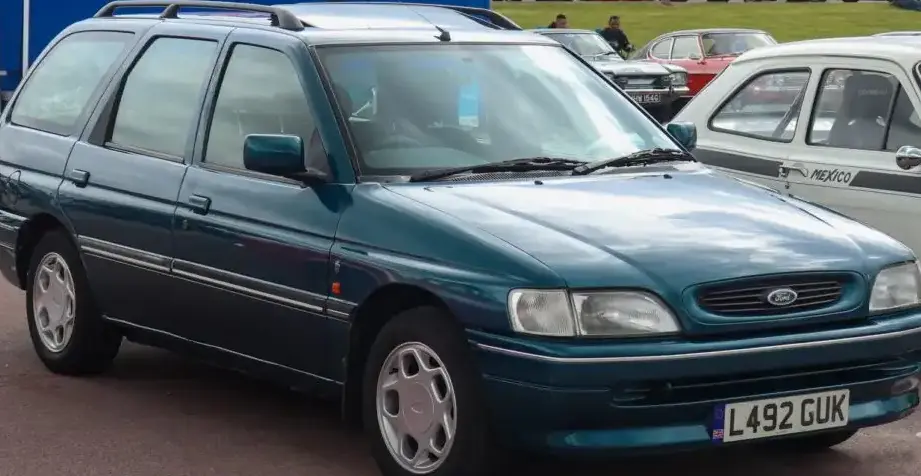
The Ford Escort VI Turnier 1.8 i 16V, produced between 1993 and 1995, represented a compelling blend of practicality and performance within the sixth generation (GAL) Escort lineup. Positioned as a mid-range offering in the Turnier (estate/wagon) body style, it catered to buyers seeking a spacious and versatile vehicle with a more spirited driving experience than the base models. This variant occupied a space between the more economical, lower-powered engines and the performance-focused versions, offering a balance of fuel efficiency and usable power. It was primarily sold in the European market, where the Turnier body style was particularly popular for families and those needing a flexible cargo area.
Technical Specifications
| Brand | Ford |
| Model | Escort |
| Generation | Escort VI Turnier (GAL) |
| Type (Engine) | 1.8 i 16V (105 Hp) |
| Start of production | 1993 |
| End of production | 1995 |
| Powertrain Architecture | Internal Combustion engine |
| Body type | Station wagon (estate) |
| Seats | 5 |
| Doors | 5 |
| Fuel consumption (combined) | 8 l/100 km (29.4 US mpg, 35.3 UK mpg, 12.5 km/l) |
| Fuel Type | Petrol (Gasoline) |
| Acceleration 0 – 100 km/h | 11.1 sec |
| Acceleration 0 – 62 mph | 11.1 sec |
| Acceleration 0 – 60 mph | 10.5 sec |
| Maximum speed | 187 km/h (116.2 mph) |
| Weight-to-power ratio | 10.9 kg/Hp, 92.1 Hp/tonne |
| Weight-to-torque ratio | 7.5 kg/Nm, 134.2 Nm/tonne |
| Power | 105 Hp @ 5500 rpm |
| Power per litre | 58.5 Hp/l |
| Torque | 153 Nm @ 4000 rpm (112.85 lb.-ft. @ 4000 rpm) |
| Engine layout | Front, Transverse |
| Engine Model/Code | RDA |
| Engine displacement | 1796 cm3 (109.6 cu. in.) |
| Number of cylinders | 4 |
| Engine configuration | Inline |
| Cylinder Bore | 80.6 mm (3.17 in.) |
| Piston Stroke | 88 mm (3.46 in.) |
| Compression ratio | 10:1 |
| Number of valves per cylinder | 4 |
| Fuel injection system | Multi-port manifold injection |
| Engine aspiration | Naturally aspirated engine |
| Valvetrain | DOHC |
| Engine oil capacity | 4.25 l (4.49 US qt | 3.74 UK qt) |
| Coolant | 7 l (7.4 US qt | 6.16 UK qt) |
| Kerb Weight | 1140 kg (2513.27 lbs.) |
| Max. weight | 1650 kg (3637.63 lbs.) |
| Max load | 510 kg (1124.36 lbs.) |
| Trunk (boot) space – minimum | 460 l (16.24 cu. ft.) |
| Trunk (boot) space – maximum | 860 l (30.37 cu. ft.) |
| Fuel tank capacity | 55 l (14.53 US gal | 12.1 UK gal) |
| Length | 4268 mm (168.03 in.) |
| Width | 1690 mm (66.54 in.) |
| Height | 1410 mm (55.51 in.) |
| Wheelbase | 2525 mm (99.41 in.) |
| Front track | 1440 mm (56.69 in.) |
| Rear (Back) track | 1455 mm (57.28 in.) |
| Drivetrain Architecture | The Internal combustion engine (ICE) drives the front wheels of the vehicle. |
| Drive wheel | Front wheel drive |
| Number of gears and type of gearbox | 5 gears, manual transmission |
| Front suspension | Wishbone |
| Rear suspension | Coil spring |
| Front brakes | Ventilated discs |
| Rear brakes | Drum |
| Assisting systems | ABS (Anti-lock braking system) |
| Steering type | Steering rack and pinion |
| Power steering | Hydraulic Steering |
| Tires size | 175/70 R13 |
INTRODUCTION
The Ford Escort VI Turnier 1.8 i 16V, launched in 1993, was a key component of Ford’s European strategy to offer a versatile and appealing family car. Built on the 1HX0/A3 platform, the sixth-generation Escort represented a significant step forward in terms of design, safety, and refinement compared to its predecessor. The Turnier body style, essentially a station wagon, provided increased cargo capacity and practicality, making it a popular choice for families and those with active lifestyles. The 1.8-liter 16V engine, paired with a five-speed manual transmission, offered a balance between performance and fuel economy, making it a sensible option for everyday driving.
Powertrain & Engine Architecture
At the heart of the Escort VI Turnier 1.8 i 16V lies the Ford RDA engine, a 1.8-liter inline-four cylinder gasoline engine. This engine featured a dual overhead camshaft (DOHC) valvetrain operating four valves per cylinder, contributing to its improved breathing and power output. The RDA engine utilized multi-port fuel injection, delivering fuel directly into the intake ports for precise fuel metering and efficient combustion. The 1796cc displacement, combined with a 10:1 compression ratio, allowed the engine to produce 105 horsepower at 5500 rpm and 153 Nm (113 lb-ft) of torque at 4000 rpm. The five-speed manual transmission provided a good spread of gears, allowing the driver to optimize engine performance for various driving conditions. Gear ratios were tuned for a balance of acceleration and fuel efficiency, with a relatively tall fifth gear for comfortable highway cruising.
Driving Characteristics
The 1.8 i 16V variant of the Escort VI Turnier offered a noticeably more engaging driving experience compared to the lower-powered engine options. While not a sports car, the 105 hp engine provided sufficient power for confident overtaking and comfortable cruising. Acceleration from 0 to 60 mph took around 10.5 seconds, and the car could reach a top speed of approximately 116 mph. The manual transmission allowed for precise control over gear selection, enabling the driver to maximize the engine’s power band. Compared to the 1.6-liter versions, the 1.8 offered a more responsive throttle and stronger mid-range pull. It wasn’t as nimble as the lighter, less-equipped models, but the added power compensated for the slightly increased weight. The suspension, tuned for comfort, provided a reasonably compliant ride, although it could feel a bit soft during spirited cornering.
Equipment & Trim Levels
The Escort VI Turnier 1.8 i 16V typically came equipped with a reasonable level of standard features. Interior appointments included cloth upholstery, a basic dashboard layout with analog gauges, and power steering. Depending on the market and optional packages, features like electric windows, central locking, and an upgraded stereo system were available. The Turnier’s rear seats could be folded down to create a larger cargo area, enhancing its practicality. Exterior features generally included body-colored bumpers and door handles. Higher trim levels might have added features like alloy wheels, a sunroof, and upgraded interior trim.
Chassis & Braking
The Escort VI Turnier utilized a front-wheel-drive layout with a MacPherson strut front suspension and a coil spring rear suspension. This setup provided a good balance of ride comfort and handling. The front brakes were ventilated discs, offering good stopping power, while the rear brakes were drums. An anti-lock braking system (ABS) was often included as standard equipment, enhancing safety. The steering was a rack-and-pinion system with hydraulic power assistance, providing light and precise steering feel. Tire size was typically 175/70 R13, offering a good compromise between grip and ride comfort.
Market Reception & Comparison
The Escort VI Turnier 1.8 i 16V was generally well-received by automotive critics as a practical and capable family car. It was praised for its spacious interior, versatile cargo area, and relatively refined driving experience. Compared to other estate cars in its class, such as the Vauxhall/Opel Astra Estate and the Volkswagen Passat Variant, the Escort offered a competitive level of equipment and performance at a reasonable price point. Fuel economy was considered acceptable for its class, although it wasn’t as frugal as the diesel-powered options. Reliability was generally good, although some owners reported minor issues with the electrical system.
Legacy
The Ford Escort VI Turnier 1.8 i 16V remains a popular choice among classic car enthusiasts and those seeking an affordable and reliable used car. The RDA engine is known for its durability and relatively simple maintenance requirements. While finding parts can sometimes be a challenge, they are generally available through specialist suppliers. Today, these Escorts are often appreciated for their retro charm and practicality. They represent a significant era in Ford’s history and continue to provide a comfortable and enjoyable driving experience for those who appreciate a classic European estate car.