
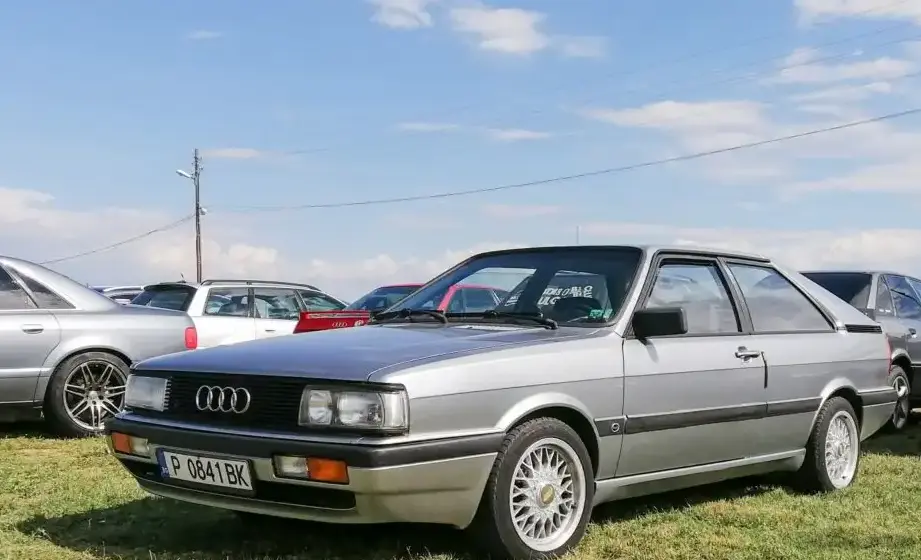
The Audi Coupe (B2), produced between 1980 and 1988, represented a significant step forward for Audi, blending sporty styling with practical usability. The GT 1.8 variant, equipped with a 90 horsepower engine and a 3-speed automatic transmission, was introduced in 1985 and continued through July 1988. This model occupied an entry-level position within the B2 Coupe range, offering a more accessible price point and a focus on comfortable, relaxed driving rather than outright performance. It was positioned below the more powerful 1.8 inline-five and later 2.3 liter versions, and served as an alternative to the five-speed manual 1.8 models.
Technical Specifications
| Brand | Audi |
| Model | Coupe |
| Generation | Coupe (B2 81, 85, facelift 1984) |
| Type (Engine) | GT 1.8 (90 Hp) CAT |
| Start of production | 1985 |
| End of production | July, 1988 |
| Powertrain Architecture | Internal Combustion engine |
| Body type | Coupe |
| Seats | 5 |
| Doors | 2 |
| Fuel Type | Petrol (Gasoline) |
| Acceleration 0 – 100 km/h | 11 sec |
| Acceleration 0 – 62 mph | 11 sec |
| Acceleration 0 – 60 mph | 10.5 sec |
| Maximum speed | 172 km/h (106.88 mph) |
| Weight-to-power ratio | 10.6 kg/Hp, 94.7 Hp/tonne |
| Weight-to-torque ratio | 6.9 kg/Nm, 144.2 Nm/tonne |
| Power | 90 Hp @ 5500 rpm |
| Power per litre | 50.5 Hp/l |
| Torque | 137 Nm @ 3250 rpm (101.05 lb.-ft. @ 3250 rpm) |
| Engine layout | Front, Longitudinal |
| Engine Model/Code | DS, JN, JV |
| Engine displacement | 1781 cm3 (108.68 cu. in.) |
| Number of cylinders | 4 |
| Engine configuration | Inline |
| Cylinder Bore | 81 mm (3.19 in.) |
| Piston Stroke | 86.4 mm (3.4 in.) |
| Compression ratio | 9:1 |
| Number of valves per cylinder | 2 |
| Fuel injection system | Multi-port manifold injection |
| Engine aspiration | Naturally aspirated engine |
| Engine oil capacity | 3 l (3.17 US qt | 2.64 UK qt) |
| Coolant | 6.5 l (6.87 US qt | 5.72 UK qt) |
| Kerb Weight | 950 kg (2094.39 lbs.) |
| Max. weight | 1410 kg (3108.52 lbs.) |
| Max load | 460 kg (1014.13 lbs.) |
| Trunk (boot) space – minimum | 443 l (15.64 cu. ft.) |
| Fuel tank capacity | 68 l (17.96 US gal | 14.96 UK gal) |
| Permitted trailer load with brakes (8%) | 1200 kg (2645.55 lbs.) |
| Permitted trailer load without brakes | 510 kg (1124.36 lbs.) |
| Length | 4421 mm (174.06 in.) |
| Width | 1682 mm (66.22 in.) |
| Height | 1350 mm (53.15 in.) |
| Wheelbase | 2538 mm (99.92 in.) |
| Front track | 1400 mm (55.12 in.) |
| Rear (Back) track | 1420 mm (55.91 in.) |
| Ride height (ground clearance) | 110 mm (4.33 in.) |
| Drag coefficient (Cd) | 0.36 |
| Minimum turning circle (turning diameter) | 10.6 m (34.78 ft.) |
| Drivetrain Architecture | The Internal combustion engine (ICE) drives the front wheels of the vehicle. |
| Drive wheel | Front wheel drive |
| Number of gears and type of gearbox | 3 gears, automatic transmission |
| Front brakes | Disc |
| Rear brakes | Drum |
| Tires size | 175/70 R13 |
| Wheel rims size | 13 |
Powertrain & Engine Architecture
The GT 1.8 variant utilized Audi’s DS, JN, or JV engine code, a 1.8-liter inline-four cylinder gasoline engine. This engine featured a cast iron block and an aluminum cylinder head, employing a single overhead camshaft (SOHC) design with two valves per cylinder. Fuel delivery was managed by Bosch K-Jetronic multi-port fuel injection, a system known for its reliability and relatively simple operation. The 9:1 compression ratio was typical for the era, balancing performance with fuel efficiency and the ability to run on readily available gasoline. The engine’s output of 90 horsepower at 5500 rpm and 137 Nm (101 lb-ft) of torque at 3250 rpm was modest, but adequate for comfortable cruising and everyday driving.
Paired with the 1.8L engine was a three-speed automatic transmission. This transmission, while providing convenience, was not known for its responsiveness or efficiency compared to the available five-speed manual. The automatic’s gear ratios were geared towards fuel economy and smooth operation, rather than spirited acceleration. This combination resulted in a more relaxed driving experience, prioritizing comfort over performance.
Driving Characteristics
The 1.8L automatic Coupe offered a distinctly different driving experience compared to its manual counterparts or the more powerful engine options. Acceleration from 0-60 mph took approximately 10.5 seconds, and top speed was around 107 mph. While not particularly quick, the car provided sufficient power for highway merging and overtaking, especially when the transmission was manually shifted when available. The automatic transmission, while smooth, could feel somewhat sluggish, particularly when attempting quick downshifts. The front-wheel-drive layout provided predictable handling, but lacked the dynamic capabilities of rear-wheel-drive vehicles. The suspension, tuned for comfort, absorbed bumps and imperfections in the road well, making it a pleasant vehicle for long journeys.
Equipment & Trim Levels
The GT 1.8 automatic typically came with a fairly basic level of equipment. Standard features included cloth upholstery, a basic stereo system, and manual windows and door locks. Power steering was often included, but air conditioning was frequently an optional extra. The interior design was functional and straightforward, reflecting the car’s positioning as an entry-level model. Optional extras could include upgraded stereo systems, sunroofs, and alloy wheels. The dashboard layout was typical of Audi’s designs of the period, with clearly marked gauges and a logical arrangement of controls.
Chassis & Braking
The B2 Audi Coupe featured a MacPherson strut front suspension and a semi-trailing arm rear suspension. The GT 1.8 variant typically used smaller diameter tires (175/70 R13) mounted on 13-inch steel wheels. Braking was accomplished via disc brakes on the front wheels and drum brakes on the rear. While adequate for normal driving conditions, the drum brakes on the rear could lack the stopping power of disc brakes, particularly under heavy braking. A stabilizer bar was fitted to the front suspension to reduce body roll during cornering.
Market Reception & Comparison
The 1.8L automatic Coupe was generally well-received as an affordable and comfortable entry point into the Audi brand. Critics acknowledged its practicality and ease of use, but often noted its lack of performance compared to the more powerful models. Fuel economy was a strong point, making it an attractive option for drivers seeking a reasonably efficient coupe. Compared to the five-speed manual 1.8, the automatic version offered less driver engagement and slower acceleration. The larger-engined models, such as the 2.3-liter, provided significantly more performance but came at a higher price point.
Legacy
The 1.8L automatic Audi Coupe (B2) has become a relatively affordable classic car. The engine and transmission combination, while not the most exciting, proved to be reasonably reliable. Regular maintenance, including timely oil changes and coolant flushes, is crucial for preserving the longevity of these vehicles. Parts availability can be a challenge, but many components are still available through specialist suppliers. Today, these cars are appreciated by enthusiasts for their classic styling, comfortable ride, and relatively simple mechanicals. They represent a piece of Audi’s history and offer a unique driving experience that is distinct from modern automobiles.
