Technical Specifications
| Brand | Nissan |
| Model | Almera |
| Generation | Almera Tino |
| Type (Engine) | 2.0 (136 Hp) CVT |
| Start of production | 2000 year |
| End of production | 2003 year |
| Powertrain Architecture | Internal Combustion engine |
| Body type | Minivan |
| Seats | 5 |
| Doors | 5 |
| Fuel consumption (economy) – urban | 12.9 l/100 km (18.2 US mpg, 21.9 UK mpg, 7.8 km/l) |
| Fuel consumption (economy) – extra urban | 7.2 l/100 km (32.7 US mpg, 39.2 UK mpg, 13.9 km/l) |
| Fuel consumption (economy) – combined | 9.3 l/100 km (25.3 US mpg, 30.4 UK mpg, 10.8 km/l) |
| Fuel Type | Petrol (Gasoline) |
| Acceleration 0 – 100 km/h | 12.6 sec |
| Acceleration 0 – 62 mph | 12.6 sec |
| Acceleration 0 – 60 mph | 12 sec |
| Maximum speed | 180 km/h (111.85 mph) |
| Weight-to-power ratio | 10.6 kg/Hp, 94.8 Hp/tonne |
| Weight-to-torque ratio | 8.2 kg/Nm, 122 Nm/tonne |
| Power | 136 Hp @ 5800 rpm |
| Power per litre | 68.1 Hp/l |
| Torque | 175 Nm @ 4800 rpm (129.07 lb.-ft. @ 4800 rpm) |
| Engine layout | Front, Transverse |
| Engine Model/Code | SR20DE |
| Engine displacement | 1998 cm3 (121.93 cu. in.) |
| Number of cylinders | 4 |
| Engine configuration | Inline |
| Cylinder Bore | 86 mm (3.39 in.) |
| Piston Stroke | 86 mm (3.39 in.) |
| Compression ratio | 10:1 |
| Number of valves per cylinder | 4 |
| Fuel injection system | Multi-port manifold injection |
| Engine aspiration | Naturally aspirated engine |
| Valvetrain | DOHC |
| Engine oil capacity | 3.7 l (3.91 US qt | 3.26 UK qt) |
| Coolant | 6.8 l (7.19 US qt | 5.98 UK qt) |
| Kerb Weight | 1435 kg (3163.63 lbs.) |
| Max. weight | 1920 kg (4232.88 lbs.) |
| Max load | 485 kg (1069.24 lbs.) |
| Trunk (boot) space – minimum | 440 l (15.54 cu. ft.) |
| Trunk (boot) space – maximum | 1950 l (68.86 cu. ft.) |
| Fuel tank capacity | 60 l (15.85 US gal | 13.2 UK gal) |
| Length | 4264 mm (167.87 in.) |
| Width | 1758 mm (69.21 in.) |
| Height | 1608 mm (63.31 in.) |
| Wheelbase | 2535 mm (99.8 in.) |
| Front track | 1535 mm (60.43 in.) |
| Rear (Back) track | 1510 mm (59.45 in.) |
| Drivetrain Architecture | The Internal combustion engine (ICE) drives the front wheels of the vehicle. |
| Drive wheel | Front wheel drive |
| Number of gears and type of gearbox | 1 gears, automatic transmission CVT |
| Front suspension | Wishbone |
| Rear suspension | Spring Strut |
| Front brakes | Ventilated discs |
| Rear brakes | Disc |
| Assisting systems | ABS (Anti-lock braking system) |
| Steering type | Steering rack and pinion |
| Power steering | Hydraulic Steering |
| Tires size | 195/65 R15 |
| Wheel rims size | 15 |
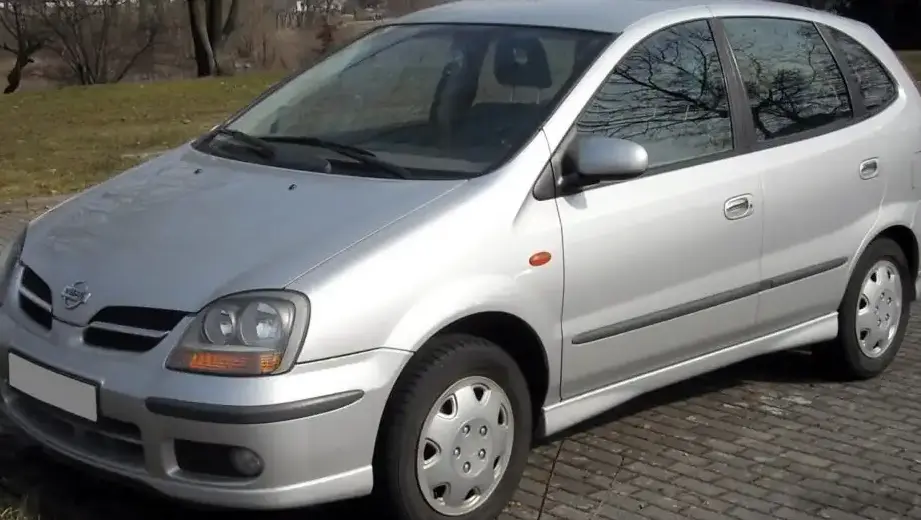
The Nissan Almera Tino 2.0, equipped with a 136 horsepower engine and a Continuously Variable Transmission (CVT), was a compact minivan produced by Nissan between 2000 and 2003. Positioned as a practical and family-oriented vehicle, the Tino was primarily marketed in Europe and Japan as a more affordable and versatile alternative to larger MPVs. It was based on the Nissan Sunny (Almera in Europe) platform, specifically utilizing the N16 chassis code. This variant, the 2.0L CVT, represented a mid-range offering within the Tino lineup, providing a balance between performance and fuel efficiency, appealing to buyers seeking a comfortable and convenient driving experience.
Powertrain & Engine Architecture
The heart of the Almera Tino 2.0 CVT is the SR20DE engine, a 2.0-liter inline-four cylinder gasoline engine. This engine is a naturally aspirated design, utilizing multi-port fuel injection and a double overhead camshaft (DOHC) valvetrain with four valves per cylinder. The SR20DE is known for its relative reliability and smooth power delivery. The engine produces 136 horsepower at 5800 rpm and 175 Nm (129 lb-ft) of torque at 4800 rpm. Paired with this engine is a Continuously Variable Transmission (CVT). Nissan’s CVT offered stepless gear changes, prioritizing fuel efficiency and smooth acceleration over the more defined shifts of a traditional automatic transmission. The CVT in the Tino was designed to work in harmony with the SR20DE’s torque curve, providing a relaxed driving experience, particularly in urban environments.
Driving Characteristics
The Almera Tino 2.0 CVT offered a comfortable and undemanding driving experience. The CVT, while not providing the sporty feel of a traditional automatic or manual transmission, delivered smooth and linear acceleration. The 136 hp engine provided adequate power for everyday driving, but acceleration was not particularly brisk, taking approximately 12.6 seconds to reach 62 mph (100 km/h). The CVT’s programming prioritized fuel economy, meaning the engine often operated at lower RPMs during cruising, contributing to a quieter cabin. Compared to the manual transmission versions of the Tino, the CVT offered greater convenience, especially in stop-and-go traffic. However, the manual versions generally provided slightly better fuel economy and a more engaging driving experience. Compared to other engine options in the Tino lineup, such as the smaller 1.6L engine, the 2.0L offered a noticeable performance advantage, making it better suited for carrying passengers and luggage.
Equipment & Trim Levels
The Almera Tino 2.0 CVT typically came equipped with a reasonable level of standard features. These included power windows, central locking, air conditioning, and an AM/FM radio. Higher trim levels offered options such as alloy wheels, a sunroof, and upgraded interior upholstery. The interior was generally functional and well-built, with a focus on practicality. The rear seats could be folded down to increase cargo space, providing flexibility for carrying larger items. Safety features included ABS (Anti-lock Braking System) as standard, and some models offered optional airbags.
Chassis & Braking
The Almera Tino utilized a front-wheel-drive layout with a MacPherson strut front suspension and a spring strut rear suspension. This setup provided a comfortable ride, although handling was not particularly sporty. The front brakes were ventilated discs, while the rear brakes were solid discs. The steering was rack and pinion with hydraulic power assistance, offering light and easy steering feel. The Tino’s suspension was tuned for comfort, prioritizing ride quality over sharp handling.
Market Reception & Comparison
The Nissan Almera Tino 2.0 CVT was generally well-received by critics as a practical and affordable family vehicle. It was praised for its spacious interior, comfortable ride, and fuel efficiency. However, some critics noted its lack of sporty handling and relatively modest performance. Compared to competitors such as the Renault Scenic and Citroën Xsara Picasso, the Tino offered a competitive price point and a reputation for reliability. Fuel economy was generally considered good for its class, averaging around 25.3 US mpg in combined driving conditions. Reliability was also a strong point, with the SR20DE engine proving to be durable and long-lasting.
Legacy
The Nissan Almera Tino, particularly the 2.0L CVT variant, has maintained a reasonable reputation for reliability in the used car market. The SR20DE engine is known for its longevity, and the CVT transmission, while requiring regular fluid changes, is generally dependable. Parts availability is generally good, making maintenance relatively straightforward. Today, the Almera Tino represents an affordable and practical option for buyers seeking a compact minivan with a proven track record. While it may not offer the latest technology or the most exciting driving experience, its combination of practicality, reliability, and affordability continues to appeal to a segment of the used car market.