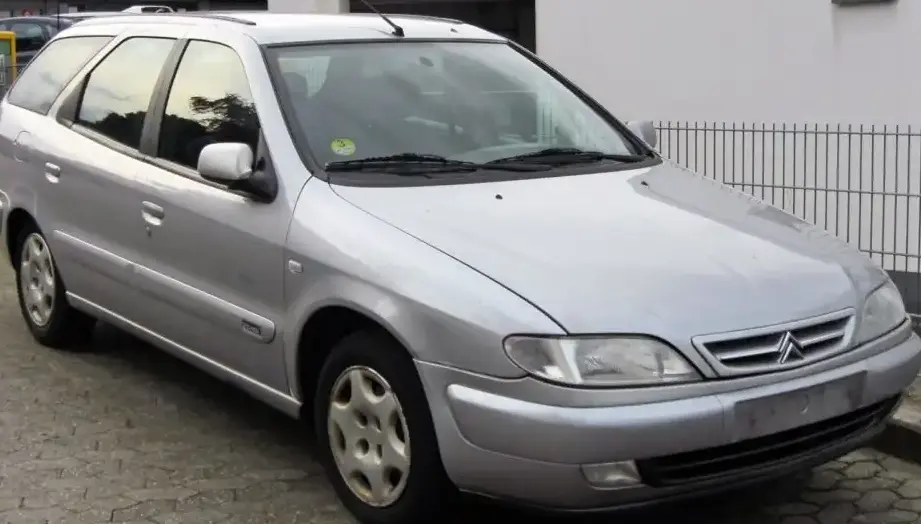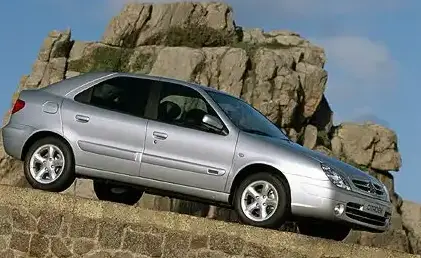
The Citroën Xsara 2.0 HDi Automatic, produced between February 2003 and 2004, represents a mid-cycle refinement of the N1 series Xsara. This variant occupied a position in the upper-mid range of the Xsara lineup, offering a blend of fuel efficiency and reasonable performance through its diesel powertrain and convenience of an automatic transmission. It was primarily marketed in Europe, where compact hatchbacks with diesel engines were highly popular due to fuel costs and driving conditions. The Phase III update brought subtle styling changes and improvements to interior trim and equipment levels compared to earlier Xsara models.
Technical Specifications
| Brand | Citroen |
| Model | Xsara |
| Generation | Xsara (N1, Phase III) |
| Type (Engine) | 2.0 HDi (109 Hp) Automatic |
| Start of production | February, 2003 |
| End of production | 2004 |
| Powertrain Architecture | Internal Combustion engine |
| Body type | Hatchback |
| Seats | 5 |
| Doors | 5 |
| Fuel consumption (urban) | 8.1 l/100 km (29 US mpg, 34.9 UK mpg, 12.3 km/l) |
| Fuel consumption (extra urban) | 4.5 l/100 km (52.3 US mpg, 62.8 UK mpg, 22.2 km/l) |
| Fuel consumption (combined) | 5.8 l/100 km (40.6 US mpg, 48.7 UK mpg, 17.2 km/l) |
| CO2 emissions | 154 g/km |
| Fuel Type | Diesel |
| Acceleration 0 – 100 km/h | 12.4 sec |
| Acceleration 0 – 62 mph | 12.4 sec |
| Acceleration 0 – 60 mph | 11.8 sec |
| Maximum speed | 190 km/h (118.06 mph) |
| Emission standard | Euro 3 |
| Weight-to-power ratio | 11.4 kg/Hp, 87.4 Hp/tonne |
| Weight-to-torque ratio | 5 kg/Nm, 200.5 Nm/tonne |
| Power | 109 Hp @ 4000 rpm |
| Power per litre | 54.6 Hp/l |
| Torque | 250 Nm @ 1750 rpm (184.39 lb.-ft. @ 1750 rpm) |
| Engine layout | Front, Transverse |
| Engine Model/Code | RHZ DW10ATED |
| Engine displacement | 1997 cm3 (121.86 cu. in.) |
| Number of cylinders | 4 |
| Engine configuration | Inline |
| Cylinder Bore | 85 mm (3.35 in.) |
| Piston Stroke | 88 mm (3.46 in.) |
| Compression ratio | 18:1 |
| Number of valves per cylinder | 2 |
| Fuel injection system | Diesel Commonrail |
| Engine aspiration | Turbocharger, Intercooler |
| Valvetrain | OHC |
| Engine oil capacity | 4.2 l (4.44 US qt | 3.7 UK qt) |
| Coolant | 5.8 l (6.13 US qt | 5.1 UK qt) |
| Kerb Weight | 1247 kg (2749.16 lbs.) |
| Max. weight | 1810 kg (3990.37 lbs.) |
| Max load | 563 kg (1241.2 lbs.) |
| Trunk (boot) space – minimum | 408 l (14.41 cu. ft.) |
| Trunk (boot) space – maximum | 1190 l (42.02 cu. ft.) |
| Fuel tank capacity | 54 l (14.27 US gal | 11.88 UK gal) |
| Max. roof load | 75 kg (165.35 lbs.) |
| Permitted trailer load with brakes (12%) | 1100 kg (2425.08 lbs.) |
| Permitted trailer load without brakes | 625 kg (1377.89 lbs.) |
| Permitted towbar download | 70 kg (154.32 lbs.) |
| Length | 4188 mm (164.88 in.) |
| Width | 1705 mm (67.13 in.) |
| Width including mirrors | 2014 mm (79.29 in.) |
| Height | 1405 mm (55.31 in.) |
| Wheelbase | 2540 mm (100 in.) |
| Front track | 1433 mm (56.42 in.) |
| Rear (Back) track | 1442 mm (56.77 in.) |
| Front overhang | 880 mm (34.65 in.) |
| Rear overhang | 768 mm (30.24 in.) |
| Minimum turning circle | 11.5 m (37.73 ft.) |
| Drivetrain Architecture | The Internal combustion engine (ICE) drives the front wheels of the vehicle. |
| Drive wheel | Front wheel drive |
| Number of gears and type of gearbox | 4 gears, automatic transmission |
| Front suspension | Independent, type McPherson with coil spring and anti-roll bar |
| Rear suspension | Torsion |
| Front brakes | Ventilated discs |
| Rear brakes | Disc |
| Assisting systems | ABS (Anti-lock braking system) |
| Steering type | Steering rack and pinion |
| Power steering | Hydraulic Steering |
| Tires size | 195/55 R15 |
| Wheel rims size | 6J x 15 |
INTRODUCTION
The Citroën Xsara 2.0 HDi Automatic, part of the N1 series produced from 2003 to 2004, was a five-door hatchback designed to appeal to buyers seeking a practical and economical family car. Positioned within the broader Xsara range, which spanned various engine options and trim levels, the 2.0 HDi Automatic represented a step up in performance and refinement compared to the lower-capacity diesel and petrol variants. It was built on the PSA Group’s 1HX0/A3 platform, shared with the Peugeot 307, offering a comfortable ride and decent handling characteristics. This model aimed to provide a balance between fuel efficiency, adequate power for everyday driving, and the convenience of an automatic transmission.
Powertrain & Engine Architecture
At the heart of the Xsara 2.0 HDi Automatic lies the DW10ATED engine, a 1997cc four-cylinder diesel engine. This engine, designated with the code RHZ, is a common-rail direct injection diesel, meaning fuel is injected directly into the cylinders at very high pressure via a common rail system. This system allows for precise control of fuel delivery, optimizing combustion and reducing emissions. The engine features an overhead camshaft (OHC) valvetrain with two valves per cylinder. A turbocharger with an intercooler is employed to increase power output by forcing more air into the cylinders. The automatic transmission is a four-speed unit, designed to provide smooth gear changes and ease of driving, particularly in urban environments. While not known for its sportiness, the transmission was reliable and well-suited to the engine’s torque characteristics.
Driving Characteristics
The 2.0 HDi Automatic Xsara offered a comfortable, if not particularly exhilarating, driving experience. The 109 horsepower and 250 Nm (184 lb-ft) of torque provided adequate acceleration for most driving situations, with a 0-60 mph time of around 11.8 seconds. The automatic transmission, while convenient, did slightly diminish the engine’s responsiveness compared to the manual versions. Gear ratios were optimized for fuel efficiency and relaxed cruising, rather than outright performance. The turbocharger provided a noticeable boost in power at lower engine speeds, making overtaking on highways relatively easy. However, the automatic transmission could sometimes feel hesitant when downshifting for quicker acceleration. Overall, the driving experience was geared towards practicality and comfort.
Equipment & Trim Levels
The 2.0 HDi Automatic trim typically included features such as air conditioning, power steering, electric front windows, and a basic audio system. Higher-spec versions could be equipped with options like alloy wheels, rear parking sensors, and upgraded interior trim. Interior upholstery was generally cloth, with a functional and durable design. The dashboard layout was typical of Citroëns of the era, with a focus on ergonomics and ease of use. Optional extras often included a sunroof, upgraded audio systems with CD changers, and metallic paint finishes. Safety features included ABS brakes and driver and passenger airbags.
Chassis & Braking
The Xsara 2.0 HDi Automatic utilized an independent McPherson strut suspension system at the front, providing a comfortable ride and decent handling. The rear suspension employed a torsion beam setup, which was cost-effective and provided adequate stability. Braking duties were handled by ventilated discs at the front and solid discs at the rear. The ABS (Anti-lock Braking System) was standard, enhancing braking performance and safety. The steering was a hydraulic power-assisted rack and pinion system, offering a reasonable level of feedback and precision.
Market Reception & Comparison
The Citroën Xsara 2.0 HDi Automatic was generally well-received by automotive critics as a practical and economical family car. It was praised for its fuel efficiency, comfortable ride, and spacious interior. However, some reviewers noted that the automatic transmission could feel sluggish at times, and the overall driving experience lacked the dynamism of some of its competitors. Compared to the 1.8-liter petrol versions, the 2.0 HDi offered significantly better fuel economy and more torque, making it a more suitable choice for long-distance driving. Against other diesel hatchbacks like the Volkswagen Golf TDI and Ford Focus TDCi, the Xsara offered a competitive package in terms of price and features.
Legacy
The DW10ATED engine, found in the Xsara 2.0 HDi Automatic, proved to be a relatively reliable unit when properly maintained. Common issues included occasional turbocharger problems and potential issues with the diesel particulate filter (DPF) in later models. The automatic transmission, while not known for being particularly sophisticated, was generally durable. Today, the Xsara 2.0 HDi Automatic represents an affordable and practical option in the used car market. Its fuel efficiency and relatively low running costs make it an attractive choice for budget-conscious buyers. However, potential buyers should be aware of the age-related issues common to older vehicles and ensure that the car has been well-maintained.