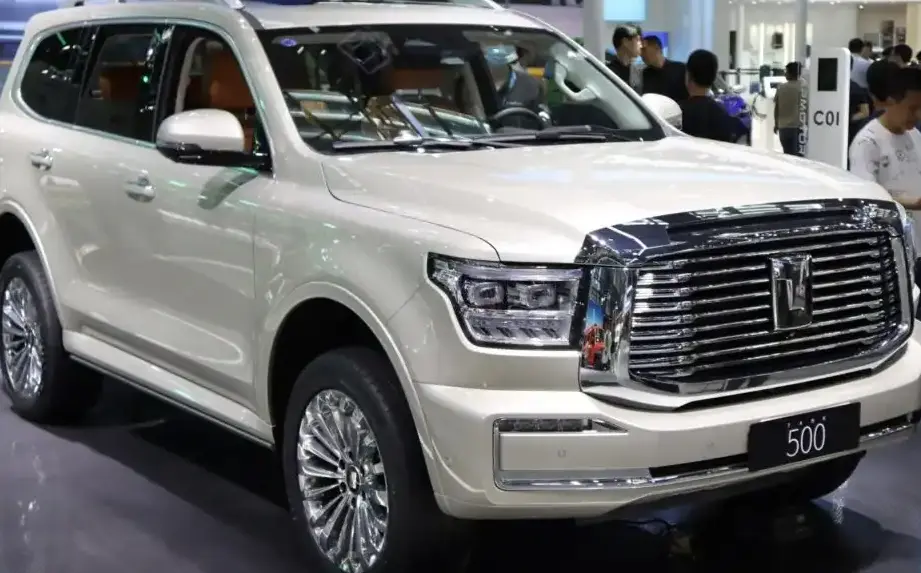
The Tank 500 Hi4-T 2.0T 37.1 kWh (422 Hp) Plug-in Hybrid 4WD Automatic, introduced in August 2025, represents a significant step in the Tank brand’s expansion into the increasingly competitive plug-in hybrid SUV market. As a facelift of the original 500 model, this variant builds upon the established rugged aesthetic and off-road capability of the Tank 500 while incorporating advanced hybrid technology. Positioned as a premium offering within the 500 lineup, it aims to appeal to buyers seeking a blend of performance, efficiency, and all-terrain prowess. The vehicle is based on a body-on-frame construction, a hallmark of Tank’s design philosophy, and is intended primarily for the Chinese domestic market, though export potential is being explored.
Technical Specifications
| Brand | Tank |
| Model | 500 |
| Generation | 500 (facelift 2025) |
| Type (Engine) | Hi4-T 2.0T 37.1 kWh (422 Hp) Plug-in Hybrid 4WD Automatic |
| Start of production | August, 2025 |
| Powertrain Architecture | PHEV (Plug-in Hybrid Electric Vehicle) |
| Body type | SUV |
| Seats | 5 |
| Doors | 5 |
| Fuel consumption (economy) – combined (WLTC) | 2.06-8.8 l/100 km (114.2 – 26.7 US mpg, 137.1 – 32.1 UK mpg, 48.5 – 11.4 km/l) |
| Fuel Type | Petrol / electricity |
| Acceleration 0 – 100 km/h | 6.9 sec |
| Acceleration 0 – 62 mph | 6.9 sec |
| Acceleration 0 – 60 mph | 6.6 sec |
| Maximum speed | 180 km/h (111.85 mph) |
| Weight-to-power ratio | 6.7 kg/Hp, 149.1 Hp/tonne |
| Weight-to-torque ratio | 3.8 kg/Nm, 265 Nm/tonne |
| Gross battery capacity | 37.1 kWh |
| Battery voltage | 325.6 V |
| Battery technology | Lithium nickel manganese cobalt oxides (Li-NMC) |
| Battery location | Under the rear seats, Under the trunk |
| All-electric range (WLTC) | 110 km (68.35 mi) |
| Average Energy consumption (WLTC) | 24.5 kWh/100 km (39.43 kWh/100 mi, 85 MPGe, 4.1 km/kWh, 2.5 mi/kWh) |
| Electric motor power | 177 Hp |
| Electric motor Torque | 495 Nm (365.09 lb.-ft.) |
| Electric motor model/code | TZ290XH007 |
| Maximum revolutions of the electric motor | 7000 rpm |
| Electric motor location | Between the combustion engine and the transmission |
| Electric motor type | Synchronous |
| System power | 422 Hp |
| System torque | 750 Nm (553.17 lb.-ft.) |
| Power | 252 Hp @ 6000 rpm |
| Torque | 385 Nm @ 1700-4000 rpm (283.96 lb.-ft. @ 1700-4000 rpm) |
| Engine layout | Front, Longitudinal |
| Engine Model/Code | E20NB |
| Engine displacement | 1998 cm3 (121.93 cu. in.) |
| Number of cylinders | 4 |
| Engine configuration | Inline |
| Cylinder Bore | 82 mm (3.23 in.) |
| Piston Stroke | 94.6 mm (3.72 in.) |
| Number of valves per cylinder | 4 |
| Fuel injection system | Direct injection |
| Engine aspiration | Turbocharger, Intercooler |
| Valvetrain | DOHC |
| Engine oil capacity | 5.9 l (6.23 US qt | 5.19 UK qt) |
| Coolant | 10.1 l (10.67 US qt | 8.89 UK qt) |
| Kerb Weight | 2830 kg (6239.08 lbs.) |
| Max. weight | 3330 kg (7341.39 lbs.) |
| Max load | 500 kg (1102.31 lbs.) |
| Trunk (boot) space – maximum | 1400 l (49.44 cu. ft.) |
| Fuel tank capacity | 70 l (18.49 US gal | 15.4 UK gal) |
| Permitted trailer load with brakes (12%) | 2500 kg (5511.56 lbs.) |
| Length | 5078 mm (199.92 in.) |
| Width | 1934 mm (76.14 in.) |
| Height | 1905 mm (75 in.) |
| Wheelbase | 2850 mm (112.2 in.) |
| Front track | 1635 mm (64.37 in.) |
| Rear (Back) track | 1635 mm (64.37 in.) |
| Ride height (ground clearance) | 213 mm (8.39 in.) |
| Approach angle | 30° |
| Departure angle | 24° |
| Climb angle | 36.9° |
| Drivetrain Architecture | The Internal combustion engine (ICE) and the electric motor permanently drive the rear wheels of the vehicle, capable of running in full electric or mixed mode, and if necessary through the electrically or mechanically controlled clutch, the front wheels are driven. |
| Drive wheel | All wheel drive (4×4) |
| Number of gears and type of gearbox | 9 gears, automatic transmission |
| Front suspension | Double wishbone, Independent coil spring, Transverse stabilizer |
| Rear suspension | Rigid axle suspension, Transverse stabilizer, Coil spring |
| Front brakes | Ventilated discs |
| Rear brakes | Ventilated discs |
| Assisting systems | ABS (Anti-lock braking system) |
| Steering type | Steering rack and pinion |
| Power steering | Electric Steering |
| Tires size | 265/60 R18; 265/55 R19; 265/50 R20 |
| Wheel rims size | 8J x 18; 8.5J x 19; 8.5J x 20 |
Powertrain & Engine Architecture
The Tank 500 Hi4-T 2.0T utilizes a sophisticated plug-in hybrid powertrain. The core of the system is the E20NB 2.0-liter turbocharged inline-four cylinder engine, producing 252 horsepower at 6000 rpm and 385 Nm (283.96 lb-ft) of torque between 1700-4000 rpm. This engine features direct fuel injection and a double overhead camshaft (DOHC) valvetrain. Paired with this is a 37.1 kWh lithium nickel manganese cobalt oxide (Li-NMC) battery pack, providing an all-electric range of 110 km (68.35 miles) according to WLTC standards. An electric motor, designated TZ290XH007, contributes an additional 177 horsepower and 495 Nm (365.09 lb-ft) of torque. The combined system output reaches 422 horsepower and 750 Nm (553.17 lb-ft) of torque. Power is delivered to all four wheels via a 9-speed automatic transmission. The drivetrain architecture allows for rear-wheel drive in electric mode, transitioning to all-wheel drive when the combustion engine engages or when additional traction is required.
Driving Characteristics
The 500 Hi4-T 2.0T offers a compelling driving experience, blending the responsiveness of electric power with the range and flexibility of a gasoline engine. In electric mode, the vehicle provides near-silent operation and brisk acceleration, particularly suited for urban driving. The 0-100 km/h (0-62 mph) acceleration time of 6.9 seconds is respectable for a vehicle of this size and weight. When the gasoline engine kicks in, the combined power output delivers strong performance, making it capable for highway overtaking and off-road excursions. The 9-speed automatic transmission is tuned for smooth shifts and efficient operation, although some drivers may find it less engaging than a manual gearbox. The weight of the battery pack does impact handling somewhat, but the robust suspension system helps to mitigate body roll.
Equipment & Trim Levels
The Tank 500 Hi4-T 2.0T typically comes well-equipped, reflecting its premium positioning. Standard features generally include leather upholstery, a large touchscreen infotainment system with smartphone integration, advanced driver-assistance systems (ADAS) such as adaptive cruise control and lane-keeping assist, and a panoramic sunroof. Optional extras may include upgraded audio systems, ventilated and heated seats, and more sophisticated off-road features like a locking rear differential and terrain management system. Interior trim levels vary, with higher trims offering more luxurious materials and finishes.
Chassis & Braking
The Tank 500 utilizes a body-on-frame construction, providing a robust and durable platform for off-road driving. The front suspension features a double wishbone setup with independent coil springs and a transverse stabilizer bar, while the rear employs a rigid axle suspension with coil springs and a transverse stabilizer bar. This configuration balances ride comfort with off-road capability. Braking duties are handled by ventilated discs on all four wheels, coupled with an anti-lock braking system (ABS) for enhanced safety. The electric power steering provides precise and responsive control.
Market Reception & Comparison
The Tank 500 Hi4-T 2.0T has been generally well-received in the Chinese market, where it competes with other plug-in hybrid SUVs. Critics have praised its combination of performance, efficiency, and off-road capability. Fuel economy figures range from 2.06-8.8 l/100 km, depending on driving conditions and battery charge level. Compared to the standard gasoline-powered Tank 500 variants, the plug-in hybrid offers significantly improved fuel efficiency and the ability to drive in all-electric mode. However, it also carries a higher price tag and a slightly increased curb weight.
Legacy
The Tank 500 Hi4-T 2.0T represents a significant step forward for the Tank brand, demonstrating its commitment to electrification and advanced technology. The long-term reliability of the powertrain remains to be seen, but the use of proven components and a robust hybrid system suggests a durable and dependable platform. As the plug-in hybrid market continues to grow, the 500 Hi4-T 2.0T is poised to become a popular choice for buyers seeking a versatile and capable SUV.