
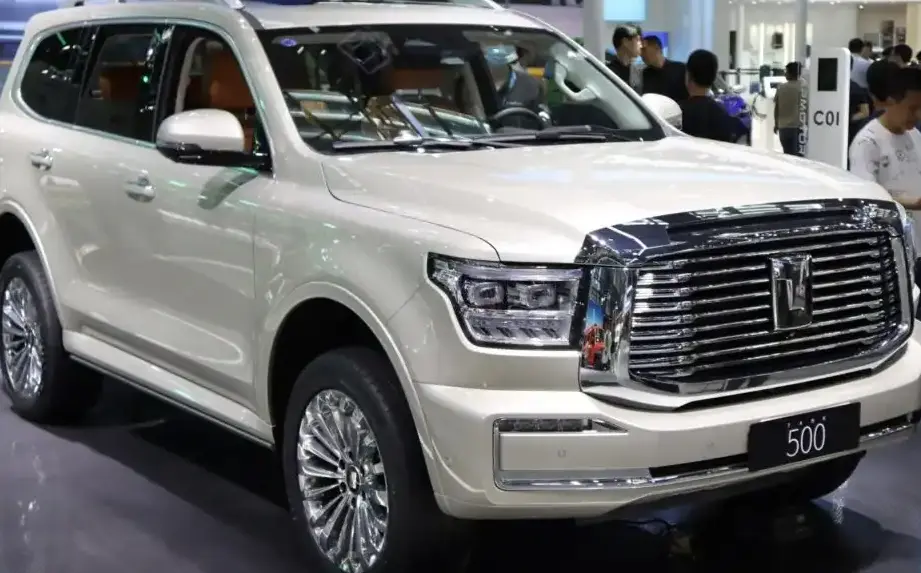
The Tank 500 Hi4-T 2.0T, a plug-in hybrid (PHEV) variant of the Tank 500 SUV, entered production in June 2023 and continued through March 2024. Positioned as a premium offering within the 500 lineup, it combines a 2.0-liter turbocharged gasoline engine with an electric motor and a substantial 37.1 kWh battery pack, delivering a combined system output of 408 horsepower. This model represents Tank’s entry into the growing PHEV market, targeting buyers seeking a blend of off-road capability, luxury, and reduced emissions. The Tank brand, launched by Great Wall Motors, aims to establish itself as a dedicated off-road SUV manufacturer, and the 500 series is its flagship model.
Technical Specifications
| Brand | Tank |
| Model | 500 |
| Generation | 500 |
| Type (Engine) | Hi4-T 2.0T 37.1 kWh (408 Hp) Plug-in Hybrid 4WD Automatic |
| Start of production | June, 2023 |
| End of production | March, 2024 |
| Powertrain Architecture | PHEV (Plug-in Hybrid Electric Vehicle) |
| Body type | SUV |
| Seats | 5 |
| Doors | 5 |
| Fuel consumption (economy) – combined (WLTC) | 2.2-9.55 l/100 km (106.9 – 24.6 US mpg, 128.4 – 29.6 UK mpg, 45.5 – 10.5 km/l) |
| Fuel Type | Petrol / electricity |
| Acceleration 0 – 100 km/h | 6.9 sec |
| Acceleration 0 – 62 mph | 6.9 sec |
| Acceleration 0 – 60 mph | 6.6 sec |
| Maximum speed | 180 km/h (111.85 mph) |
| Weight-to-power ratio | 6.9 kg/Hp, 145.2 Hp/tonne |
| Weight-to-torque ratio | 3.7 kg/Nm, 266.9 Nm/tonne |
| Gross battery capacity | 37.1 kWh |
| Battery voltage | 325.6 V |
| Battery technology | Lithium nickel manganese cobalt oxides (Li-NMC) |
| Battery location | Under the rear seats, Under the trunk |
| All-electric range | 110-120 km (68.35 – 74.56 mi) |
| Average Energy consumption | 25.7 kWh/100 km (41.36 kWh/100 mi, 81 MPGe, 3.9 km/kWh, 2.4 mi/kWh) |
| Electric motor power | 163 Hp |
| Electric motor Torque | 400 Nm (295.02 lb.-ft.) |
| Electric motor model/code | TZ290XH001 |
| Maximum revolutions of the electric motor | 7000 rpm |
| Electric motor location | Between the combustion engine and the transmission |
| Electric motor type | Synchronous |
| System power | 408 Hp |
| System torque | 750 Nm (553.17 lb.-ft.) |
| Power | 252 Hp @ 5500-6000 rpm |
| Power per litre | 126.1 Hp/l |
| Torque | 385 Nm @ 1700-4000 rpm (283.96 lb.-ft. @ 1700-4000 rpm) |
| Engine layout | Front, Longitudinal |
| Engine Model/Code | E20NA |
| Engine displacement | 1998 cm3 (121.93 cu. in.) |
| Number of cylinders | 4 |
| Engine configuration | Inline |
| Cylinder Bore | 82 mm (3.23 in.) |
| Piston Stroke | 94.6 mm (3.72 in.) |
| Number of valves per cylinder | 4 |
| Fuel injection system | Direct injection |
| Engine aspiration | Turbocharger, Intercooler |
| Valvetrain | DOHC |
| Engine oil capacity | 5.9 l (6.23 US qt | 5.19 UK qt) |
| Coolant | 10.2 l (10.78 US qt | 8.97 UK qt) |
| Kerb Weight | 2810 kg (6194.99 lbs.) |
| Max. weight | 3310 kg (7297.3 lbs.) |
| Max load | 500 kg (1102.31 lbs.) |
| Fuel tank capacity | 70 l (18.49 US gal | 15.4 UK gal) |
| Permitted trailer load with brakes (12%) | 2500 kg (5511.56 lbs.) |
| Length | 5078 mm (199.92 in.) |
| Width | 1934 mm (76.14 in.) |
| Height | 1905 mm (75 in.) |
| Wheelbase | 2850 mm (112.2 in.) |
| Front track | 1635 mm (64.37 in.) |
| Rear (Back) track | 1635 mm (64.37 in.) |
| Ride height (ground clearance) | 213 mm (8.39 in.) |
| Approach angle | 29.5° |
| Departure angle | 24° |
| Ramp-over (brakeover) angle | 20° |
| Climb angle | 37° |
| Drivetrain Architecture | The Internal combustion engine (ICE) and the electric motor permanently drive the rear wheels of the vehicle, capable of running in full electric or mixed mode, and if necessary through the electrically or mechanically controlled clutch, the front wheels are driven. |
| Drive wheel | All wheel drive (4×4) |
| Number of gears and type of gearbox | 9 gears, automatic transmission |
| Front suspension | Double wishbone, Independent coil spring, Transverse stabilizer |
| Rear suspension | Rigid axle suspension, Transverse stabilizer, Coil spring |
| Front brakes | Ventilated discs |
| Rear brakes | Ventilated discs |
| Assisting systems | ABS (Anti-lock braking system) |
| Steering type | Steering rack and pinion |
| Power steering | Electric Steering |
| Tires size | 265/55 R19; 265/50 R20 |
| Wheel rims size | 8.5J x 19; 8.5J x 20 |
Powertrain & Engine Architecture
The Tank 500 Hi4-T 2.0T utilizes a sophisticated plug-in hybrid powertrain. The core of the system is the E20NA 2.0-liter inline-four cylinder turbocharged engine. This engine employs direct fuel injection and a double overhead camshaft (DOHC) valvetrain to optimize combustion efficiency and power output. The turbocharger, coupled with an intercooler, enhances performance by increasing air intake density. The engine produces 252 horsepower at 5500-6000 rpm and 385 Nm (283.96 lb-ft) of torque between 1700-4000 rpm. Complementing the gasoline engine is a 163 horsepower electric motor (TZ290XH001), powered by a 37.1 kWh lithium nickel manganese cobalt oxide (Li-NMC) battery pack. The battery is strategically located under the rear seats and in the trunk to optimize space utilization and maintain a low center of gravity. The electric motor is a synchronous type, capable of reaching 7000 rpm. The combined system output reaches 408 horsepower and 750 Nm (553.17 lb-ft) of torque. Power is delivered to all four wheels via a 9-speed automatic transmission, allowing for smooth and efficient gear changes. The drivetrain architecture allows for rear-wheel drive in electric mode, and seamlessly engages the front wheels when needed for enhanced traction.
Driving Characteristics
The Tank 500 Hi4-T 2.0T offers a unique driving experience, blending the responsiveness of an electric motor with the range and power of a gasoline engine. In electric-only mode, the vehicle provides quiet and emission-free operation, suitable for urban driving and short commutes. The 110-120 km (68-75 miles) all-electric range allows for significant daily driving without relying on the gasoline engine. When the gasoline engine engages, the combined power output delivers brisk acceleration, achieving 0-100 km/h (0-62 mph) in 6.9 seconds. The 9-speed automatic transmission is tuned for both efficiency and performance, providing smooth shifts and optimal gear selection. Compared to lower-powered Tank 500 variants, the Hi4-T offers significantly enhanced acceleration and overall performance. While not as raw or focused as a dedicated performance SUV, the Hi4-T provides a comfortable and capable driving experience, particularly on and off-road.
Equipment & Trim Levels
The Hi4-T trim level of the Tank 500 typically comes well-equipped with standard features focused on comfort, convenience, and technology. Interior appointments include premium leather upholstery, heated and ventilated front seats, and a large touchscreen infotainment system with navigation and smartphone integration. Standard safety features include a comprehensive suite of driver-assistance systems, such as adaptive cruise control, lane-keeping assist, automatic emergency braking, and blind-spot monitoring. Optional extras may include a panoramic sunroof, upgraded audio system, and advanced off-road features like a locking rear differential and enhanced terrain management system. The overall interior design emphasizes a luxurious and rugged aesthetic, reflecting the Tank brand’s focus on off-road capability and premium comfort.
Chassis & Braking
The Tank 500 Hi4-T features a robust chassis designed to handle both on-road and off-road conditions. The front suspension utilizes a double wishbone configuration with independent coil springs and a transverse stabilizer bar, providing a comfortable ride and precise handling. The rear suspension employs a rigid axle setup with coil springs and a transverse stabilizer bar, enhancing stability and load-carrying capacity. The braking system consists of ventilated discs on all four wheels, providing ample stopping power. An anti-lock braking system (ABS) is standard, enhancing safety and control during emergency braking situations. The vehicle’s electric power steering system offers precise and responsive steering feel. The Tank 500 Hi4-T rides on 19 or 20-inch alloy wheels, fitted with 265/55 R19 or 265/50 R20 tires, respectively.
Market Reception & Comparison
The Tank 500 Hi4-T has been generally well-received in the Chinese market, where it has gained popularity among buyers seeking a capable and luxurious off-road SUV with plug-in hybrid technology. Critics have praised the vehicle’s powerful powertrain, comfortable ride, and comprehensive feature set. Fuel economy is a significant advantage of the Hi4-T, with combined consumption ranging from 2.2-9.55 l/100 km. Compared to the standard gasoline-powered Tank 500 variants, the Hi4-T offers improved fuel efficiency and reduced emissions. However, the Hi4-T’s higher price point may be a deterrent for some buyers. Compared to other PHEV SUVs in its class, the Tank 500 Hi4-T stands out with its rugged design, off-road capability, and spacious interior.
Legacy
The Tank 500 Hi4-T represents a significant step for the Tank brand, demonstrating its commitment to innovation and sustainable mobility. The powertrain, while relatively new, is expected to offer good long-term reliability, given the proven technology used in both the gasoline engine and electric motor components. The large battery pack and sophisticated hybrid system may require specialized maintenance, but the overall design is intended for durability. As the Tank brand expands into international markets, the Hi4-T is likely to become a key model, appealing to buyers seeking a unique and capable plug-in hybrid SUV. Its success will depend on Tank’s ability to establish a strong brand reputation and provide a comprehensive service network.

