
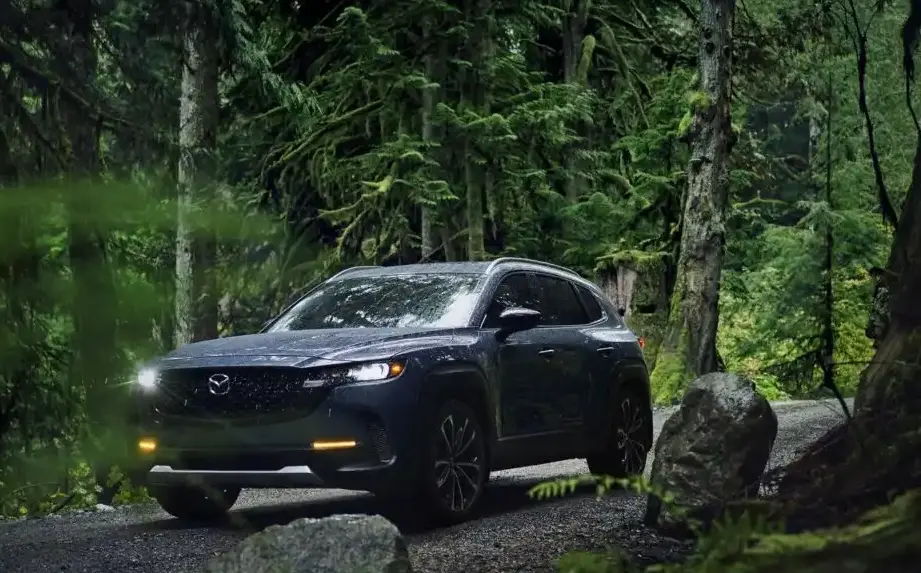
The Mazda CX-50 2.5 Hybrid eAWD eCVT, introduced in July 2024, represents Mazda’s entry into the compact SUV segment with a focus on both on-road refinement and off-pavement capability. Positioned as a more rugged alternative to the CX-5, the CX-50 utilizes Mazda’s latest hybrid technology to deliver improved fuel efficiency without sacrificing the driving experience Mazda is known for. This particular variant, combining a 2.5-liter inline-four engine with a hybrid system and an eCVT transmission, occupies a mid-range position within the CX-50 lineup, offering a balance between performance, economy, and features. It’s designed to appeal to buyers seeking a versatile vehicle for both daily commuting and weekend adventures.
Technical Specifications
| Brand | Mazda |
| Model | CX-50 |
| Generation | CX-50 |
| Type (Engine) | 2.5 (219 Hp) Hybrid eAWD eCVT |
| Start of production | July, 2024 |
| Powertrain Architecture | FHEV (Full Hybrid Electric Vehicle) |
| Body type | SUV |
| Seats | 5 |
| Doors | 5 |
| Fuel consumption (economy) – urban (EPA) | 6 l/100 km (39.2 US mpg, 47.1 UK mpg, 16.7 km/l) |
| Fuel consumption (economy) – extra urban (EPA) | 6.4 l/100 km (36.8 US mpg, 44.1 UK mpg, 15.6 km/l) |
| Fuel consumption (economy) – combined (EPA) | 6.2 l/100 km (37.9 US mpg, 45.6 UK mpg, 16.1 km/l) |
| Fuel Type | Petrol (Gasoline) |
| Maximum speed | 180 km/h (111.85 mph) |
| Emission standard | LEV3 SULEV30 |
| Weight-to-power ratio | 8.3 kg/Hp (120.5 Hp/tonne) |
| Weight-to-torque ratio | 8.2 kg/Nm (121.6 Nm/tonne) |
| Gross battery capacity | 1.59 kWh |
| Battery voltage | 244.8 V |
| Battery technology | Nickel-metal hydride (NiMH) |
| Battery weight | 47 kg (103.62 lbs.) |
| Electric motor power (1) | 118 Hp |
| Electric motor Torque (1) | 274 Nm (202.09 lb.-ft.) |
| Maximum revolutions of the electric motor (1) | 7000 rpm |
| Electric motor location (1) | Integrated into the transmission |
| Electric motor type (1) | Synchronous |
| Electric motor power (2) | 54 Hp |
| Electric motor Torque (2) | 164 Nm (120.96 lb.-ft.) |
| Maximum revolutions of the electric motor (2) | 7000 rpm |
| Electric motor location (2) | Rear axle, Transverse |
| Electric motor type (2) | Synchronous |
| System power | 219 Hp |
| Power | 176 Hp @ 5700 rpm |
| Power per litre | 70.8 Hp/l |
| Torque | 221 Nm @ 3600-5200 rpm (163 lb.-ft. @ 3600-5200 rpm) |
| Maximum engine speed | 5700 rpm |
| Engine layout | Front, Transverse |
| Engine Model/Code | Dynamic Force |
| Engine displacement | 2487 cm3 (151.77 cu. in.) |
| Number of cylinders | 4 |
| Engine configuration | Inline |
| Cylinder Bore | 87.5 mm (3.44 in.) |
| Piston Stroke | 103.4 mm (4.07 in.) |
| Compression ratio | 14:1 |
| Number of valves per cylinder | 4 |
| Fuel injection system | Direct injection and Multi-port manifold injection |
| Engine aspiration | Naturally aspirated engine |
| Valvetrain | DOHC |
| Kerb Weight | 1818 kg (4008 lbs.) |
| Max. weight | 2329 kg (5134.57 lbs.) |
| Max load | 511 kg (1126.56 lbs.) |
| Trunk (boot) space – minimum | 826 l (29.17 cu. ft.) |
| Fuel tank capacity | 55 l (14.53 US gal | 12.1 UK gal) |
| Permitted trailer load with brakes (12%) | 680 kg (1499.14 lbs.) |
| Length | 4726 mm (186.06 in.) |
| Width | 1920 mm (75.59 in.) |
| Width including mirrors | 2052 mm (80.79 in.) |
| Height | 1648-1671 mm (64.88 – 65.79 in.) |
| Wheelbase | 2815 mm (110.83 in.) |
| Front overhang | 960 mm (37.8 in.) |
| Rear overhang | 950 mm (37.4 in.) |
| Ride height (ground clearance) | 193 mm (7.6 in.) |
| Minimum turning circle (turning diameter) | 11.8 m (38.71 ft.) |
| Approach angle | 17.4-18° |
| Departure angle | 22.6-23° |
| Drivetrain Architecture | An Internal combustion engine (ICE) drives the front wheels, one electric motor drives the front wheels, one electric motor drives the rear wheels. There is an ability for running in full electric or mixed mode. |
| Drive wheel | All wheel drive (4×4) |
| Number of gears and type of gearbox | automatic transmission eCVT |
| Front suspension | Independent, type McPherson with coil spring and anti-roll bar |
| Rear suspension | Torsion |
| Front brakes | Ventilated discs, 326 mm |
| Rear brakes | Disc, 325 mm |
| Assisting systems | ABS (Anti-lock braking system) |
| Steering type | Steering rack and pinion |
| Power steering | Electric Steering |
| Tires size | 225/65 R17; 225/55 R19 |
| Wheel rims size | 7J x 17; 7.5J x 19 |
Powertrain & Engine Architecture
The CX-50 2.5 Hybrid utilizes Mazda’s Dynamic Force engine, a 2.5-liter inline-four cylinder gasoline engine. This engine, designated as part of Mazda’s Skyactiv technology, features high compression (14:1) and direct injection, contributing to improved thermal efficiency. The engine produces 176 horsepower at 5700 rpm and 221 Nm (163 lb-ft) of torque between 3600 and 5200 rpm. The hybrid system adds two electric motors – one integrated with the front wheels and another driving the rear axle – boosting the total system output to 219 horsepower. The front motor delivers 118 hp and 274 Nm of torque, while the rear motor contributes 54 hp and 164 Nm. The eCVT (electronically controlled continuously variable transmission) manages power delivery, prioritizing fuel efficiency and smooth acceleration. Unlike traditional CVTs, Mazda’s eCVT is designed to mimic the feel of a conventional automatic transmission, reducing the “rubber band” effect often associated with CVTs. The Nickel-metal hydride (NiMH) battery pack has a gross capacity of 1.59 kWh and is positioned under the rear seats.
Driving Characteristics
The 2.5-liter Hybrid eAWD eCVT offers a noticeably different driving experience compared to the gasoline-only CX-50 models. The electric motors provide instant torque, resulting in brisk acceleration from a standstill. While not as overtly sporty as the turbocharged variants, the hybrid powertrain delivers adequate power for everyday driving and highway merging. The eCVT transmission operates smoothly, and Mazda’s programming minimizes the droning sensation often found in CVTs. The all-wheel-drive system provides confident traction in various weather conditions. Fuel economy is a key strength of this variant, achieving an EPA-estimated 37.9 US mpg combined, making it one of the most fuel-efficient options in the CX-50 lineup. However, the added weight of the hybrid components does slightly impact handling agility compared to lighter CX-50 trims.
Equipment & Trim Levels
The CX-50 2.5 Hybrid eAWD eCVT typically comes well-equipped with standard features including Mazda’s i-Activsense safety suite (including adaptive cruise control, lane departure warning, and automatic emergency braking), a 10.25-inch infotainment display with Apple CarPlay and Android Auto integration, and a premium sound system. Interior upholstery is typically cloth or synthetic leather, depending on the specific package. Available options include a power moonroof, heated front seats, a Bose premium audio system, and leather upholstery. Trim levels often build upon the base model with additional convenience and aesthetic features.
Chassis & Braking
The CX-50 utilizes a MacPherson strut front suspension and a torsion beam rear suspension. This setup provides a comfortable ride quality while maintaining reasonable handling characteristics. The chassis is designed to be rigid, enhancing stability and responsiveness. Braking duties are handled by ventilated discs at the front and solid discs at the rear. The anti-lock braking system (ABS) and electronic stability control (ESC) are standard features, enhancing safety and control. The suspension tuning is geared towards providing a balance between on-road comfort and off-road capability.
Market Reception & Comparison
The Mazda CX-50 2.5 Hybrid has been generally well-received by automotive critics, praised for its fuel efficiency, comfortable ride, and stylish design. Compared to the non-hybrid CX-50 2.5, the hybrid variant offers significantly improved fuel economy, albeit with a slightly higher price tag. Compared to the turbocharged CX-50 models, the hybrid prioritizes efficiency over outright performance. Reliability reports are still emerging for this relatively new model, but Mazda has a strong reputation for building durable and dependable vehicles. The hybrid powertrain is expected to require similar maintenance to the gasoline-only models, with the addition of periodic inspections of the hybrid system components.
Legacy
The Mazda CX-50 2.5 Hybrid represents Mazda’s commitment to electrification and sustainable mobility. As hybrid technology continues to evolve, this variant is likely to become increasingly popular among buyers seeking a fuel-efficient and versatile SUV. The long-term reliability of the hybrid powertrain remains to be seen, but Mazda’s engineering expertise and quality control measures suggest that it will prove to be a durable and dependable option in the used car market. The CX-50 Hybrid’s blend of efficiency, style, and driving dynamics positions it as a compelling choice in the competitive compact SUV segment.
