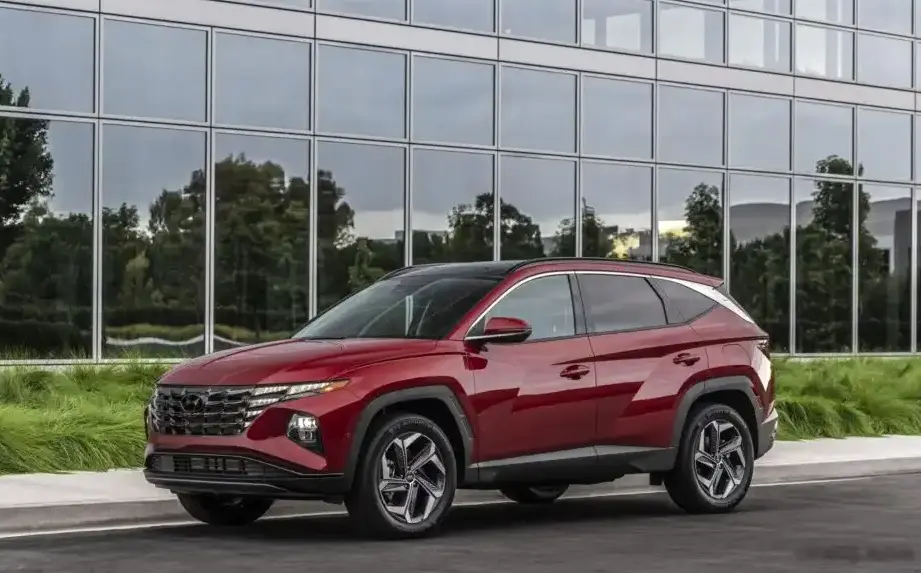
The Hyundai Tucson IV 1.6 Smartstream (261 Hp) Plug-in Hybrid HTRAC AWD Automatic, produced from November 2020 to March 2024, represents a significant step in Hyundai’s commitment to electrified powertrains and all-wheel-drive capability within the popular Tucson compact SUV range. This variant occupied a premium position within the fourth-generation Tucson (NX4) lineup, offering a blend of performance, efficiency, and advanced technology. It was primarily marketed towards consumers seeking a practical, family-oriented SUV with reduced emissions and the flexibility of both electric and gasoline power. The Tucson IV platform (codenamed NX4) was a major redesign, emphasizing bolder styling and a more spacious interior compared to its predecessor.
Technical Specifications
| Brand | Hyundai |
| Model | Tucson |
| Generation | Tucson IV |
| Type (Engine) | 1.6 Smartstream (261 Hp) Plug-in Hybrid HTRAC AWD Automatic |
| Start of production | November, 2020 |
| End of production | March, 2024 |
| Powertrain Architecture | PHEV (Plug-in Hybrid Electric Vehicle) |
| Body type | SUV |
| Seats | 5 |
| Doors | 5 |
| Fuel Type | Petrol / electricity |
| Gross battery capacity | 13.8 kWh |
| Battery voltage | 360 V |
| Battery technology | Lithium-polymer (LiPo) |
| Battery location | Below the floor, under the front seats |
| Electric motor power | 91 Hp @ 2100-3300 rpm |
| Electric motor Torque | 304 Nm @ 2100 rpm / 224.22 lb.-ft. @ 2100 rpm |
| Electric motor location | Between the combustion engine and the transmission |
| System power | 261 Hp |
| Power | 180 Hp @ 5500 rpm |
| Power per litre | 112.6 Hp/l |
| Torque | 264 Nm @ 1500-4500 rpm / 194.72 lb.-ft. @ 1500-4500 rpm |
| Engine layout | Front, Transverse |
| Engine Model/Code | G4FP |
| Engine displacement | 1598 cm3 / 97.52 cu. in. |
| Number of cylinders | 4 |
| Engine configuration | Inline |
| Cylinder Bore | 75.59 mm / 2.98 in. |
| Piston Stroke | 89 mm / 3.5 in. |
| Compression ratio | 10.5:1 |
| Number of valves per cylinder | 4 |
| Fuel injection system | Direct injection |
| Engine aspiration | Turbocharger, Intercooler |
| Valvetrain | DOHC, CVVD |
| Engine oil capacity | 4.8 l / 5.07 US qt | 4.22 UK qt |
| Coolant | 6.8 l / 7.19 US qt | 5.98 UK qt |
| Trunk (boot) space – minimum | 903 l / 31.89 cu. ft. |
| Trunk (boot) space – maximum | 1846 l / 65.19 cu. ft. |
| Fuel tank capacity | 42 l / 11.1 US gal | 9.24 UK gal |
| Max. roof load | 100 kg / 220.46 lbs. |
| Permitted trailer load with brakes (12%) | 907 kg / 1999.59 lbs. |
| Permitted trailer load without brakes | 748 kg / 1649.06 lbs. |
| Length | 4630 mm / 182.28 in. |
| Width | 1864 mm / 73.39 in. |
| Height | 1666 mm / 65.59 in. |
| Wheelbase | 2756 mm / 108.5 in. |
| Front track | 1615-1621 mm / 63.58 – 63.82 in. |
| Rear (Back) track | 1623-1628 mm / 63.9 – 64.09 in. |
| Front overhang | 894 mm / 35.2 in. |
| Rear overhang | 980 mm / 38.58 in. |
| Ride height (ground clearance) | 211 mm / 8.31 in. |
| Drag coefficient (Cd) | 0.33 |
| Drivetrain Architecture | The Internal combustion engine (ICE) and the electric motor permanently drive the front wheels of the vehicle, capable of running in full electric or mixed mode, and if necessary through the electrically or mechanically controlled clutch, the rear wheels are driven. |
| Drive wheel | All wheel drive (4×4) |
| Number of gears and type of gearbox | 6 gears, automatic transmission |
| Front suspension | Independent, type McPherson with coil spring and anti-roll bar |
| Rear suspension | Independent multi-link spring suspension with stabilizer |
| Front brakes | Ventilated discs, 325 mm |
| Rear brakes | Disc, 300 mm |
| Assisting systems | ABS (Anti-lock braking system) |
| Steering type | Steering rack and pinion |
| Power steering | Electric Steering |
| Wheel rims size | 17; 19 |
Powertrain & Engine Architecture
At the heart of the Tucson PHEV lies the Hyundai Smartstream 1.6-liter turbocharged four-cylinder gasoline engine (G4FP). This engine produces 180 horsepower and 264 Nm (194.72 lb-ft) of torque. It features direct injection, a cooled exhaust gas recirculation (EGR) system, and Hyundai’s Continuously Variable Valve Duration (CVVD) technology. CVVD optimizes valve timing based on driving conditions, improving both performance and fuel efficiency. The engine is paired with a 60 kW (91 hp) electric motor integrated between the engine and the six-speed automatic transmission. The combined system output reaches 261 horsepower. The 13.8 kWh lithium-polymer battery pack is positioned under the floor, minimizing impact on passenger space. The transmission itself is a conventional six-speed automatic, chosen for its robustness and smooth operation, rather than a continuously variable transmission (CVT) often found in hybrids.
Driving Characteristics
The 1.6L Plug-in Hybrid Tucson offers a refined driving experience. In electric-only mode, it can travel a significant distance (approximately 33 miles EPA estimated) before the gasoline engine kicks in. The transition between electric and gasoline power is generally seamless. The HTRAC all-wheel-drive system provides enhanced traction and stability, particularly in inclement weather. While not a sports SUV, the 261 hp combined output delivers adequate acceleration for everyday driving and highway merging. Compared to the standard 2.5L gasoline Tucson, the PHEV offers quicker initial acceleration due to the electric motor’s instant torque. However, the added weight of the battery pack does slightly impact overall agility. The six-speed automatic transmission provides smooth shifts, but isn’t as quick to downshift as some dual-clutch transmissions.
Equipment & Trim Levels
The 1.6 Smartstream Plug-in Hybrid was typically offered in well-equipped trims, often representing the higher end of the Tucson IV range. Standard features generally included leather upholstery, heated and ventilated front seats, a large touchscreen infotainment system with navigation, a premium sound system, and a suite of advanced driver-assistance systems (ADAS) such as adaptive cruise control, lane-keeping assist, and automatic emergency braking. Optional extras could include a panoramic sunroof, a digital instrument cluster, and a head-up display. The interior design emphasized a modern and minimalist aesthetic with high-quality materials.
Chassis & Braking
The Tucson IV utilizes a fully independent suspension system, with a McPherson strut setup at the front and a multi-link setup at the rear. This configuration provides a comfortable ride and good handling characteristics. Stabilizer bars are fitted to both axles to reduce body roll during cornering. Braking duties are handled by ventilated discs at the front and solid discs at the rear. The ABS (Anti-lock Braking System) is standard, along with electronic brake-force distribution (EBD) and brake assist. The HTRAC all-wheel-drive system actively distributes torque between the front and rear axles based on driving conditions, enhancing stability and traction.
Market Reception & Comparison
The Hyundai Tucson IV Plug-in Hybrid was generally well-received by automotive critics. It was praised for its fuel efficiency, comfortable ride, spacious interior, and comprehensive list of standard features. Compared to other plug-in hybrid SUVs in its class, such as the Toyota RAV4 Prime and Mitsubishi Outlander PHEV, the Tucson offered a competitive combination of price, performance, and features. Some reviewers noted that the infotainment system could be slightly complex to navigate, and the overall driving experience wasn’t as sporty as some rivals. Fuel economy was a strong point, with EPA ratings of around 80 MPGe (miles per gallon equivalent) in hybrid mode and 35 mpg on gasoline alone.
Legacy
The Hyundai Tucson IV 1.6 Smartstream Plug-in Hybrid HTRAC AWD Automatic represents a pivotal model in Hyundai’s transition towards electrification. The powertrain, while not without its complexities, has proven to be relatively reliable in early model years. The combination of a turbocharged engine, electric motor, and all-wheel drive provides a versatile and efficient driving experience. On the used car market, these models hold their value reasonably well, reflecting the growing demand for plug-in hybrid vehicles. The Smartstream engine family and HTRAC all-wheel-drive system continue to be utilized in subsequent Hyundai models, demonstrating the success of these technologies.