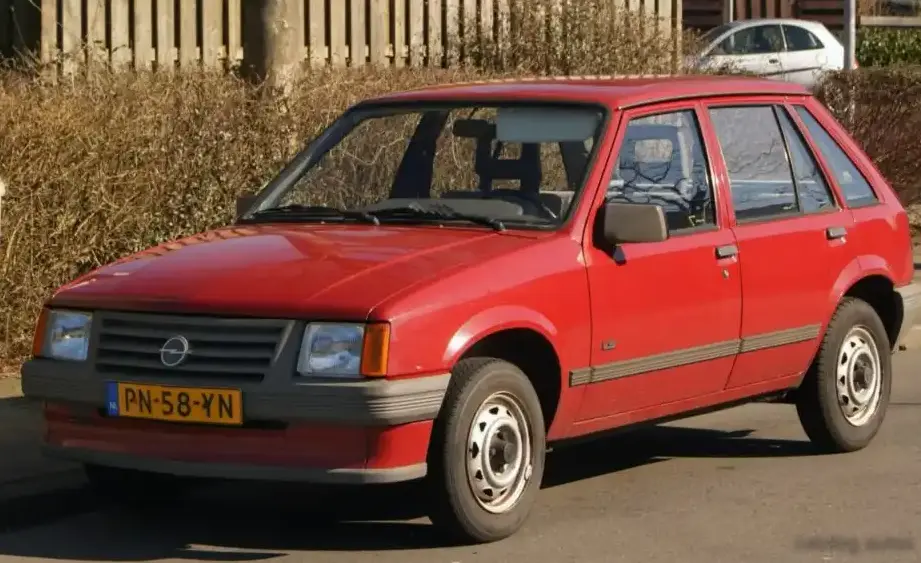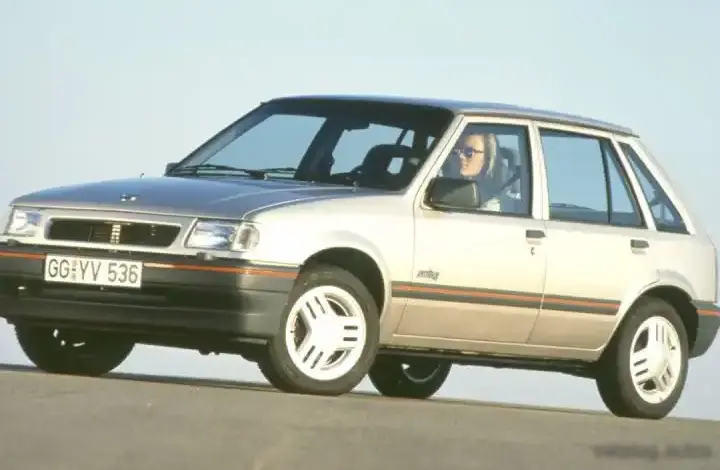
The Opel Corsa A (facelifted in 1987) 1.2 S, producing 50 horsepower, represents an entry-level offering within the broader Corsa A range, manufactured primarily for the European market. Introduced around 1990, this variant aimed to provide affordable and economical transportation, capitalizing on the Corsa A’s reputation as a practical and reliable supermini. It occupied the base trim level, positioned below the more powerful 1.4 and 1.6-liter variants, and served as a stepping stone for buyers seeking a no-frills, fuel-efficient hatchback. Production of this specific configuration was relatively short-lived, concluding in 1990.
Technical Specifications
| Brand | Opel |
| Model | Corsa |
| Generation | Corsa A (facelift 1987) |
| Type (Engine) | 1.2 S (50 Hp) |
| Start of production | 1990 |
| End of production | 1990 |
| Powertrain Architecture | Internal Combustion engine |
| Body type | Hatchback |
| Seats | 5 |
| Doors | 3 |
| Fuel consumption (combined) | 7.1 l/100 km |
| Fuel consumption (US mpg) | 33.1 |
| Fuel consumption (UK mpg) | 39.8 |
| Fuel consumption (km/l) | 14.1 |
| Fuel Type | Petrol (Gasoline) |
| Acceleration 0 – 100 km/h | 17 sec |
| Acceleration 0 – 62 mph | 17 sec |
| Acceleration 0 – 60 mph | 16.2 sec |
| Maximum speed | 150 km/h (93.21 mph) |
| Weight-to-power ratio | 14.8 kg/Hp |
| Weight-to-torque ratio | 8.4 kg/Nm |
| Power | 50 Hp @ 5600 rpm |
| Power per litre | 41.8 Hp/l |
| Torque | 88 Nm @ 2200 rpm (64.91 lb.-ft. @ 2200 rpm) |
| Engine layout | Front, Transverse |
| Engine Model/Code | 12NV |
| Engine displacement | 1196 cm3 (72.98 cu. in.) |
| Number of cylinders | 4 |
| Engine configuration | Inline |
| Cylinder Bore | 77.8 mm (3.06 in.) |
| Piston Stroke | 62.9 mm (2.48 in.) |
| Compression ratio | 9.2:1 |
| Number of valves per cylinder | 2 |
| Fuel injection system | Carburettor |
| Engine aspiration | Naturally aspirated |
| Valvetrain | SOHC |
| Engine oil capacity | 3 l (3.17 US qt | 2.64 UK qt) |
| Coolant capacity | 6.1 l (6.45 US qt | 5.37 UK qt) |
| Kerb Weight | 740 kg (1631.42 lbs.) |
| Max. weight | 1215 kg (2678.62 lbs.) |
| Max load | 475 kg (1047.2 lbs.) |
| Trunk (boot) space – minimum | 270 l (9.53 cu. ft.) |
| Trunk (boot) space – maximum | 1060 l (37.43 cu. ft.) |
| Fuel tank capacity | 42 l (11.1 US gal | 9.24 UK gal) |
| Length | 3622 mm (142.6 in.) |
| Width | 1532 mm (60.31 in.) |
| Height | 1365 mm (53.74 in.) |
| Wheelbase | 2343 mm (92.24 in.) |
| Front track | 1320 mm (51.97 in.) |
| Rear track | 1300 mm (51.18 in.) |
| Ride height (ground clearance) | 140 mm (5.51 in.) |
| Drag coefficient (Cd) | 0.36 |
| Minimum turning circle | 10 m (32.81 ft.) |
| Drivetrain | Front wheel drive |
| Number of gears | 4 |
| Gearbox type | Manual transmission |
| Front brakes | Disc |
| Rear brakes | Drum |
| Tires size | 145/70 R13 |
| Wheel rims size | 13 |
INTRODUCTION
The Opel Corsa A, launched in 1982 and facelifted in 1987, was a significant model for Opel, representing their entry into the burgeoning supermini segment. The 1.2 S variant, with its modest 50 horsepower output, was a key component of the lineup, designed to appeal to budget-conscious buyers. It was a direct competitor to vehicles like the Fiat Uno, Renault 5, and Peugeot 205 in the European market. The facelift brought subtle styling changes and improvements to the interior, enhancing the Corsa A’s appeal. This particular engine and transmission combination was aimed at maximizing fuel efficiency and providing a comfortable, if not particularly sporty, driving experience.
Powertrain & Engine Architecture
The 1.2 S variant was powered by the 12NV engine, a 1196cc inline-four cylinder engine. This engine utilized a single overhead camshaft (SOHC) valvetrain with two valves per cylinder. Critically, it employed a carburetor fuel system, a relatively simple and cost-effective technology for the time, but less efficient and precise than fuel injection. The carburetor contributed to the engine’s lower power output and higher emissions compared to later, fuel-injected Corsas. The engine produced 50 horsepower at 5600 rpm and 88 Nm (64.91 lb-ft) of torque at 2200 rpm. The engine was transversely mounted, driving the front wheels. The transmission was a four-speed manual gearbox, chosen for its simplicity and affordability. This gearbox featured relatively long gear ratios, prioritizing fuel economy over rapid acceleration.
Driving Characteristics
The Corsa A 1.2 S offered a predictable, but uninspiring, driving experience. Acceleration was leisurely, taking approximately 17 seconds to reach 62 mph (100 km/h). The long gearing and modest power output meant that the engine needed to be revved to extract the most performance. Compared to the 1.4 and 1.6-liter versions, the 1.2 S felt noticeably slower, particularly when carrying passengers or luggage. However, the light weight of the vehicle (740 kg) helped to mitigate the lack of power. The steering was light and easy, making it well-suited for urban driving. The suspension, while basic, provided a reasonably comfortable ride, absorbing bumps and imperfections in the road surface adequately. The manual transmission was notchy but precise.
Equipment & Trim Levels
The 1.2 S trim level was fairly basic. Standard equipment typically included cloth upholstery, a simple dashboard layout with analog gauges, and manual windows and door locks. Features like central locking, power steering, and a radio were often optional extras. The interior plastics were durable but utilitarian. The exterior styling was characterized by its boxy shape and small dimensions. The 1.2 S often featured steel wheels with hubcaps, and the paint options were limited to a range of solid colors. Optional extras included a sunroof, upgraded upholstery, and a more comprehensive instrument cluster.
Chassis & Braking
The Corsa A utilized a relatively simple chassis design. The front suspension consisted of MacPherson struts, while the rear suspension employed a twist-beam axle. This setup provided a good balance between ride comfort and handling. The braking system featured disc brakes on the front wheels and drum brakes on the rear wheels. The brakes were adequate for the vehicle’s weight and performance, but lacked the stopping power of more modern systems. The steering was a rack-and-pinion system, providing light and responsive steering feel. The 1.2 S typically featured smaller tires (145/70 R13) compared to the higher-spec models.
Market Reception & Comparison
The Corsa A 1.2 S was generally well-received as an affordable and reliable city car. Critics praised its fuel efficiency and ease of driving, but noted its lack of performance and basic interior. Compared to the 1.4 and 1.6-liter versions, the 1.2 S offered significantly lower running costs but at the expense of driving enjoyment. The 1.4-liter version, while more expensive, provided a noticeable improvement in performance and was often considered a better all-around choice. The 1.6-liter models were aimed at buyers seeking a more sporty driving experience. In terms of reliability, the 1.2 S proved to be a durable and dependable engine, although the carburetor required periodic maintenance.
Legacy
The Opel Corsa A 1.2 S, while not a performance icon, holds a place in automotive history as a practical and affordable supermini that provided transportation for a generation of European drivers. The 12NV engine, despite its simplicity, proved to be relatively robust and long-lasting. Today, these cars are increasingly sought after by classic car enthusiasts and collectors, particularly well-maintained examples. While parts availability can be a challenge, the Corsa A’s simple mechanical design makes it relatively easy to repair and maintain. The 1.2 S variant, as the entry-level model, is often the most affordable Corsa A to acquire, making it an accessible entry point into classic Opel ownership.