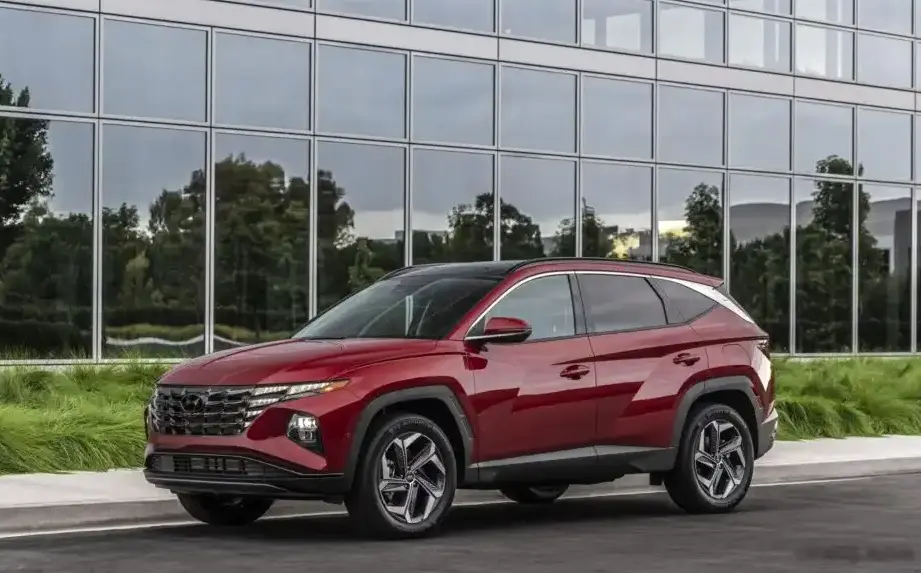
The Hyundai Tucson IV 1.6 T-GDI (150 hp) Mild Hybrid DCT is a compact SUV produced by the South Korean manufacturer Hyundai from December 2020 to May 2024. This variant occupied a key position in the fourth-generation Tucson (NX4) lineup, serving as a fuel-efficient and technologically advanced option for buyers seeking a balance between performance and economy. It was positioned as a mid-range offering, slotting between the base engine options and the more powerful gasoline and hybrid variants. The Tucson IV represented a significant leap forward in design and technology for the model, and this particular powertrain combination aimed to broaden its appeal in the competitive European and global SUV markets.
Technical Specifications
| Brand | Hyundai |
| Model | Tucson |
| Generation | Tucson IV |
| Type (Engine) | 1.6 T-GDI (150 Hp) Mild Hybrid DCT |
| Start of production | December, 2020 |
| End of production | May, 2024 |
| Powertrain Architecture | MHEV (Mild Hybrid Electric Vehicle) |
| Body type | SUV |
| Seats | 5 |
| Doors | 5 |
| Fuel consumption at Low speed (WLTP) | 7.8-7.9 l/100 km (30.2 – 29.8 US mpg) |
| Fuel consumption at Medium speed (WLTP) | 6.1-6.2 l/100 km (38.6 – 37.9 US mpg) |
| Fuel consumption at high speed (WLTP) | 5.4-5.5 l/100 km (43.6 – 42.8 US mpg) |
| Fuel consumption at very high speed (WLTP) | 6.8-7 l/100 km (34.6 – 33.6 US mpg) |
| Combined fuel consumption (WLTP) | 6.4-6.5 l/100 km (36.8 – 36.2 US mpg) |
| CO2 emissions (WLTP) | 144-147 g/km |
| Fuel consumption (economy) – urban (NEDC) | 6.6 l/100 km (35.6 US mpg) |
| Fuel consumption (economy) – extra urban (NEDC) | 5.2 l/100 km (45.2 US mpg) |
| Fuel consumption (economy) – combined (NEDC) | 5.7 l/100 km (41.3 US mpg) |
| CO2 emissions (NEDC) | 130 g/km |
| Fuel Type | Petrol (Gasoline) |
| Acceleration 0 – 100 km/h | 9.6 sec |
| Acceleration 0 – 62 mph | 9.6 sec |
| Acceleration 0 – 60 mph | 9.1 sec |
| Maximum speed | 189 km/h (117.44 mph) |
| Emission standard | Euro 6d |
| Weight-to-power ratio | 9.9 kg/Hp |
| Weight-to-torque ratio | 6 kg/Nm |
| Gross battery capacity | 0.44 kWh |
| Power | 150 Hp @ 5500 rpm |
| Torque | 250 Nm @ 1500-4000 rpm (184.39 lb.-ft. @ 1500-4000 rpm) |
| Engine layout | Front, Transverse |
| Engine Model/Code | G4FU |
| Engine displacement | 1598 cm3 (97.52 cu. in.) |
| Number of cylinders | 4 |
| Engine configuration | Inline |
| Cylinder Bore | 75.6 mm (2.98 in.) |
| Piston Stroke | 89 mm (3.5 in.) |
| Compression ratio | 10.5:1 |
| Number of valves per cylinder | 4 |
| Fuel injection system | Direct injection |
| Engine aspiration | Twin-Turbo, Intercooler |
| Valvetrain | DOHC |
| Engine oil capacity | 4.8 l (5.07 US qt | 4.22 UK qt) |
| Coolant | 8 l (8.45 US qt | 7.04 UK qt) |
| Kerb Weight | 1491-1621 kg (3287.09 – 3573.69 lbs.) |
| Max. weight | 2100 kg (4629.71 lbs.) |
| Max load | 479-609 kg (1056.01 – 1342.62 lbs.) |
| Trunk (boot) space – minimum | 577 l (20.38 cu. ft.) |
| Trunk (boot) space – maximum | 1756 l (62.01 cu. ft.) |
| Fuel tank capacity | 54 l (14.27 US gal | 11.88 UK gal) |
| Max. roof load | 100 kg (220.46 lbs.) |
| Permitted trailer load with brakes (12%) | 1650 kg (3637.63 lbs.) |
| Permitted trailer load without brakes | 750 kg (1653.47 lbs.) |
| Permitted towbar download | 100 kg (220.46 lbs.) |
| Length | 4500 mm (177.17 in.) |
| Width | 1865 mm (73.43 in.) |
| Width including mirrors | 2130 mm (83.86 in.) |
| Height | 1651 mm (65 in.) |
| Wheelbase | 2680 mm (105.51 in.) |
| Front track | 1615-1630 mm (63.58 – 64.17 in.) |
| Rear (Back) track | 1622-1637 mm (63.86 – 64.45 in.) |
| Front overhang | 895 mm (35.24 in.) |
| Rear overhang | 925 mm (36.42 in.) |
| Ride height (ground clearance) | 170 mm (6.69 in.) |
| Drag coefficient (Cd) | 0.315 |
| Minimum turning circle | 10.92 m (35.83 ft.) |
| Front brakes | Ventilated discs, 291 mm |
| Rear brakes | Disc, 302 mm |
| Number of gears and type of gearbox | 7 gears, automatic transmission DCT |
Powertrain & Engine Architecture
The heart of this Tucson variant is the Hyundai G4FU 1.6-liter turbocharged gasoline direct injection (TGDI) engine. This engine is part of Hyundai-Kia’s ‘Smartstream’ engine family, designed for improved efficiency and reduced emissions. The G4FU utilizes a twin-scroll turbocharger and intercooler to deliver 150 horsepower at 5500 rpm and 250 Nm (184 lb-ft) of torque between 1500 and 4000 rpm. The direct injection system ensures precise fuel delivery, optimizing combustion and power output. The ‘Mild Hybrid’ aspect comes from a 48V integrated starter generator (ISG) which assists the engine during acceleration and allows for smoother start-stop operation, contributing to fuel savings. The engine is paired with a 7-speed dual-clutch transmission (DCT), offering quick and smooth gear changes. This DCT is known for its efficiency and responsiveness compared to traditional automatic transmissions.
Driving Characteristics
The 1.6 T-GDI with the 7-speed DCT provides a comfortable and refined driving experience. While not overtly sporty, the engine delivers adequate power for everyday driving situations. Acceleration from 0-60 mph takes around 9.1 seconds, and the car feels responsive in most scenarios. The DCT transmission contributes to a smooth power delivery, and the mild hybrid system provides a subtle boost during acceleration. Compared to higher-output Tucson variants, this version prioritizes fuel economy over outright performance. The gear ratios are tuned for efficiency, meaning the engine may feel slightly strained when climbing steep hills or during aggressive overtaking maneuvers. However, for typical commuting and highway driving, the powertrain is well-suited.
Equipment & Trim Levels
The 1.6 T-GDI Mild Hybrid DCT trim typically came standard with a generous array of features. These included automatic climate control, a touchscreen infotainment system with Apple CarPlay and Android Auto compatibility, a rearview camera, and a suite of safety features such as lane keeping assist, forward collision avoidance assist, and automatic emergency braking. Interior upholstery was typically cloth, with options for leather upgrades. Higher trim levels within the 1.6 T-GDI range offered additional features like a panoramic sunroof, heated and ventilated front seats, and a premium sound system. The dashboard configuration was modern and driver-focused, with a digital instrument cluster available on some trims.
Chassis & Braking
The Tucson IV utilizes a front-wheel-drive platform with independent suspension on all four wheels. The front suspension employs a McPherson strut setup with a coil spring and anti-roll bar, while the rear features a multi-link suspension system, also with a stabilizer bar. This configuration provides a comfortable ride quality and decent handling characteristics. Braking duties are handled by ventilated discs at the front and solid discs at the rear. The braking system is equipped with ABS (Anti-lock Braking System) and electronic stability control, ensuring safe and controlled stopping power.
Market Reception & Comparison
The Hyundai Tucson IV 1.6 T-GDI Mild Hybrid DCT was generally well-received by automotive critics. It was praised for its fuel efficiency, comfortable ride, and well-equipped interior. However, some reviewers noted that the engine could feel underpowered at times, particularly when fully loaded. Compared to the 2.0-liter gasoline and hybrid variants, this version offered a more affordable entry point into the Tucson IV range, but at the expense of some performance. Its fuel economy figures were competitive with other compact SUVs in its class, and the mild hybrid system provided a noticeable improvement in real-world efficiency.
Legacy
The 1.6 T-GDI engine, coupled with the 7-speed DCT, has proven to be a relatively reliable powertrain in the Hyundai-Kia lineup. While some early models experienced minor software glitches with the DCT, these were generally addressed through software updates. On the used car market, this Tucson variant represents a good value proposition, offering a blend of practicality, efficiency, and technology. Its relatively low running costs and comfortable driving experience make it an attractive option for buyers seeking a reliable and fuel-efficient compact SUV.