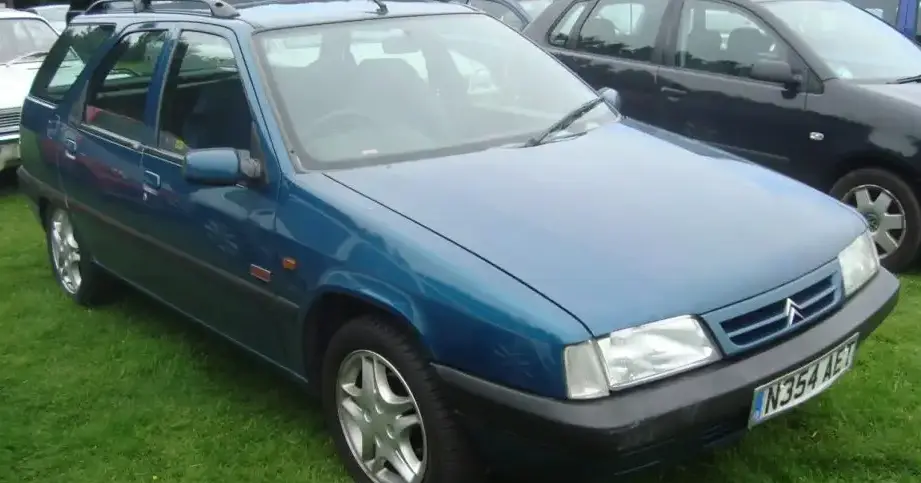
The Citroën ZX Break (N2, Phase II) 1.9 D, produced from July 1994 to 1997, represents a practical and economical variant within the broader ZX Break (estate) range. Positioned as a budget-friendly option, it catered to buyers prioritizing fuel efficiency and load-carrying capacity over outright performance. The ZX Break, itself a derivative of the more compact ZX hatchback, aimed to provide a spacious and versatile family vehicle within the competitive European mid-size segment. This particular 1.9 D model was a key offering for those seeking a diesel-powered wagon, offering a balance between running costs and practicality. It falls within the N2 generation, representing the Phase II facelift of the ZX line.
Technical Specifications
| Brand | Citroen |
| Model | ZX |
| Generation | ZX Break (N2, Phase II) |
| Type (Engine) | 1.9 D (71 Hp) |
| Start of production | July, 1994 |
| End of production | 1997 |
| Powertrain Architecture | Internal Combustion engine |
| Body type | Station wagon (estate) |
| Seats | 5 |
| Doors | 5 |
| Fuel consumption (urban) | 6.7 l/100 km (35.1 US mpg, 42.2 UK mpg, 14.9 km/l) |
| Fuel consumption (extra urban) | 4.6 l/100 km (51.1 US mpg, 61.4 UK mpg, 21.7 km/l) |
| Fuel consumption (combined) | 5.8 l/100 km (40.6 US mpg, 48.7 UK mpg, 17.2 km/l) |
| Fuel Type | Diesel |
| Acceleration 0 – 100 km/h | 18.7 sec |
| Acceleration 0 – 62 mph | 18.7 sec |
| Acceleration 0 – 60 mph | 17.8 sec |
| Maximum speed | 161 km/h (100.04 mph) |
| Weight-to-power ratio | 15.4 kg/Hp, 65.1 Hp/tonne |
| Weight-to-torque ratio | 9.1 kg/Nm, 110.1 Nm/tonne |
| Power | 71 Hp @ 4600 rpm |
| Power per litre | 37.3 Hp/l |
| Torque | 120 Nm @ 2000 rpm (88.51 lb.-ft. @ 2000 rpm) |
| Engine layout | Front, Transverse |
| Engine Model/Code | D9B XUD9A/L |
| Engine displacement | 1905 cm3 (116.25 cu. in.) |
| Number of cylinders | 4 |
| Engine configuration | Inline |
| Cylinder Bore | 83 mm (3.27 in.) |
| Piston Stroke | 88 mm (3.46 in.) |
| Compression ratio | 23:1 |
| Number of valves per cylinder | 2 |
| Fuel injection system | Precombustion chamber injection |
| Engine aspiration | Naturally aspirated engine |
| Valvetrain | OHC |
| Engine oil capacity | 5 l (5.28 US qt | 4.4 UK qt) |
| Coolant | 8.5 l (8.98 US qt | 7.48 UK qt) |
| Kerb Weight | 1090 kg (2403.04 lbs.) |
| Max. weight | 1650 kg (3637.63 lbs.) |
| Max load | 560 kg (1234.59 lbs.) |
| Trunk (boot) space – minimum | 488 l (17.23 cu. ft.) |
| Trunk (boot) space – maximum | 1580 l (55.8 cu. ft.) |
| Fuel tank capacity | 54 l (14.27 US gal | 11.88 UK gal) |
| Max. roof load | 100 kg (220.46 lbs.) |
| Permitted trailer load with brakes (12%) | 1000 kg (2204.62 lbs.) |
| Permitted trailer load without brakes | 545 kg (1201.52 lbs.) |
| Permitted towbar download | 40 kg (88.18 lbs.) |
| Length | 4260 mm (167.72 in.) |
| Width | 1705 mm (67.13 in.) |
| Height | 1457 mm (57.36 in.) |
| Wheelbase | 2540 mm (100 in.) |
| Front track | 1422 mm (55.98 in.) |
| Rear (Back) track | 1415 mm (55.71 in.) |
| Front overhang | 849 mm (33.43 in.) |
| Rear overhang | 871 mm (34.29 in.) |
| Minimum turning circle | 11.1 m (36.42 ft.) |
| Drivetrain Architecture | The Internal combustion engine (ICE) drives the front wheels of the vehicle. |
| Drive wheel | Front wheel drive |
| Number of gears and type of gearbox | 5 gears, manual transmission |
| Front suspension | Independent type McPherson, Wishbone |
| Rear suspension | Hydro-pneumatic element, Trailing arm |
| Front brakes | Ventilated discs |
| Rear brakes | Drum |
| Steering type | Steering rack and pinion |
| Power steering | Hydraulic Steering |
| Tires size | 175/65 R14 |
| Wheel rims size | 5.5J x 14 |
Powertrain & Engine Architecture
The heart of the ZX Break 1.9 D is the D9B XUD9A/L engine, a 1.9-liter inline-four diesel. This engine, a mainstay of Citroën and Peugeot vehicles of the era, is known for its robustness and relatively simple design. It utilizes precombustion chamber injection, a system common in diesel engines of the 1990s, where fuel is injected into a small pre-chamber to initiate combustion before entering the main cylinder. The engine features an overhead camshaft (OHC) valvetrain operating two valves per cylinder. The 71 horsepower output at 4600 rpm and 120 Nm (88.51 lb-ft) of torque at 2000 rpm are typical figures for a naturally aspirated diesel of this displacement and era. The engine is transversely mounted, driving the front wheels. The 5-speed manual transmission was the standard offering, chosen for its efficiency and cost-effectiveness.
Driving Characteristics
The 1.9 D variant of the ZX Break prioritizes fuel economy over outright performance. Acceleration is leisurely, with a 0-60 mph time around 17.8 seconds. The engine’s torque delivery is relatively flat, providing adequate pulling power for everyday driving and hauling loads, but lacking the responsiveness of higher-output gasoline engines. The gear ratios in the 5-speed manual transmission are geared towards maximizing fuel efficiency, meaning the engine operates at lower revolutions per minute (RPM) during cruising. Compared to the more powerful gasoline variants, such as those equipped with the 2.0-liter 16-valve engine, the 1.9 D feels significantly slower. However, it offers a more relaxed driving experience and substantially lower running costs.
Equipment & Trim Levels
The 1.9 D Break typically represented an entry-level or mid-range trim within the ZX Break lineup. Standard equipment generally included basic features such as power steering, central locking, and cloth upholstery. The interior was functional and durable, prioritizing practicality over luxury. Optional extras could include features like air conditioning, electric windows, and upgraded audio systems. The dashboard layout was typical of Citroëns of the period, with a focus on ergonomics and ease of use. Trim levels varied slightly depending on the market, but the 1.9 D generally offered a good level of standard equipment for its price point.
Chassis & Braking
The ZX Break utilized an independent McPherson strut front suspension and a hydro-pneumatic trailing arm rear suspension. The hydro-pneumatic system, a Citroën hallmark, provided a comfortable and self-leveling ride, even when the vehicle was heavily loaded. Front brakes were ventilated discs, providing adequate stopping power, while rear brakes were drums, a cost-saving measure common in this segment. The steering was a rack and pinion system with hydraulic power assistance, offering precise and responsive handling. Stabilizer bars were fitted to both the front and rear axles to reduce body roll during cornering.
Market Reception & Comparison
The Citroën ZX Break 1.9 D was well-received in markets where diesel-powered station wagons were popular, particularly in Europe. Critics praised its fuel efficiency, spacious interior, and comfortable ride. However, its relatively slow acceleration and basic interior trim were points of criticism. Compared to other diesel station wagons of the time, such as the Ford Mondeo Estate 1.8 TD, the ZX Break offered a comparable level of practicality and economy, but with the added benefit of Citroën’s unique hydro-pneumatic suspension. The 1.9 D was generally considered a more sensible and economical choice than the higher-powered gasoline variants, appealing to buyers prioritizing value and running costs.
Legacy
The D9B XUD9A/L engine, found in the ZX Break 1.9 D, is known for its durability and longevity. With proper maintenance, these engines can reliably exceed 200,000 miles. Today, the ZX Break 1.9 D is a relatively affordable and practical classic car. While not highly sought after by collectors, it remains a popular choice for those seeking a reliable and economical estate car. Parts availability is generally good, and the simple mechanical design makes it relatively easy to maintain and repair. The hydro-pneumatic suspension, while requiring occasional maintenance, continues to provide a unique and comfortable driving experience.