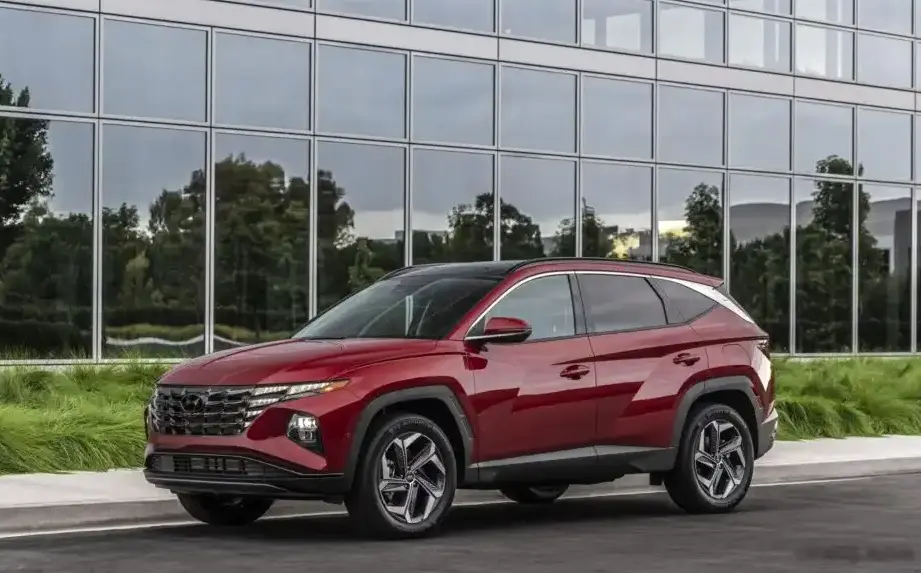
The Hyundai Tucson IV 1.6 T-GDI (180 hp) Mild Hybrid 4WD DCT is a compact SUV produced by the South Korean manufacturer Hyundai from December 2020 to May 2024. This variant represents a key offering within the fourth generation (NX4) Tucson lineup, positioned as a mid-range option balancing fuel efficiency, performance, and all-weather capability. It utilizes a 48-volt mild hybrid system paired with a turbocharged gasoline engine and a dual-clutch transmission (DCT), offering a sophisticated powertrain for the increasingly competitive crossover segment. The Tucson IV, overall, marked a significant design departure for Hyundai, embracing a bolder, more angular aesthetic and a more technologically advanced interior.
Technical Specifications
| Brand | Hyundai |
| Model | Tucson |
| Generation | Tucson IV |
| Type (Engine) | 1.6 T-GDI (180 Hp) Mild Hybrid 4WD DCT |
| Start of production | December, 2020 |
| End of production | May, 2024 |
| Powertrain Architecture | MHEV (Mild Hybrid Electric Vehicle) |
| Body type | SUV |
| Seats | 5 |
| Doors | 5 |
| Fuel consumption at Low speed (WLTP) | 8.3 l/100 km (28.3 US mpg) |
| Fuel consumption at Medium speed (WLTP) | 6.6 l/100 km (35.6 US mpg) |
| Fuel consumption at high speed (WLTP) | 6 l/100 km (39.2 US mpg) |
| Fuel consumption at very high speed (WLTP) | 7.7 l/100 km (30.5 US mpg) |
| Combined fuel consumption (WLTP) | 7.1 l/100 km (33.1 US mpg) |
| CO2 emissions (WLTP) | 160 g/km |
| Fuel Type | Petrol (Gasoline) |
| Acceleration 0 – 100 km/h | 9.0 sec |
| Acceleration 0 – 62 mph | 9.0 sec |
| Acceleration 0 – 60 mph | 8.6 sec |
| Maximum speed | 201 km/h (124.9 mph) |
| Emission standard | Euro 6d |
| Weight-to-power ratio | 8.7 kg/Hp |
| Weight-to-torque ratio | 5.9 kg/Nm |
| Gross battery capacity | 0.44 kWh |
| Power | 180 Hp @ 5500 rpm |
| Torque | 265 Nm @ 1500-4500 rpm (195.45 lb.-ft.) |
| Engine layout | Front, Transverse |
| Engine Model/Code | G4FU |
| Engine displacement | 1598 cm3 (97.52 cu. in.) |
| Number of cylinders | 4 |
| Engine configuration | Inline |
| Cylinder Bore | 75.6 mm (2.98 in.) |
| Piston Stroke | 89 mm (3.5 in.) |
| Compression ratio | 10.5:1 |
| Number of valves per cylinder | 4 |
| Fuel injection system | Direct injection |
| Engine aspiration | Twin-Turbo, Intercooler |
| Valvetrain | DOHC |
| Engine oil capacity | 4.8 l (5.07 US qt | 4.22 UK qt) |
| Coolant | 8 l (8.45 US qt | 7.04 UK qt) |
| Kerb Weight | 1558-1689 kg (3434.8 – 3723.61 lbs.) |
| Max. weight | 2170 kg (4784.03 lbs.) |
| Max load | 481-612 kg (1060.42 – 1349.23 lbs.) |
| Trunk (boot) space – minimum | 577 l (20.38 cu. ft.) |
| Trunk (boot) space – maximum | 1756 l (62.01 cu. ft.) |
| Fuel tank capacity | 54 l (14.27 US gal | 11.88 UK gal) |
| Max. roof load | 100 kg (220.46 lbs.) |
| Permitted trailer load with brakes (12%) | 1650 kg (3637.63 lbs.) |
| Permitted trailer load without brakes | 750 kg (1653.47 lbs.) |
| Permitted towbar download | 100 kg (220.46 lbs.) |
| Length | 4500 mm (177.17 in.) |
| Width | 1865 mm (73.43 in.) |
| Width including mirrors | 2130 mm (83.86 in.) |
| Height | 1651 mm (65 in.) |
| Wheelbase | 2680 mm (105.51 in.) |
| Front track | 1615-1630 mm (63.58 – 64.17 in.) |
| Rear (Back) track | 1622-1637 mm (63.86 – 64.45 in.) |
| Front overhang | 895 mm (35.24 in.) |
| Rear overhang | 925 mm (36.42 in.) |
| Ride height (ground clearance) | 170 mm (6.69 in.) |
| Drag coefficient (Cd) | 0.315 |
| Minimum turning circle (turning diameter) | 10.92 m (35.83 ft.) |
| Front suspension | Independent, type McPherson with coil spring and anti-roll bar |
| Rear suspension | Independent multi-link spring suspension with stabilizer |
| Front brakes | Ventilated discs, 291 mm |
| Rear brakes | Disc, 302 mm |
| Number of gears and type of gearbox | 7 gears, automatic transmission DCT |
| Tires size | 215/65 R17; 235/55 R18; 235/50 R19 |
| Wheel rims size | 7.0J x 17; 7.5J x 18; 7.5J x 19 |
INTRODUCTION
The Hyundai Tucson IV 1.6 T-GDI Mild Hybrid 4WD DCT, launched in December 2020, is a significant model within the Tucson IV range (NX4). This generation of Tucson represented a substantial leap forward in design and technology for Hyundai. The 1.6 T-GDI variant, with its mild hybrid assistance and all-wheel-drive system, was aimed at buyers seeking a balance between fuel economy, performance, and all-weather capability. It occupied a middle ground in the Tucson IV lineup, offering more power and features than the base models but remaining more accessible than the higher-output engine options.
Powertrain & Engine Architecture
At the heart of this Tucson variant lies the Hyundai-Kia G4FU 1.6-liter turbocharged four-cylinder gasoline engine. This engine utilizes direct injection and a twin-scroll turbocharger to deliver 180 horsepower at 5500 rpm and 265 Nm (195 lb-ft) of torque between 1500 and 4500 rpm. The mild hybrid system, employing a 48V battery and a belt-driven starter generator (BSG), provides assistance during acceleration and allows for extended engine-off coasting, improving fuel efficiency. The engine features a DOHC valvetrain and a compression ratio of 10.5:1. The engine is transversely mounted. The powertrain is coupled with a 7-speed dual-clutch transmission (DCT), known for its quick and smooth shifts. This DCT is a key component in maximizing the engine’s efficiency and responsiveness.
Driving Characteristics
The 1.6 T-GDI with the DCT offers a refined driving experience. While not as overtly sporty as some competitors, it provides ample power for everyday driving and highway merging. The DCT contributes to brisk acceleration, with a 0-60 mph time of around 8.6 seconds. The mild hybrid system is largely transparent to the driver, providing a subtle boost during acceleration. The all-wheel-drive system enhances traction in inclement weather, providing added confidence. Compared to the base 1.6L naturally aspirated engine, the turbo variant delivers a noticeable improvement in performance. Compared to the 2.5L naturally aspirated engine, it offers similar power but with better fuel economy. The DCT, while generally smooth, can exhibit some low-speed jerkiness in certain situations, a common characteristic of these transmissions.
Equipment & Trim Levels
The 1.6 T-GDI Mild Hybrid 4WD DCT typically came equipped with a generous array of standard features. These included automatic climate control, a touchscreen infotainment system with Apple CarPlay and Android Auto compatibility, a rearview camera, and a suite of advanced driver-assistance systems (ADAS) such as lane-keeping assist, forward collision avoidance assist, and adaptive cruise control. Higher trim levels added features like leather upholstery, a panoramic sunroof, a premium sound system, and heated/ventilated front seats. Interior upholstery was typically cloth on lower trims and leather on higher trims. Dashboard configurations were modern and driver-focused, with a digital instrument cluster available on select models.
Chassis & Braking
The Tucson IV utilizes a McPherson strut front suspension and a multi-link rear suspension, providing a comfortable and controlled ride. Stabilizer bars are fitted to both axles to reduce body roll. The braking system consists of ventilated discs at the front and solid discs at the rear. ABS (Anti-lock Braking System) is standard. The suspension tuning is geared towards comfort, prioritizing ride quality over outright handling prowess. The all-wheel-drive system automatically distributes torque between the front and rear axles based on traction conditions.
Market Reception & Comparison
The Hyundai Tucson IV 1.6 T-GDI Mild Hybrid 4WD DCT was generally well-received by automotive critics. It was praised for its stylish design, spacious interior, and comprehensive feature set. The powertrain was noted for its balance of performance and fuel efficiency. Fuel economy figures averaged around 33.1 US mpg combined, making it a competitive option in its class. Compared to other trims, the 1.6 T-GDI offered a compelling upgrade in performance without a significant penalty in fuel economy. Reliability reports have been generally positive, with few widespread issues reported.
Legacy
The Hyundai Tucson IV 1.6 T-GDI Mild Hybrid 4WD DCT has established itself as a reliable and practical choice in the used car market. The G4FU engine, while not without its minor quirks, has proven to be relatively durable. The DCT transmission, if properly maintained, is also generally reliable. The mild hybrid system adds a layer of future-proofing, appealing to buyers seeking improved fuel efficiency. As the Tucson IV continues to age, this variant is likely to remain a popular choice for those seeking a well-rounded and technologically advanced compact SUV.