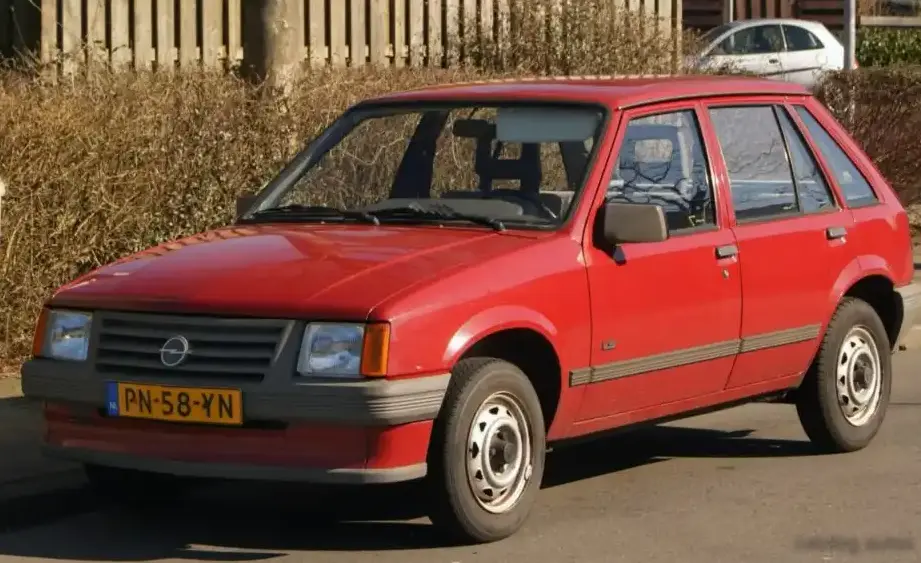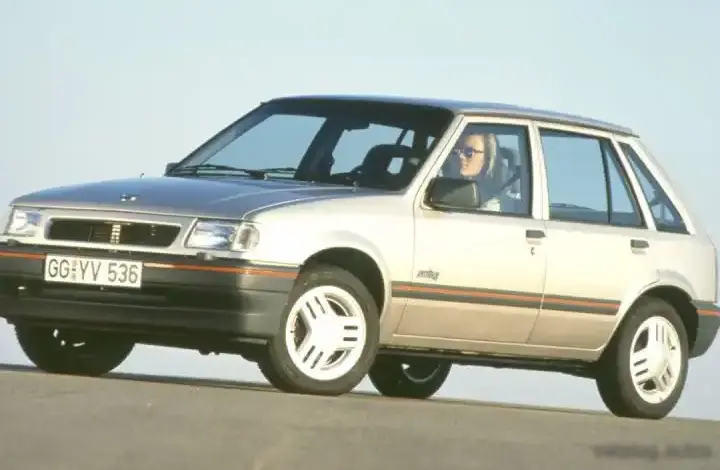
The Opel Corsa A (facelifted in 1987) 1.4i, producing 72 horsepower, was a key variant in the first generation of the Corsa, produced from 1989 to 1990. This model represented a significant step for Opel (and later Vauxhall in the UK) into the subcompact hatchback segment, aiming to provide affordable and practical transportation for European buyers. The facelift brought updated styling and minor mechanical improvements over the initial 1982 launch. The 1.4i trim occupied a middle ground in the Corsa A lineup, offering a balance between economy and performance, positioned above the base 1.0L models and below the more powerful 1.6L versions.
Technical Specifications
| Brand | Opel |
| Model | Corsa |
| Generation | Corsa A (facelift 1987) |
| Type (Engine) | 1.4i (72 Hp) |
| Start of production | 1989 |
| End of production | 1990 |
| Powertrain Architecture | Internal Combustion engine |
| Body type | Hatchback |
| Seats | 5 |
| Doors | 3-5 |
| Fuel consumption (urban) | 8.6 l/100 km (27.4 US mpg, 32.8 UK mpg, 11.6 km/l) |
| Fuel consumption (extra urban) | 5.2 l/100 km (45.2 US mpg, 54.3 UK mpg, 19.2 km/l) |
| Fuel consumption (combined) | 6.9 l/100 km (34.1 US mpg, 40.9 UK mpg, 14.5 km/l) |
| Fuel Type | Petrol (Gasoline) |
| Maximum speed | 168 km/h (104.39 mph) |
| Weight-to-power ratio | 10.7 kg/Hp |
| Weight-to-torque ratio | 7.5 kg/Nm |
| Power | 72 Hp @ 5600 rpm |
| Power per litre | 51.8 Hp/l |
| Torque | 103 Nm @ 2600 rpm (75.97 lb.-ft. @ 2600 rpm) |
| Engine layout | Front, Transverse |
| Engine Model/Code | 14NV |
| Engine displacement | 1389 cm3 (84.76 cu. in.) |
| Number of cylinders | 4 |
| Engine configuration | Inline |
| Cylinder Bore | 77.6 mm (3.06 in.) |
| Piston Stroke | 73.4 mm (2.89 in.) |
| Compression ratio | 9.4:1 |
| Number of valves per cylinder | 2 |
| Fuel injection system | Multi-port manifold injection |
| Engine aspiration | Naturally aspirated |
| Valvetrain | SOHC |
| Engine oil capacity | 3 l (3.17 US qt | 2.64 UK qt) |
| Coolant capacity | 5.7 l (6.02 US qt | 5.02 UK qt) |
| Kerb Weight | 770 kg (1697.56 lbs.) |
| Max. weight | 1245 kg (2744.76 lbs.) |
| Max load | 475 kg (1047.2 lbs.) |
| Trunk (boot) space – minimum | 270 l (9.53 cu. ft.) |
| Trunk (boot) space – maximum | 1060 l (37.43 cu. ft.) |
| Fuel tank capacity | 42 l (11.1 US gal | 9.24 UK gal) |
| Permitted trailer load (braked) | 800 kg (1763.7 lbs.) |
| Permitted trailer load (unbraked) | 400 kg (881.85 lbs.) |
| Length | 3622 mm (142.6 in.) |
| Width | 1532 mm (60.31 in.) |
| Height | 1365 mm (53.74 in.) |
| Wheelbase | 2343 mm (92.24 in.) |
| Front track | 1320 mm (51.97 in.) |
| Rear track | 1307 mm (51.46 in.) |
| Ride height | 140 mm (5.51 in.) |
| Drag coefficient (Cd) | 0.36 |
| Turning circle | 10 m (32.81 ft.) |
| Drivetrain | Front wheel drive |
| Gearbox | 5 gears, manual transmission |
| Front suspension | Coil spring |
| Rear suspension | Coil spring |
| Front brakes | Disc |
| Rear brakes | Drum |
| Assisting systems | ABS (Anti-lock braking system) |
| Steering | Steering rack and pinion |
| Tires size | 165/65 R14 |
| Wheel rims size | 14 |
INTRODUCTION
The Opel Corsa A, launched in 1982 and facelifted in 1987, was Opel’s entry into the burgeoning subcompact car market. Designed as a modern, front-wheel-drive alternative to the rear-wheel-drive Opel Kadett, the Corsa aimed to appeal to a younger, more urban demographic. The 1.4i variant, introduced in 1989, offered a step up in performance from the base 1.0L engine, while remaining relatively affordable. It was available in both 3-door and 5-door body styles, catering to different lifestyle needs. This model played a crucial role in establishing the Corsa as a popular choice in Europe, competing with rivals like the Peugeot 205, Renault Clio, and Ford Fiesta.
Powertrain & Engine Architecture
The 1.4i Corsa A utilized the 14NV engine, a naturally aspirated, inline-four cylinder petrol engine displacing 1389cc. This engine featured a single overhead camshaft (SOHC) valvetrain with two valves per cylinder. Fuel delivery was managed by a multi-port fuel injection system, a significant improvement over the carbureted engines found in older Opel models. The 14NV engine produced 72 horsepower at 5600 rpm and 103 Nm (76 lb-ft) of torque at 2600 rpm. The engine’s relatively simple design prioritized reliability and ease of maintenance. The 1.4i was typically paired with a five-speed manual transmission, although a three-speed automatic transmission was also available, albeit less common. The automatic transmission, while offering convenience, did impact acceleration and fuel economy.
Driving Characteristics
The Corsa A 1.4i offered a reasonably sprightly driving experience for its class. While not a performance car, the 72 hp engine provided adequate power for everyday driving, including navigating city streets and merging onto highways. The five-speed manual transmission allowed drivers to keep the engine in its optimal power band, resulting in acceptable acceleration. The automatic transmission, however, felt sluggish in comparison, with noticeable delays in downshifting. Steering was light and precise, making the Corsa easy to maneuver. The suspension, while basic, provided a comfortable ride, absorbing most road imperfections without excessive body roll. Compared to the 1.0L models, the 1.4i offered a noticeable improvement in responsiveness, while the larger 1.6L versions provided significantly more power but at a higher price point.
Equipment & Trim Levels
The 1.4i Corsa A typically came with a modest level of standard equipment. Basic models featured cloth upholstery, a simple dashboard layout, and manual windows and door locks. Higher trim levels offered options such as power steering, central locking, and upgraded interior trim. A radio/cassette player was a popular optional extra. The 3-door version was often marketed towards younger buyers, while the 5-door model appealed to families seeking greater practicality. The interior space was adequate for a subcompact car, offering comfortable seating for four adults. Safety features were limited by the standards of the time, typically including seatbelts and a basic braking system.
Chassis & Braking
The Corsa A utilized a relatively simple chassis design, featuring a front-wheel-drive layout with coil spring suspension at all four corners. The front suspension employed MacPherson struts, while the rear suspension utilized a twist beam axle. Braking duties were handled by disc brakes at the front and drum brakes at the rear. ABS (Anti-lock Braking System) was available as an optional extra, enhancing braking performance and safety, particularly in wet or slippery conditions. The steering system employed a rack and pinion setup, providing precise and responsive steering feel. The relatively lightweight construction of the Corsa A contributed to its nimble handling characteristics.
Market Reception & Comparison
The Opel Corsa A 1.4i was generally well-received by automotive critics. It was praised for its affordability, practicality, and relatively refined driving experience. However, some critics noted the engine’s lack of outright power and the somewhat basic interior. Compared to the 1.0L models, the 1.4i offered a significant improvement in performance, making it a more appealing option for drivers who frequently traveled on highways or carried passengers. The 1.6L versions provided even more power but came at a higher cost. Fuel economy was considered reasonable for its class, with combined fuel consumption figures around 6.9 l/100 km (34.1 US mpg). Reliability was generally good, although some owners reported minor issues with the electrical system.
Legacy
The Opel Corsa A 1.4i remains a relatively common sight on European roads today, particularly among classic car enthusiasts. The 14NV engine is known for its durability and relatively simple maintenance requirements. While not a particularly collectible model, well-maintained examples command reasonable prices in the used car market. The Corsa A played a significant role in establishing the Corsa as a successful model line for Opel, paving the way for subsequent generations that have continued to build on its reputation for affordability, practicality, and reliability. The 1.4i variant, in particular, represents a sweet spot in the lineup, offering a good balance between performance, economy, and price.