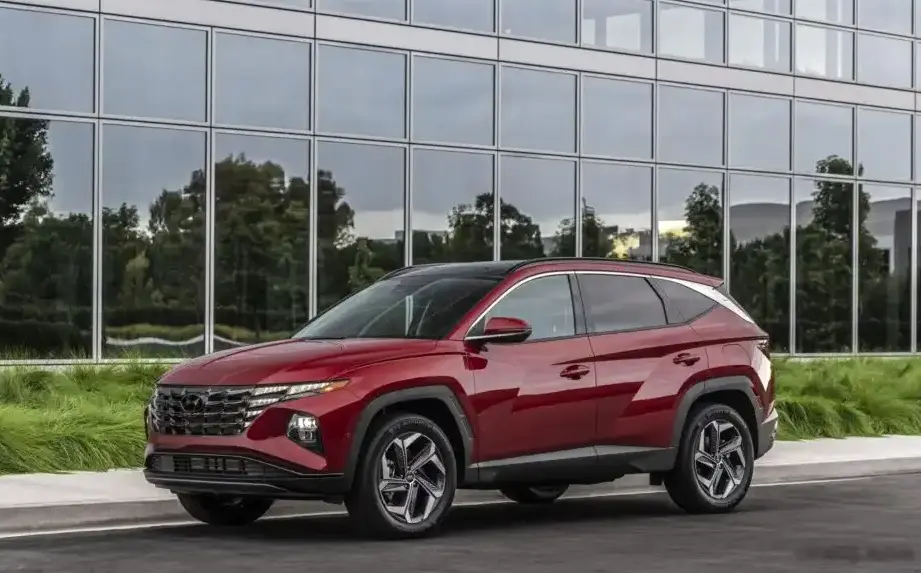
The Hyundai Tucson IV 1.6 T-GDi Plug-in Hybrid 4WD Automatic is a variant of the fourth-generation Hyundai Tucson (codenamed NX4), produced from May 2021 to May 2024. This model represents Hyundai’s entry into the increasingly competitive plug-in hybrid SUV market, offering a blend of gasoline engine power and electric-only driving capability. Positioned as a mid-to-high range trim within the Tucson IV lineup, it aimed to appeal to buyers seeking fuel efficiency, reduced emissions, and all-weather capability. The Tucson IV, launched in 2020, marked a significant design departure for the model, adopting a bolder, more angular aesthetic and incorporating advanced technology features.
Technical Specifications
| Brand | Hyundai |
| Model | Tucson |
| Generation | Tucson IV |
| Type (Engine) | 1.6 T-GDi (265 Hp) Plug-in Hybrid 4WD Automatic |
| Start of production | May, 2021 |
| End of production | May, 2024 |
| Powertrain Architecture | PHEV (Plug-in Hybrid Electric Vehicle) |
| Body type | SUV |
| Seats | 5 |
| Doors | 5 |
| Combined fuel consumption (WLTP) | 1.4 l/100 km (168 US mpg, 201.8 UK mpg, 71.4 km/l) |
| CO2 emissions (WLTP) | 31 g/km |
| Fuel Type | Petrol / electricity |
| Acceleration 0 – 100 km/h | 8.2 sec |
| Acceleration 0 – 62 mph | 8.2 sec |
| Acceleration 0 – 60 mph | 7.8 sec |
| Maximum speed | 191 km/h (118.68 mph) |
| Emission standard | Euro 6d |
| Weight-to-power ratio | 6.9 kg/Hp, 145.8 Hp/tonne |
| Weight-to-torque ratio | 5.2 kg/Nm, 192.5 Nm/tonne |
| Gross battery capacity | 13.8 kWh |
| Battery voltage | 360 V |
| Battery technology | Lithium-polymer (LiPo) |
| Battery location | Below the floor, under the front seats |
| All-electric range (WLTP) | 62 km (38.53 mi) |
| Average Energy consumption (WLTP) | 17.7 kWh/100 km (28.49 kWh/100 mi, 118 MPGe, 5.6 km/kWh, 3.5 mi/kWh) |
| Electric motor power | 91 Hp @ 2100-3300 rpm (304 Nm @ 1500-4500 rpm / 224.22 lb.-ft. @ 1500-4500 rpm) |
| Electric motor location | Between the combustion engine and the transmission |
| System power | 265 Hp @ 5500 rpm (350 Nm @ 1500-4500 rpm / 258.15 lb.-ft. @ 1500-4500 rpm) |
| Power | 180 Hp @ 5500 rpm (265 Nm @ 1500-4500 rpm / 195.45 lb.-ft. @ 1500-4500 rpm) |
| Engine layout | Front, Transverse |
| Engine Model/Code | G4FP |
| Engine displacement | 1598 cm3 (97.52 cu. in.) |
| Number of cylinders | 4 |
| Engine configuration | Inline |
| Cylinder Bore | 75.6 mm (2.98 in.) |
| Piston Stroke | 89 mm (3.5 in.) |
| Compression ratio | 10.5:1 |
| Number of valves per cylinder | 4 |
| Fuel injection system | Direct injection |
| Engine aspiration | Turbocharger, Intercooler |
| Valvetrain | DOHC |
| Engine oil capacity | 4.8 l (5.07 US qt | 4.22 UK qt) |
| Coolant | 6.8 l (7.19 US qt | 5.98 UK qt) |
| Kerb Weight | 1818-1924 kg (4008 – 4241.69 lbs.) |
| Max. weight | 2415 kg (5324.16 lbs.) |
| Max load | 491-597 kg (1082.47 – 1316.16 lbs.) |
| Trunk (boot) space – minimum | 558 l (19.71 cu. ft.) |
| Trunk (boot) space – maximum | 1721 l (60.78 cu. ft.) |
| Fuel tank capacity | 42 l (11.1 US gal | 9.24 UK gal) |
| Max. roof load | 100 kg (220.46 lbs.) |
| Permitted trailer load with brakes (12%) | 1350 kg (2976.24 lbs.) |
| Permitted trailer load without brakes | 750 kg (1653.47 lbs.) |
| Permitted towbar download | 100 kg (220.46 lbs.) |
| Length | 4500 mm (177.17 in.) |
| Width | 1865 mm (73.43 in.) |
| Height | 1650 mm (64.96 in.) |
| Wheelbase | 2680 mm (105.51 in.) |
| Front track | 1615 mm (63.58 in.) |
| Rear (Back) track | 1622 mm (63.86 in.) |
| Ride height (ground clearance) | 170 mm (6.69 in.) |
| Minimum turning circle (turning diameter) | 10.9 m (35.76 ft.) |
| Drivetrain Architecture | The Internal combustion engine (ICE) and the electric motor permanently drive the front wheels of the vehicle, capable of running in full electric or mixed mode, and if necessary through the electrically or mechanically controlled clutch, the rear wheels are driven. |
| Drive wheel | All wheel drive (4×4) |
| Number of gears and type of gearbox | 6 gears, automatic transmission |
| Front suspension | Independent type McPherson |
| Rear suspension | Independent multi-link suspension |
| Front brakes | Ventilated discs |
| Rear brakes | Disc |
| Assisting systems | ABS (Anti-lock braking system) |
| Steering type | Steering rack and pinion |
| Power steering | Electric Steering |
| Tires size | 235/50 R19 |
| Wheel rims size | 7.5J x 19 |
INTRODUCTION
The Hyundai Tucson IV 1.6 T-GDi Plug-in Hybrid 4WD Automatic, launched in May 2021, is a significant offering from Hyundai in the rapidly expanding plug-in hybrid SUV segment. Built on the NX4 platform, shared with the Kia Sportage, the Tucson IV represents a substantial upgrade in design, technology, and driving experience compared to its predecessor. This particular variant combines a 1.6-liter turbocharged gasoline engine with an electric motor and a 13.8 kWh battery pack, delivering a combined system output of 265 horsepower. The inclusion of all-wheel drive (AWD) further enhances its appeal in regions with challenging weather conditions. This trim level aimed to provide a balance between efficiency, performance, and practicality for families and individuals seeking a versatile SUV.
Powertrain & Engine Architecture
At the heart of the Tucson PHEV lies the Hyundai-Kia Smartstream G4FP 1.6-liter turbocharged four-cylinder gasoline engine. This engine utilizes direct injection and a sophisticated turbocharging system to produce 180 horsepower and 265 Nm (195.45 lb-ft) of torque. The engine is paired with a 91 horsepower electric motor, integrated between the engine and the six-speed automatic transmission. The electric motor draws power from a 13.8 kWh lithium-polymer battery pack located under the floor, minimizing impact on cabin space. The powertrain operates in several modes, including electric-only, hybrid, and sport, allowing the driver to prioritize fuel efficiency or performance. The transmission is a conventional six-speed automatic, optimized for smooth operation and efficiency in both gasoline and electric modes. The engine management system seamlessly blends the power from both sources, providing a responsive and refined driving experience.
Driving Characteristics
The 1.6 T-GDi Plug-in Hybrid 4WD Automatic Tucson delivers a surprisingly refined driving experience. In electric-only mode, the vehicle offers near-silent operation and brisk acceleration for city driving, with a WLTP-rated range of 62 km (38.53 miles). When the gasoline engine engages, the transition is smooth and almost imperceptible. The combined system output of 265 horsepower provides ample power for highway merging and overtaking, with a 0-60 mph time of around 7.8 seconds. The all-wheel-drive system provides excellent traction in various conditions, enhancing stability and confidence. Compared to the standard gasoline-powered Tucson, the PHEV variant offers a more relaxed and refined driving experience, particularly in urban environments. While the added weight of the battery pack slightly impacts handling agility compared to lighter trims, the overall ride quality is comfortable and well-controlled.
Equipment & Trim Levels
The Tucson IV 1.6 T-GDi Plug-in Hybrid 4WD Automatic typically came well-equipped, reflecting its mid-to-high range positioning. Standard features often included a large touchscreen infotainment system with Apple CarPlay and Android Auto compatibility, a digital instrument cluster, leather upholstery, heated and ventilated front seats, a panoramic sunroof, and a suite of advanced driver-assistance systems (ADAS) such as adaptive cruise control, lane-keeping assist, and automatic emergency braking. Optional extras could include premium sound systems, a head-up display, and upgraded interior trim materials. The interior design emphasized a modern and minimalist aesthetic, with high-quality materials and a user-friendly layout.
Chassis & Braking
The Tucson IV utilizes a robust chassis with independent suspension at all four corners. The front suspension employs a McPherson strut design, while the rear features a multi-link setup. This configuration provides a good balance between ride comfort and handling precision. The braking system consists of ventilated discs at the front and solid discs at the rear, providing adequate stopping power. The electronic stability control (ESC) system and anti-lock braking system (ABS) work in conjunction to enhance safety and control. The all-wheel-drive system utilizes a multi-plate clutch to distribute torque between the front and rear axles, optimizing traction in various conditions.
Market Reception & Comparison
The Hyundai Tucson IV 1.6 T-GDi Plug-in Hybrid 4WD Automatic received generally positive reviews from automotive critics. Praised for its fuel efficiency, comfortable ride, and generous equipment levels, it was seen as a competitive offering in the plug-in hybrid SUV segment. Compared to other trims in the Tucson lineup, the PHEV variant offered significantly improved fuel economy and reduced emissions, albeit at a higher price point. Against rivals such as the Toyota RAV4 Prime and Mitsubishi Outlander PHEV, the Tucson PHEV offered a compelling combination of value, features, and performance. Some critics noted that the battery pack slightly reduced cargo space compared to non-hybrid models.
Legacy
The Hyundai Tucson IV 1.6 T-GDi Plug-in Hybrid 4WD Automatic represents a significant step forward in Hyundai’s commitment to electrification. The powertrain, while relatively new, has demonstrated good reliability in early reports. As a used vehicle, these models are becoming increasingly attractive to buyers seeking a fuel-efficient and environmentally friendly SUV. The combination of a capable all-wheel-drive system, a comfortable interior, and a generous suite of features ensures that the Tucson PHEV remains a competitive option in the used car market for years to come. Its long-term value will likely be bolstered by the growing demand for plug-in hybrid vehicles and the increasing awareness of environmental concerns.