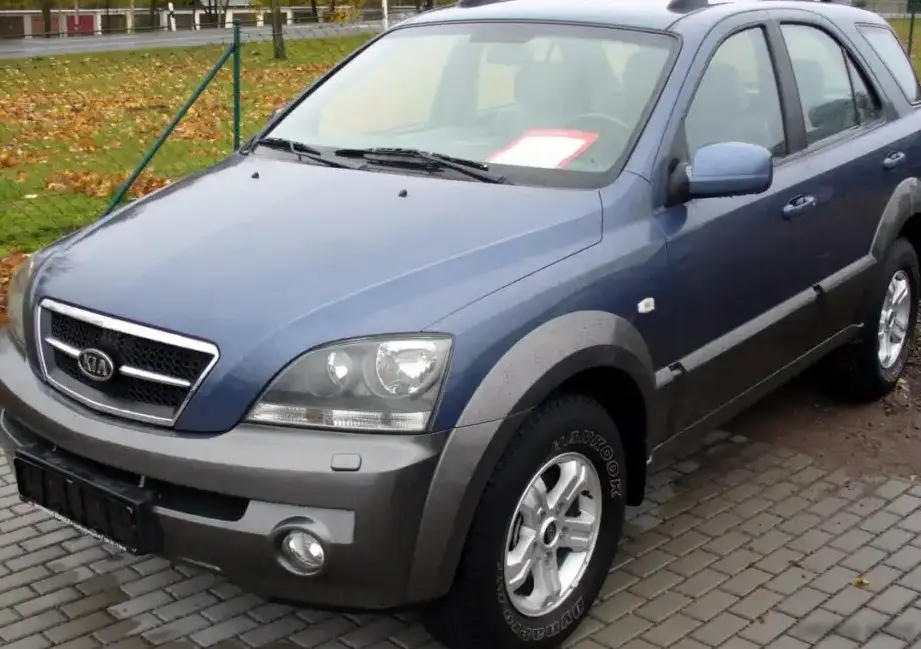
The Kia Sorento I (facelift, introduced in 2006) 2.5 CRDi 4×4 Automatic represents a significant iteration of Kia’s first foray into the mid-size SUV segment. Produced from 2006 to 2009, this variant occupied a middle ground within the Sorento lineup, offering a balance between performance, fuel efficiency, and all-weather capability. It was primarily marketed towards families and individuals seeking a versatile vehicle with the added security of four-wheel drive. The facelift brought styling updates and refinements to the original Sorento, enhancing its appeal in a competitive market. This particular configuration, pairing the 2.5-liter diesel engine with a five-speed automatic transmission and a 4×4 drivetrain, was a popular choice in many European and Asian markets.
Technical Specifications
| Brand | Kia |
| Model | Sorento |
| Generation | Sorento I (facelift 2006) |
| Type (Engine) | 2.5 CRDi (170 Hp) 4×4 Automatic |
| Start of production | 2006 |
| End of production | 2009 |
| Powertrain Architecture | Internal Combustion engine |
| Body type | SUV |
| Seats | 5 |
| Doors | 5 |
| Fuel Type | Diesel |
| Acceleration 0 – 100 km/h | 12.4 sec |
| Acceleration 0 – 62 mph | 12.4 sec |
| Acceleration 0 – 60 mph | 11.8 sec |
| Maximum speed | 180 km/h (111.85 mph) |
| Emission standard | Euro 4 |
| Power | 170 Hp @ 3800 rpm |
| Power per litre | 68.1 Hp/l |
| Torque | 400 Nm (295.02 lb.-ft.) |
| Engine layout | Front, Longitudinal |
| Engine Model/Code | D4CB |
| Engine displacement | 2497 cm3 (152.38 cu. in.) |
| Number of cylinders | 4 |
| Engine configuration | Inline |
| Cylinder Bore | 91 mm (3.58 in.) |
| Piston Stroke | 96 mm (3.78 in.) |
| Compression ratio | 19.3:1 |
| Number of valves per cylinder | 4 |
| Fuel injection system | Diesel Commonrail |
| Engine aspiration | Turbocharger, Intercooler |
| Engine oil capacity | 8.2 l (8.66 US qt | 7.21 UK qt) |
| Coolant | 10 l (10.57 US qt | 8.8 UK qt) |
| Fuel tank capacity | 80 l (21.13 US gal | 17.6 UK gal) |
| Length | 4590 mm (180.71 in.) |
| Width | 1865 mm (73.43 in.) |
| Height | 1730 mm (68.11 in.) |
| Drive wheel | All wheel drive (4×4) |
| Number of gears and type of gearbox | 5 gears, automatic transmission |
| Front brakes | Ventilated discs |
| Rear brakes | Ventilated discs |
| Assisting systems | ABS (Anti-lock braking system) |
| Tires size | 245/70 R16; 245/65 R17 |
| Wheel rims size | 16; 17 |
Powertrain & Engine Architecture
The heart of the Sorento 2.5 CRDi is the D4CB engine, a 2.5-liter inline-four cylinder diesel. This engine utilizes a common-rail direct injection system, delivering fuel at extremely high pressure for improved combustion efficiency and reduced emissions. A turbocharger with an intercooler further enhances performance by forcing more air into the cylinders. The D4CB produces 170 horsepower at 3800 rpm and a substantial 400 Nm (295 lb-ft) of torque. The five-speed automatic transmission was sourced from Kia’s partnership with Hyundai, and was chosen for its smooth operation and ease of use, appealing to a broader range of drivers. While not a particularly advanced transmission by modern standards, it was considered reliable and well-suited to the engine’s torque characteristics.
Driving Characteristics
The 2.5 CRDi Automatic Sorento offered a comfortable and capable driving experience. The automatic transmission, while not offering the quickest shifts, provided smooth acceleration and made the vehicle easy to drive in urban environments. The 400 Nm of torque provided ample pulling power for towing or navigating challenging terrain. Compared to the manual transmission versions, the automatic sacrificed some responsiveness, and acceleration figures were slightly slower. Against higher-output Sorento variants, such as those equipped with the 3.5-liter V6 gasoline engine, the 2.5 CRDi Automatic was noticeably less powerful, but it compensated with significantly better fuel economy. The 4×4 system, typically operating in a part-time mode, provided enhanced traction in slippery conditions, making it a practical choice for drivers in regions with inclement weather.
Equipment & Trim Levels
The 2006-2009 Sorento 2.5 CRDi 4×4 Automatic typically came equipped with a reasonable level of standard features. These included air conditioning, power windows and locks, a basic audio system, and ABS brakes. Higher trim levels, often denoted by designations like “LX” or “EX”, added features such as alloy wheels, a sunroof, leather upholstery, and upgraded audio systems. Optional extras included a navigation system, rear parking sensors, and heated seats. Interior upholstery was generally cloth on base models, with leather available as an upgrade. The dashboard layout was functional and straightforward, prioritizing usability over stylistic flair.
Chassis & Braking
The Sorento I utilized a body-on-frame construction, a traditional SUV design that prioritized durability and off-road capability. The suspension consisted of independent front suspension with coil springs and a multi-link rear suspension. Braking duties were handled by ventilated discs on all four wheels, providing adequate stopping power for the vehicle’s weight. The 4×4 system employed a part-time transfer case, allowing the driver to switch between two-wheel drive and four-wheel drive modes as needed. Stabilizer bars were fitted to both the front and rear axles to reduce body roll during cornering.
Market Reception & Comparison
The Kia Sorento, and specifically the 2.5 CRDi Automatic variant, was generally well-received by automotive critics as a value-oriented SUV. It offered a compelling combination of space, practicality, and affordability. Compared to rivals like the Toyota RAV4 and Honda CR-V, the Sorento offered a more rugged appearance and a more powerful diesel engine option. However, it lagged behind in terms of refinement and brand prestige. Fuel economy was a strong point for the 2.5 CRDi, offering a significant advantage over gasoline-powered competitors. Reliability was generally considered good, although some owners reported issues with the automatic transmission over the long term.
Legacy
The Kia Sorento I, including the 2.5 CRDi 4×4 Automatic, played a crucial role in establishing Kia as a credible player in the global SUV market. The D4CB engine proved to be a durable and reliable powerplant, and many examples are still on the road today. In the used car market, these Sorentos are often sought after for their affordability and practicality. While maintenance costs can be higher than some Japanese competitors due to parts availability, the Sorento’s robust construction and relatively simple mechanicals make it a viable option for budget-conscious buyers. The success of the first-generation Sorento paved the way for subsequent generations, which have continued to improve in terms of refinement, technology, and overall quality.