Technical Specifications
| Brand | Mercedes-Benz |
| Model | E-class |
| Generation | E-class (W212) |
| Type | E 400 V6 (329 Hp) Hybrid 7G-TRONIC PLUS |
| Start of production | 2012 |
| End of production | 2013 |
| Powertrain Architecture | FHEV (Full Hybrid Electric Vehicle) |
| Body type | Sedan |
| Seats | 5 |
| Doors | 4 |
| Fuel consumption (urban) | 9.8 l/100 km (24 US mpg) |
| Fuel consumption (extra urban) | 7.6 l/100 km (30.9 US mpg) |
| Fuel consumption (combined) | 8.7 l/100 km (27 US mpg) |
| Fuel Type | Petrol (Gasoline) |
| Acceleration 0 – 60 mph | 6.7 sec |
| Maximum speed | 210 km/h (130.49 mph) |
| Weight-to-power ratio | 5.8 kg/Hp |
| Weight-to-torque ratio | 5.1 kg/Nm |
| Gross battery capacity | 0.8 kWh |
| Battery technology | Lithium-ion (Li-Ion) |
| All-electric range | 1 km (0.62 mi) |
| Max speed (electric) | 35 km/h (21.75 mph) |
| Electric motor power | 27 Hp |
| Electric motor Torque | 250 Nm (184.39 lb.-ft.) |
| Electric motor location | Between the combustion engine and the transmission |
| Electric motor type | Synchronous |
| System power | 329 Hp |
| Power | 306 Hp |
| Torque | 370 Nm (272.9 lb.-ft.) |
| Engine layout | Front, Longitudinal |
| Engine Model/Code | M 276.952 |
| Engine displacement | 3498 cm3 (213.46 cu. in.) |
| Number of cylinders | 6 |
| Engine configuration | V-engine |
| Cylinder Bore | 92.9 mm (3.66 in.) |
| Piston Stroke | 86 mm (3.39 in.) |
| Number of valves per cylinder | 4 |
| Fuel injection system | Direct injection |
| Engine aspiration | Naturally aspirated engine |
| Valvetrain | DOHC |
| Engine oil capacity | 6.5 l (6.87 US qt | 5.72 UK qt) |
| Kerb Weight | 1900 kg (4188.78 lbs.) |
| Trunk space (minimum) | 450 l (15.89 cu. ft.) |
| Max. roof load | 100 kg (220.46 lbs.) |
| Length | 4869 mm (191.69 in.) |
| Width | 1854 mm (72.99 in.) |
| Width including mirrors | 2070 mm (81.5 in.) |
| Height | 1471 mm (57.91 in.) |
| Wheelbase | 2875 mm (113.19 in.) |
| Drag coefficient (Cd) | 0.27 |
| Minimum turning circle | 11.25 m (36.91 ft.) |
| Drivetrain Architecture | Rear wheel drive. FHEV. |
| Drive wheel | Rear wheel drive |
| Number of gears | 7 |
| Gearbox type | automatic transmission G-TRONIC PLUS |
| Front suspension | Coil spring, Independent multi-link suspension, Transverse stabilizer |
| Rear suspension | Independent multi-link spring suspension with stabilizer |
| Front brakes | Ventilated discs |
| Rear brakes | Ventilated discs |
| Assisting systems | ABS (Anti-lock braking system) |
| Steering type | Steering rack and pinion |
| Power steering | Electric Steering |
| Tires size | 245/45 R17 |
| Wheel rims size | 8J x 17 |
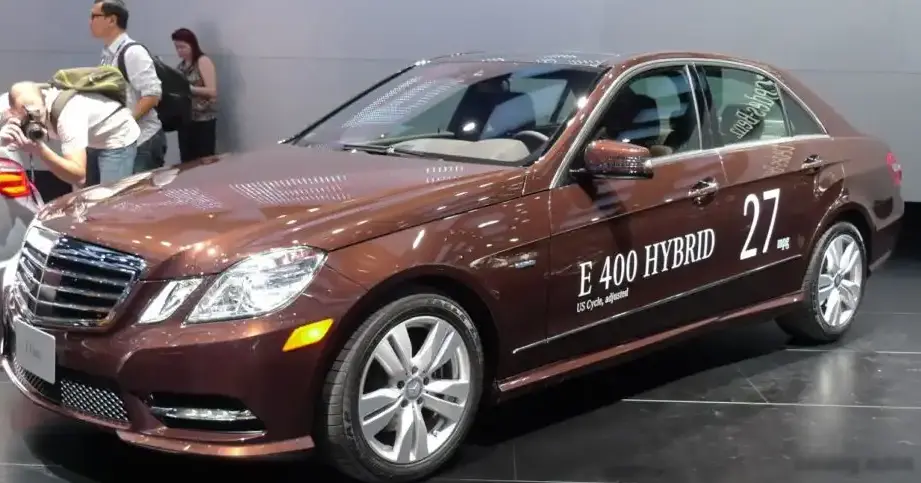
The W212 E-Class, produced from 2009 to 2016, represented a significant evolution for Mercedes-Benz’s mid-size executive sedan. The E 400 Hybrid, introduced in 2012 and continuing through 2013, was a key component of this generation, showcasing Mercedes-Benz’s commitment to fuel efficiency and reduced emissions. Built on the 1HX0/A3 platform, the E 400 Hybrid aimed to deliver a premium driving experience without compromising environmental responsibility. It was positioned above the base E 350 models but below the more performance-oriented E 63 AMG, appealing to a buyer who valued both luxury and efficiency.
Powertrain & Engine Architecture
At the heart of the E 400 Hybrid lies the M 276.952 3.5-liter V6 gasoline engine. This engine, a naturally aspirated powerplant, utilizes direct fuel injection and a double overhead camshaft (DOHC) valvetrain. The engine produces 306 horsepower and 370 Nm (272.9 lb.-ft.) of torque. Integrated with this engine is a 27 horsepower electric motor, powered by a 0.8 kWh lithium-ion battery pack. The electric motor is strategically positioned between the engine and the 7G-TRONIC PLUS seven-speed automatic transmission. This configuration allows for electric-only driving at low speeds and assists the gasoline engine during acceleration, improving overall efficiency. The 7G-TRONIC PLUS transmission is known for its smooth shifting and responsiveness, contributing to a refined driving experience. The hybrid system allows for a limited all-electric range of approximately 1 kilometer (0.62 miles) and a maximum electric speed of 35 km/h (21.75 mph).
Driving Characteristics
The E 400 Hybrid offers a noticeably different driving experience compared to its conventionally powered siblings. The electric motor provides instant torque, resulting in brisk acceleration off the line. While the 0-60 mph time of 6.7 seconds is respectable, it’s slightly slower than the E 350 with the same transmission. However, the hybrid system’s ability to seamlessly blend electric and gasoline power delivers a smooth and refined driving experience. The 7G-TRONIC PLUS transmission is well-tuned, providing quick and precise gear changes. The gear ratios are optimized for both fuel efficiency and performance, allowing the car to maintain comfortable cruising speeds on the highway. Compared to the more powerful E 550 or E 63 AMG models, the E 400 Hybrid prioritizes efficiency over outright performance, offering a more relaxed and comfortable driving experience.
Equipment & Trim Levels
The E 400 Hybrid typically came well-equipped with standard features befitting a luxury sedan. These included leather upholstery, power-adjustable front seats with memory function, dual-zone automatic climate control, a premium audio system, and a navigation system. Standard safety features included ABS, traction control, stability control, and a suite of airbags. Optional extras included a panoramic sunroof, upgraded leather options, a rear-seat entertainment system, and advanced driver-assistance systems such as lane-keeping assist and adaptive cruise control. The interior design was characterized by Mercedes-Benz’s signature elegance and attention to detail, with high-quality materials and a user-friendly interface.
Chassis & Braking
The E 400 Hybrid utilizes a sophisticated suspension system designed to provide a comfortable and controlled ride. The front suspension features coil springs and an independent multi-link setup with a transverse stabilizer bar, while the rear suspension employs an independent multi-link spring suspension with a stabilizer bar. This configuration effectively absorbs bumps and minimizes body roll. The braking system consists of ventilated discs on all four wheels, providing ample stopping power. ABS (Anti-lock Braking System) is standard, enhancing safety and control during emergency braking situations. The electric steering system offers precise and responsive handling, contributing to a confident driving experience.
Market Reception & Comparison
The E 400 Hybrid received generally positive reviews from automotive critics. It was praised for its smooth and refined driving experience, its fuel efficiency, and its luxurious interior. However, some critics noted that the all-electric range was limited and that the hybrid system added some weight to the vehicle. Compared to the E 350, the E 400 Hybrid offered improved fuel economy and a slightly different driving character. Compared to the E 550, it sacrificed some performance in exchange for greater efficiency. The E 400 Hybrid’s fuel economy figures of 8.7 l/100 km (27 US mpg) combined were competitive for its class, making it an attractive option for environmentally conscious buyers.
Legacy
The Mercedes-Benz E 400 Hybrid, while a relatively short-lived model, played an important role in establishing Mercedes-Benz as a leader in hybrid technology. The powertrain, while not without its complexities, proved to be reasonably reliable in the long term. Today, used examples of the E 400 Hybrid are available at relatively affordable prices. Potential buyers should be aware of the potential maintenance costs associated with the hybrid system, including the battery pack. However, for those seeking a luxurious, efficient, and technologically advanced executive sedan, the E 400 Hybrid remains a compelling option.