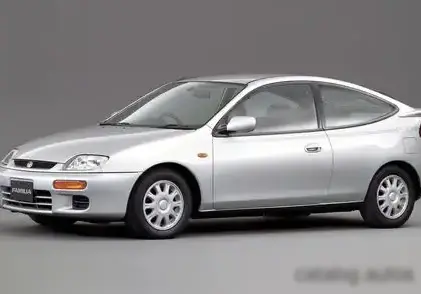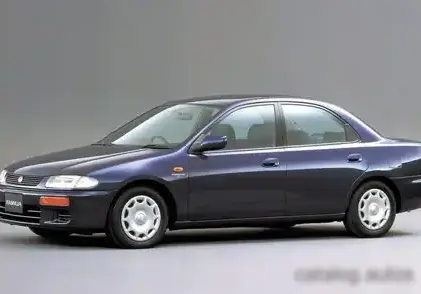
The Mazda Familia 1.3i (85 hp) was a compact sedan produced between 1998 and 2003, representing a key variant within the broader Familia (also known as the 323 in some markets) generation. This particular model, powered by the B3 engine, served as the entry point into the Familia lineup in many regions, particularly in Asia and Latin America. It was designed to offer affordable and reliable transportation, prioritizing fuel efficiency and practicality over outright performance. The Familia, throughout its history, was a significant model for Mazda, known for its balanced engineering and value proposition.
Technical Specifications
| Brand | Mazda |
| Model | Familia |
| Generation | Familia |
| Type (Engine) | 1.3 i (85 Hp) |
| Start of production | 1998 year |
| End of production | 2003 year |
| Powertrain Architecture | Internal Combustion engine |
| Body type | Sedan |
| Seats | 5 |
| Doors | 4 |
| Fuel Type | Petrol (Gasoline) |
| Weight-to-power ratio | 12 kg/Hp, 83.3 Hp/tonne |
| Weight-to-torque ratio | 9.3 kg/Nm, 107.8 Nm/tonne |
| Power | 85 Hp @ 6000 rpm |
| Power per litre | 64.2 Hp/l |
| Torque | 110 Nm @ 4000 rpm |
| Torque (lb-ft) | 81.13 lb.-ft. @ 4000 rpm |
| Engine layout | Front, Transverse |
| Engine Model/Code | B3 |
| Engine displacement | 1323 cm3 |
| Engine displacement (cu. in.) | 80.73 cu. in. |
| Number of cylinders | 4 |
| Engine configuration | Inline |
| Cylinder Bore | 71 mm |
| Cylinder Bore (in.) | 2.8 in. |
| Piston Stroke | 83.6 mm |
| Piston Stroke (in.) | 3.29 in. |
| Compression ratio | 9:1 |
| Number of valves per cylinder | 4 |
| Fuel injection system | Multi-port manifold injection |
| Engine aspiration | Naturally aspirated engine |
| Valvetrain | DOHC |
| Kerb Weight | 1020 kg |
| Kerb Weight (lbs.) | 2248.72 lbs. |
| Fuel tank capacity | 50 l |
| Fuel tank capacity (US gal) | 13.21 US gal |
| Fuel tank capacity (UK gal) | 11 UK gal |
| Length | 4315 mm |
| Length (in.) | 169.88 in. |
| Width | 1695 mm |
| Width (in.) | 66.73 in. |
| Height | 1410 mm |
| Height (in.) | 55.51 in. |
| Wheelbase | 2610 mm |
| Wheelbase (in.) | 102.76 in. |
| Front track | 1470 mm |
| Front track (in.) | 57.87 in. |
| Rear (Back) track | 1470 mm |
| Rear (Back) track (in.) | 57.87 in. |
| Drivetrain Architecture | The Internal combustion engine (ICE) drives the front wheels of the vehicle. |
| Drive wheel | Front wheel drive |
| Front brakes | Ventilated discs |
| Rear brakes | Drum |
| Tires size | 175/70 R13 82 S |
| Wheel rims size | 5J x 13 ET 45 |
Powertrain & Engine Architecture
The heart of the Familia 1.3i was the B3 engine, a 1.3-liter inline-four cylinder gasoline engine. This engine utilized a naturally aspirated configuration with multi-port fuel injection, a common setup for vehicles in this class during the late 1990s and early 2000s. The B3 featured a double overhead camshaft (DOHC) valvetrain, contributing to improved breathing and efficiency compared to older single overhead cam designs. The 9:1 compression ratio was a compromise between performance and the ability to run on readily available fuel grades. The engine was transversely mounted in the front of the vehicle, driving the front wheels. The transmission paired with the B3 was typically a four-speed automatic, chosen for its ease of use and appeal to a broader range of drivers. While not offering the sporty engagement of a manual transmission, the automatic provided smooth shifts and convenient operation in urban environments.
Driving Characteristics
The 85 horsepower output of the 1.3i engine, coupled with the four-speed automatic transmission, resulted in modest but adequate performance. Acceleration was not brisk, with a focus on smooth and predictable power delivery. The automatic transmission’s gear ratios were tuned for fuel economy rather than outright speed. Compared to the higher-output Familia variants, such as those equipped with larger engines, the 1.3i felt noticeably slower, particularly when accelerating for overtaking or merging onto highways. However, the lower power output also contributed to better fuel economy, making it an attractive option for drivers prioritizing cost-effectiveness. The steering was light and easy, making it maneuverable in city traffic, but lacked the precision and feedback found in more performance-oriented vehicles.
Equipment & Trim Levels
The Familia 1.3i typically came with a fairly basic level of equipment, reflecting its position as the entry-level model. Standard features generally included power steering, air conditioning (often optional), and a basic audio system. Interior upholstery was typically cloth, with a simple and functional dashboard layout. Optional extras could include power windows, central locking, and upgraded audio systems. The trim level often dictated the availability of these features, with higher sub-trims offering more amenities. Safety features were also relatively basic, typically including seatbelts and airbags, but lacking the advanced safety systems found in more modern vehicles.
Chassis & Braking
The Familia 1.3i utilized a relatively conventional chassis design, featuring independent front suspension and a torsion beam rear suspension. The front brakes were ventilated discs, providing adequate stopping power for the vehicle’s weight and performance. However, the rear brakes were drums, a cost-saving measure common in this class of vehicle. The suspension was tuned for comfort rather than sporty handling, providing a reasonably smooth ride over uneven surfaces. The 175/70 R13 tires were chosen for their balance of grip, ride comfort, and affordability. Stabilizer bars were often omitted or smaller in diameter compared to higher-spec Familia models, further emphasizing the focus on comfort over handling.
Market Reception & Comparison
The Mazda Familia 1.3i was generally well-received as an affordable and reliable compact sedan. Critics praised its fuel efficiency and practicality, but noted its lack of performance compared to other variants in the Familia lineup. Compared to the 1.5L or 1.8L Familia models, the 1.3i offered significantly less power and acceleration. However, it also offered lower running costs and a more accessible price point. In terms of reliability, the B3 engine proved to be generally robust, with relatively few major issues reported. Fuel economy was a strong point, consistently achieving respectable figures for its class.
Legacy
The Mazda Familia 1.3i, while not the most powerful or exciting variant of the Familia, remains a popular choice in the used car market, particularly in regions where affordability and reliability are highly valued. The B3 engine is known for its durability and relatively low maintenance costs. Parts availability is generally good, making it a practical option for budget-conscious buyers. While it may not offer the same level of refinement or technology as more modern vehicles, the Familia 1.3i continues to provide dependable transportation for those seeking a simple and economical compact sedan.