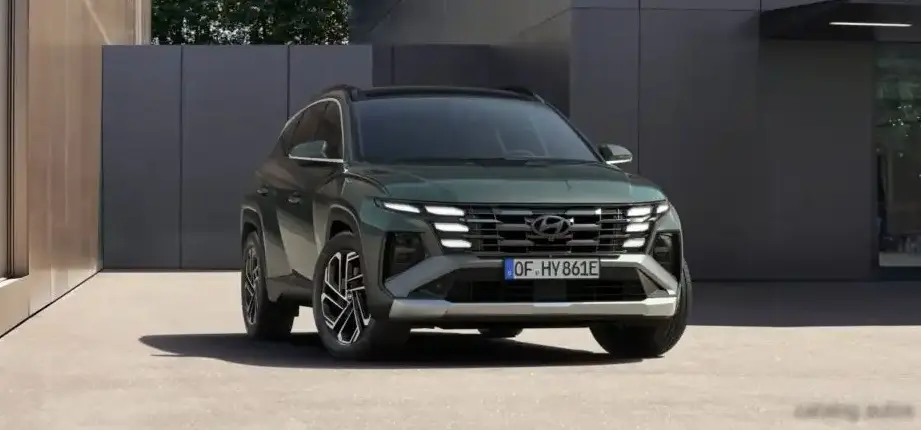
The Hyundai Tucson IV, specifically the facelifted version introduced in 2024, represents a significant evolution of Hyundai’s popular compact SUV. The 1.6 T-GDI (150 hp) variant, slated for production starting in September 2025, occupies a key position within the Tucson IV lineup, offering a balance between fuel efficiency, performance, and affordability. This model is primarily targeted towards the European and global markets, where smaller displacement turbocharged engines are increasingly favored due to emissions regulations and fuel economy concerns. It builds upon the foundation of the NX4 platform (also known as the 1HX0 internally), offering a modern and feature-rich SUV experience.
Technical Specifications
| Brand | Hyundai |
| Model | Tucson |
| Generation | Tucson IV (facelift 2024) |
| Type (Engine) | 1.6 T-GDI (150 Hp) |
| Start of production | September, 2025 |
| Powertrain Architecture | Internal Combustion engine |
| Body type | SUV |
| Seats | 5 |
| Doors | 5 |
| Combined fuel consumption (WLTP) | 7.1 l/100 km |
| Combined fuel consumption (US mpg) | 33.1 US mpg |
| Combined fuel consumption (UK mpg) | 39.8 UK mpg |
| Combined fuel consumption (km/l) | 14.1 km/l |
| CO2 emissions (WLTP) | 162 g/km |
| Fuel Type | Petrol (Gasoline) |
| Acceleration 0 – 100 km/h | 9.5 sec |
| Acceleration 0 – 62 mph | 9.5 sec |
| Acceleration 0 – 60 mph | 9 sec |
| Maximum speed | 196 km/h (121.79 mph) |
| Emission standard | Euro 6e-bis |
| Weight-to-power ratio | 9.8 kg/Hp, 102.2 Hp/tonne |
| Weight-to-torque ratio | 5.9 kg/Nm, 170.4 Nm/tonne |
| Power | 150 Hp @ 4500-6000 rpm |
| Power per litre | 93.9 Hp/l |
| Torque | 250 Nm @ 1500-4000 rpm (184.39 lb.-ft. @ 1500-4000 rpm) |
| Engine layout | Front, Transverse |
| Engine Model/Code | G4FY |
| Engine displacement | 1598 cm3 (97.52 cu. in.) |
| Number of cylinders | 4 |
| Engine configuration | Inline |
| Cylinder Bore | 75.6 mm (2.98 in.) |
| Piston Stroke | 89 mm (3.5 in.) |
| Number of valves per cylinder | 4 |
| Fuel injection system | Direct injection |
| Engine aspiration | Turbocharger, Intercooler |
| Engine oil capacity | 4.8 l (5.07 US qt | 4.22 UK qt) |
| Coolant | 7.9 l (8.35 US qt | 6.95 UK qt) |
| Kerb Weight | 1467-1608 kg (3234.18 – 3545.03 lbs.) |
| Max. weight | 2065 kg (4552.55 lbs.) |
| Max load | 457-598 kg (1007.51 – 1318.36 lbs.) |
| Trunk (boot) space – minimum | 620 l (21.9 cu. ft.) |
| Trunk (boot) space – maximum | 1799 l (63.53 cu. ft.) |
| Fuel tank capacity | 54 l (14.27 US gal | 11.88 UK gal) |
| Max. roof load | 100 kg (220.46 lbs.) |
| Permitted trailer load with brakes (12%) | 1650 kg (3637.63 lbs.) |
| Permitted trailer load without brakes | 750 kg (1653.47 lbs.) |
| Permitted towbar download | 100 kg (220.46 lbs.) |
| Length | 4525 mm (178.15 in.) |
| Width | 1865 mm (73.43 in.) |
| Height | 1650 mm (64.96 in.) |
| Wheelbase | 2680 mm (105.51 in.) |
| Front track | 1630 mm (64.17 in.) |
| Rear (Back) track | 1637 mm (64.45 in.) |
| Ride height (ground clearance) | 170 mm (6.69 in.) |
| Drivetrain Architecture | The Internal combustion engine (ICE) drives the front wheels of the vehicle. |
| Drive wheel | Front wheel drive |
| Number of gears and type of gearbox | 6 gears, manual transmission |
| Front suspension | Independent type McPherson |
| Rear suspension | Independent multi-link suspension |
| Front brakes | Ventilated discs |
| Rear brakes | Disc |
| Assisting systems | ABS (Anti-lock braking system) |
| Steering type | Steering rack and pinion |
| Power steering | Electric Steering |
| Tires size | 215/65 R17 |
| Wheel rims size | 7.0J x 17 |
Powertrain & Engine Architecture
At the heart of the Tucson 1.6 T-GDI lies the Hyundai-Kia G4FY engine, a 1.6-liter inline-four cylinder gasoline engine. This engine utilizes direct injection technology, delivering fuel directly into the combustion chamber for improved efficiency and power. A single twin-scroll turbocharger, coupled with an intercooler, provides forced induction, boosting power output. The engine’s valvetrain features dual continuously variable valve timing (CVVT) on both intake and exhaust camshafts, optimizing engine breathing across the rev range. The 6-speed manual transmission is standard, providing drivers with direct control over gear selection. This transmission is known for its relatively smooth shifts and durability. The engine is designed to meet stringent Euro 6e-bis emission standards, incorporating a particulate filter to reduce harmful emissions.
Driving Characteristics
The 150 hp output of the 1.6 T-GDI, combined with the 250 Nm (184 lb-ft) of torque, provides adequate performance for everyday driving. Acceleration from 0 to 100 km/h (0-62 mph) takes approximately 9.5 seconds. While not a performance-oriented trim, the turbocharger provides a noticeable boost in power during acceleration, making overtaking maneuvers relatively effortless. The manual transmission allows for precise control, but the gear ratios are tuned for fuel efficiency rather than outright speed. Compared to higher-output versions of the Tucson IV, such as those equipped with more powerful engines, the 1.6 T-GDI offers a more relaxed and economical driving experience. It prioritizes fuel efficiency and comfort over sporty handling.
Equipment & Trim Levels
The 1.6 T-GDI trim typically comes with a respectable level of standard equipment. This generally includes air conditioning, a touchscreen infotainment system with Apple CarPlay and Android Auto compatibility, Bluetooth connectivity, and a suite of safety features such as ABS, electronic stability control, and multiple airbags. Higher trim levels offer additional features like leather upholstery, a panoramic sunroof, heated seats, and advanced driver-assistance systems (ADAS) such as adaptive cruise control and lane-keeping assist. Interior upholstery is typically cloth on base models, with options for leather or premium cloth on higher trims. Dashboard configurations are modern and user-friendly, with a focus on intuitive controls.
Chassis & Braking
The Tucson IV utilizes a McPherson strut front suspension and a multi-link rear suspension, providing a comfortable and controlled ride. The suspension is tuned to prioritize comfort over sporty handling. Braking duties are handled by ventilated discs at the front and solid discs at the rear. ABS (Anti-lock Braking System) is standard, enhancing braking performance and stability. The electric power steering provides light and precise steering feel. The chassis is designed to provide a stable and secure driving experience, with a focus on minimizing body roll and maximizing passenger comfort.
Market Reception & Comparison
The 1.6 T-GDI variant of the Tucson IV has been generally well-received by critics as a practical and efficient option. Its fuel economy of 7.1 l/100 km (33.1 US mpg) is competitive within its class. Compared to diesel variants, the 1.6 T-GDI offers a lower initial cost and potentially lower maintenance costs, although it may not achieve the same level of fuel economy. Compared to higher-output gasoline engines, it provides a more affordable entry point into the Tucson IV range. Reliability has been generally good, with few reported issues specific to the 1.6 T-GDI powertrain.
Legacy
The Hyundai Tucson IV 1.6 T-GDI is expected to maintain a solid reputation for reliability and affordability in the used car market. The G4FY engine has proven to be a durable and relatively trouble-free unit. As with any used vehicle, regular maintenance is crucial to ensure long-term reliability. The combination of fuel efficiency, practicality, and a reasonable price point makes this variant a compelling option for buyers seeking a well-rounded compact SUV.