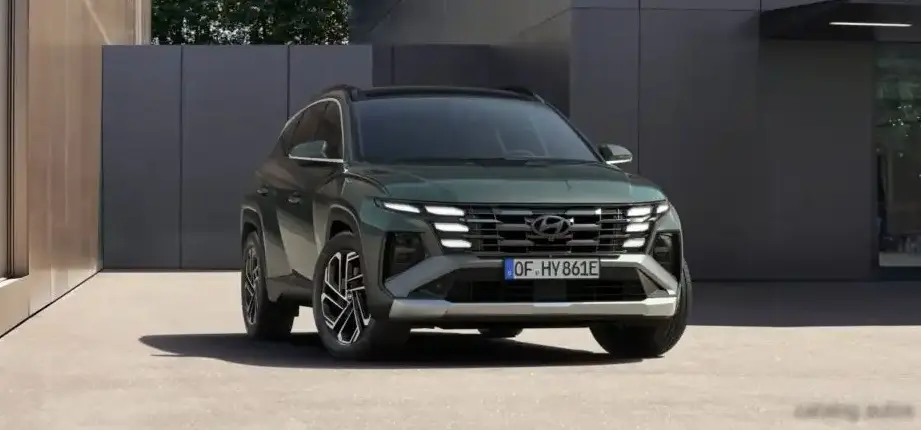
The Hyundai Tucson IV, specifically the facelifted model introduced in 2024, represents a significant evolution of Hyundai’s popular compact SUV. The 1.6 T-GDI (150 hp) variant with a Dual Clutch Transmission (DCT) began production in September 2025 and is positioned as a mainstream offering within the Tucson IV lineup, balancing fuel efficiency with adequate performance. This model caters to buyers seeking a modern, well-equipped SUV without the higher price tag of the more powerful engine options. It builds upon the foundation of the NX4 platform (also known as the 1HX0 internally), shared with the Kia Sportage and other Hyundai group vehicles.
Technical Specifications
| Brand | Hyundai |
| Model | Tucson |
| Generation | Tucson IV (facelift 2024) |
| Type (Engine) | 1.6 T-GDI (150 Hp) DCT |
| Start of production | September, 2025 |
| Powertrain Architecture | Internal Combustion engine |
| Body type | SUV |
| Seats | 5 |
| Doors | 5 |
| Combined fuel consumption (WLTP) | 7.0-7.1 l/100 km (33.6 – 33.1 US mpg, 40.4 – 39.8 UK mpg, 14.3 – 14.1 km/l) |
| CO2 emissions (WLTP) | 158-162 g/km |
| Fuel Type | Petrol (Gasoline) |
| Acceleration 0 – 100 km/h | 9.4 sec |
| Acceleration 0 – 62 mph | 9.4 sec |
| Acceleration 0 – 60 mph | 8.9 sec |
| Maximum speed | 196 km/h (121.79 mph) |
| Emission standard | Euro 6e-bis |
| Weight-to-power ratio | 10 kg/Hp, 100.5 Hp/tonne |
| Weight-to-torque ratio | 6 kg/Nm, 167.4 Nm/tonne |
| Power | 150 Hp @ 4500-6000 rpm |
| Power per litre | 93.9 Hp/l |
| Torque | 250 Nm @ 1500-4000 rpm (184.39 lb.-ft. @ 1500-4000 rpm) |
| Engine layout | Front, Transverse |
| Engine Model/Code | G4FY |
| Engine displacement | 1598 cm3 (97.52 cu. in.) |
| Number of cylinders | 4 |
| Engine configuration | Inline |
| Cylinder Bore | 75.6 mm (2.98 in.) |
| Piston Stroke | 89 mm (3.5 in.) |
| Number of valves per cylinder | 4 |
| Fuel injection system | Direct injection |
| Engine aspiration | Turbocharger, Intercooler |
| Engine oil capacity | 4.8 l (5.07 US qt | 4.22 UK qt) |
| Coolant | 7.9 l (8.35 US qt | 6.95 UK qt) |
| Kerb Weight | 1493-1635 kg (3291.5 – 3604.56 lbs.) |
| Max. weight | 2095 kg (4618.68 lbs.) |
| Max load | 460-602 kg (1014.13 – 1327.18 lbs.) |
| Trunk (boot) space – minimum | 620 l (21.9 cu. ft.) |
| Trunk (boot) space – maximum | 1799 l (63.53 cu. ft.) |
| Fuel tank capacity | 54 l (14.27 US gal | 11.88 UK gal) |
| Max. roof load | 100 kg (220.46 lbs.) |
| Permitted trailer load with brakes (12%) | 1650 kg (3637.63 lbs.) |
| Permitted trailer load without brakes | 750 kg (1653.47 lbs.) |
| Permitted towbar download | 100 kg (220.46 lbs.) |
| Length | 4525 mm (178.15 in.) |
| Width | 1865 mm (73.43 in.) |
| Height | 1650 mm (64.96 in.) |
| Wheelbase | 2680 mm (105.51 in.) |
| Front track | 1615-1630 mm (63.58 – 64.17 in.) |
| Rear (Back) track | 1622-1637 mm (63.86 – 64.45 in.) |
| Ride height (ground clearance) | 170 mm (6.69 in.) |
| Drivetrain Architecture | The Internal combustion engine (ICE) drives the front wheels of the vehicle. |
| Drive wheel | Front wheel drive |
| Number of gears and type of gearbox | 7 gears, automatic transmission DCT |
| Front suspension | Independent type McPherson |
| Rear suspension | Independent multi-link suspension |
| Front brakes | Ventilated discs |
| Rear brakes | Disc |
| Assisting systems | ABS (Anti-lock braking system) |
| Steering type | Steering rack and pinion |
| Power steering | Electric Steering |
| Tires size | 215/65 R17; 235/55 R18 |
| Wheel rims size | 7.0J x 17; 7.5J x 18 |
Powertrain & Engine Architecture
At the heart of this Tucson variant lies the Hyundai G4FY engine, a 1.6-liter turbocharged four-cylinder gasoline engine. This engine utilizes direct injection technology, enhancing fuel efficiency and power delivery. The turbocharger, coupled with an intercooler, provides a boost in power output, allowing the engine to produce 150 horsepower and 250 Nm (184 lb-ft) of torque. The engine’s architecture features a cast iron block and an aluminum cylinder head, contributing to a balance of durability and weight reduction. The G4FY engine is known for its relatively quiet operation and responsiveness. The engine is paired with a 7-speed Dual Clutch Transmission (DCT). DCTs offer faster and smoother gear changes compared to traditional automatic transmissions, contributing to improved acceleration and fuel economy. This particular DCT is designed for efficiency and reliability, with optimized shift logic for everyday driving conditions.
Driving Characteristics
The 1.6 T-GDI with DCT delivers a comfortable and refined driving experience. Acceleration from 0 to 60 mph takes approximately 8.9 seconds, which is adequate for most daily driving scenarios. The DCT provides quick and seamless gear changes, enhancing responsiveness during acceleration and overtaking maneuvers. While not as sporty as the higher-output engine options, the 1.6 T-GDI offers sufficient power for highway cruising and city driving. The DCT’s programming prioritizes fuel efficiency, resulting in slightly less aggressive shift points compared to sportier DCT setups. The steering is light and precise, making the Tucson easy to maneuver in urban environments. Overall, the driving experience is geared towards comfort and ease of use rather than outright performance.
Equipment & Trim Levels
The 1.6 T-GDI DCT trim typically includes a comprehensive suite of standard features. These generally include automatic climate control, a touchscreen infotainment system with Apple CarPlay and Android Auto compatibility, a rearview camera, and a suite of advanced driver-assistance systems (ADAS) such as lane-keeping assist, forward collision avoidance assist, and adaptive cruise control. Interior upholstery is typically cloth, with options for leather upgrades available. Higher trim levels within the 1.6 T-GDI range may add features such as a panoramic sunroof, heated and ventilated front seats, and a premium audio system. Optional extras often include navigation, upgraded wheels, and various cosmetic enhancements.
Chassis & Braking
The Tucson IV utilizes a front-wheel-drive chassis with independent suspension at all four corners. The front suspension employs a McPherson strut design, while the rear features a multi-link setup. This configuration provides a comfortable ride quality and good handling characteristics. The braking system consists of ventilated discs at the front and solid discs at the rear, providing adequate stopping power for the vehicle’s weight class. Anti-lock Braking System (ABS) is standard, enhancing safety during emergency braking situations. The suspension tuning is geared towards comfort, prioritizing ride quality over sporty handling.
Market Reception & Comparison
The 1.6 T-GDI DCT variant of the Tucson IV has been well-received in the market as a practical and efficient option. Critics have praised its comfortable ride, spacious interior, and comprehensive feature set. Compared to the more powerful 2.5-liter engine option, the 1.6 T-GDI offers better fuel economy but slightly less performance. It also represents a more affordable entry point into the Tucson IV range. Compared to diesel variants (where available), the 1.6 T-GDI offers a smoother and quieter driving experience, although it may not match the diesel’s low-end torque. Reliability has been generally good, with few reported issues specific to the 1.6 T-GDI powertrain.
Legacy
The Hyundai G4FY engine and the associated 7-speed DCT have proven to be relatively reliable powertrains in the Tucson IV. While long-term durability data is still emerging, early indications suggest that these components are holding up well under normal driving conditions. In the used car market, the 1.6 T-GDI DCT variant is expected to hold its value reasonably well, appealing to buyers seeking a modern, fuel-efficient, and well-equipped compact SUV. Regular maintenance, including timely oil changes and DCT fluid replacements, will be crucial for ensuring the longevity of this powertrain.