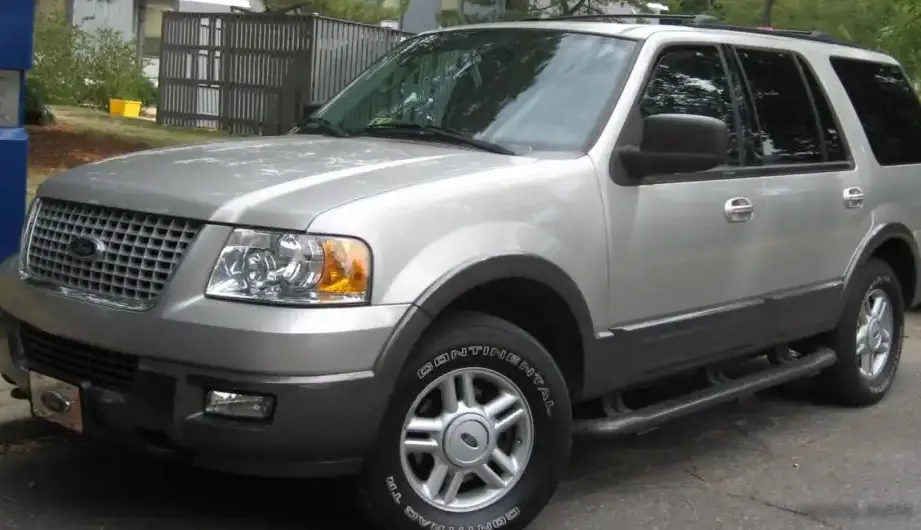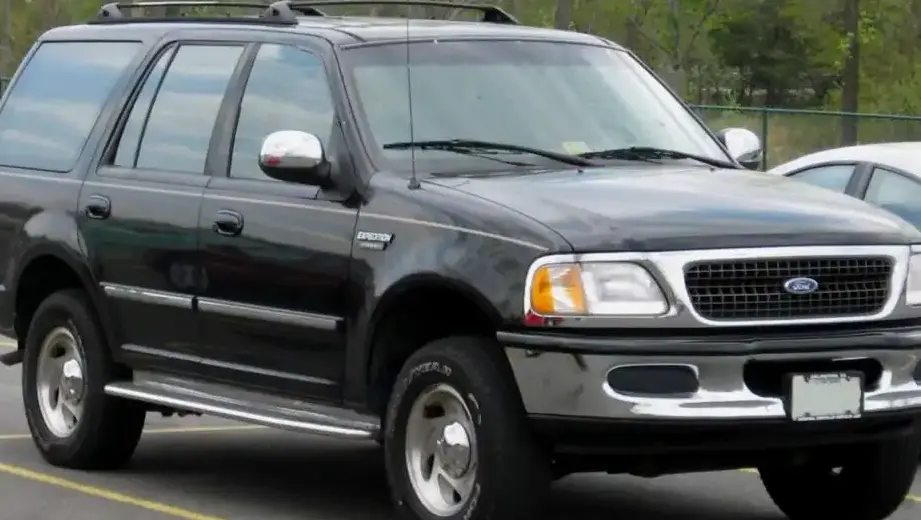
The Ford Expedition, introduced in 1997 as a replacement for the Ford Bronco II and the full-size Bronco, quickly became a cornerstone of Ford’s SUV lineup. The first generation, designated the U173, spanned from 1997 to 2003. Among the various configurations offered, the 5.4-liter V8 engine paired with a four-speed automatic transmission and four-wheel drive represents a popular and capable choice for American families seeking a large, comfortable, and powerful SUV. This variant was positioned as a mid-to-upper trim level, offering a significant step up in performance from the base 4.6-liter V8 while remaining more accessible than potential future high-performance or luxury-focused Expedition models.
Technical Specifications
| Brand | Ford |
| Model | Expedition |
| Generation | Expedition I (U173) |
| Type (Engine) | 5.4 i V8 16V (264 Hp) 4WD |
| Start of production | 1999 year |
| End of production | 2003 year |
| Powertrain Architecture | Internal Combustion engine |
| Body type | SUV |
| Seats | 5 |
| Doors | 5 |
| Fuel consumption (urban) | 15.7 l/100 km (15 US mpg, 18 UK mpg) |
| Fuel consumption (extra urban) | 11.8 l/100 km (19.9 US mpg, 23.9 UK mpg) |
| Fuel Type | Petrol (Gasoline) |
| Acceleration 0 – 100 km/h | 10 sec |
| Acceleration 0 – 62 mph | 10 sec |
| Acceleration 0 – 60 mph | 9.5 sec |
| Maximum speed | 165 km/h (102.53 mph) |
| Weight-to-power ratio | 9.7 kg/Hp |
| Weight-to-torque ratio | 5.4 kg/Nm |
| Power | 264 Hp @ 4500 rpm |
| Torque | 474 Nm @ 2500 rpm (349.6 lb.-ft. @ 2500 rpm) |
| Engine layout | Front, Longitudinal |
| Engine Model/Code | Triton |
| Engine displacement | 5398 cm3 (329.41 cu. in.) |
| Number of cylinders | 8 |
| Engine configuration | V-engine |
| Cylinder Bore | 90.2 mm (3.55 in.) |
| Piston Stroke | 105.7 mm (4.16 in.) |
| Compression ratio | 9:1 |
| Number of valves per cylinder | 2 |
| Fuel injection system | Multi-port manifold injection |
| Engine aspiration | Naturally aspirated engine |
| Valvetrain | OHC |
| Engine oil capacity | 5.7 l (6.02 US qt | 5.02 UK qt) |
| Coolant capacity | 19.7 l (20.82 US qt | 17.33 UK qt) |
| Kerb Weight | 2555 kg (5632.81 lbs.) |
| Max. weight | 3357 kg (7400.92 lbs.) |
| Max load | 802 kg (1768.11 lbs.) |
| Trunk (boot) space – minimum | 1725 l (60.92 cu. ft.) |
| Trunk (boot) space – maximum | 3135 l (110.71 cu. ft.) |
| Fuel tank capacity | 113 l (29.85 US gal | 24.86 UK gal) |
| Length | 5198 mm (204.65 in.) |
| Width | 1996 mm (78.58 in.) |
| Height | 1992 mm (78.43 in.) |
| Wheelbase | 3023 mm (119.02 in.) |
| Front track | 1661 mm (65.39 in.) |
| Rear (Back) track | 1664 mm (65.51 in.) |
| Drivetrain Architecture | All wheel drive (4×4) |
| Number of gears | 4 |
| Type of gearbox | automatic transmission |
| Front suspension | Torsion |
| Rear suspension | Rigid axle suspension |
| Front brakes | Ventilated discs |
| Rear brakes | Disc |
| Assisting systems | ABS (Anti-lock braking system) |
| Power steering | Hydraulic Steering |
| Tires size | 265/70 R17 |
Powertrain & Engine Architecture
The heart of this Expedition variant is Ford’s 5.4-liter Triton V8 engine. Introduced in 1996, the Triton family of engines became a mainstay of Ford’s truck and SUV offerings. This particular iteration, used from 1999-2003, features a 90.2mm bore and 105.7mm stroke, resulting in a displacement of 5398cc (329.41 cubic inches). The engine utilizes a single overhead camshaft (OHC) design with two valves per cylinder, and a multi-port fuel injection system. The 9:1 compression ratio was a compromise between performance and the ability to run on readily available gasoline grades. The engine’s code is often simply referred to as “Triton,” but specific variations exist. The four-speed 4R70W automatic transmission was the standard pairing for the 5.4L engine. This transmission is known for its durability and relatively smooth shifting, although it lacks the efficiency of more modern transmissions with additional gears.
Driving Characteristics
The 5.4-liter V8, producing 264 horsepower and 349.6 lb-ft of torque, provided a noticeable performance advantage over the base 4.6-liter engine. Acceleration from 0-60 mph was achieved in around 9.5 seconds, making it adequately quick for highway merging and passing maneuvers. While not a sports car, the Expedition 5.4L offered sufficient power to comfortably tow trailers and handle fully loaded passenger compartments. The four-speed automatic transmission, while reliable, had relatively wide gear ratios. This meant that the engine often operated at higher RPMs during highway cruising, impacting fuel economy. Compared to manual transmission equipped Expeditions (which were less common), the automatic offered convenience but sacrificed some driver control and responsiveness. The 5.4L also felt more refined and less strained than the 4.6L when subjected to demanding tasks like towing or climbing steep hills.
Equipment & Trim Levels
The 5.4-liter Expedition typically came equipped with features considered standard for a mid-range SUV of the era. These included air conditioning, power windows and locks, a CD player, and cloth upholstery. Higher trim levels, such as the Eddie Bauer edition, added leather upholstery, woodgrain interior trim, upgraded audio systems, and additional convenience features like heated seats and automatic climate control. Optional extras included a power sunroof, rear entertainment system, and upgraded towing packages. The exterior styling remained consistent across most trim levels, with minor variations in wheel designs and body cladding.
Chassis & Braking
The first-generation Expedition utilized a body-on-frame construction, providing a robust and durable platform. The front suspension employed torsion bars, while the rear suspension featured a solid axle with leaf springs. This setup prioritized ride comfort and load-carrying capacity over sporty handling. Braking duties were handled by ventilated discs at the front and solid discs at the rear. Anti-lock brakes (ABS) were standard equipment, enhancing safety during emergency braking situations. The steering system was hydraulic power-assisted, providing relatively light and easy steering effort.
Market Reception & Comparison
The Expedition, particularly with the 5.4-liter V8, was well-received by American consumers. Critics praised its spacious interior, comfortable ride, and strong towing capacity. The 5.4L engine was considered a significant upgrade over the 4.6L, offering a more satisfying driving experience. However, fuel economy was a common criticism, as the large SUV and powerful engine combination resulted in relatively high fuel consumption. Compared to the 4.6L Expedition, the 5.4L commanded a higher price but offered a better balance of performance and capability. The 5.4L also proved to be more reliable than some of the early iterations of the 4.6L engine.
Legacy
The first-generation Ford Expedition established a strong foundation for the model line. The 5.4-liter Triton V8, while eventually superseded by more modern engines, proved to be a durable and reliable powertrain when properly maintained. Today, these Expeditions can be found in the used car market at relatively affordable prices. Common maintenance issues include oil leaks, spark plug issues, and potential timing chain wear. However, with regular servicing and attention to detail, these vehicles can provide years of reliable service. The 5.4L Expedition remains a popular choice for those seeking a large, capable, and comfortable SUV with a proven track record.