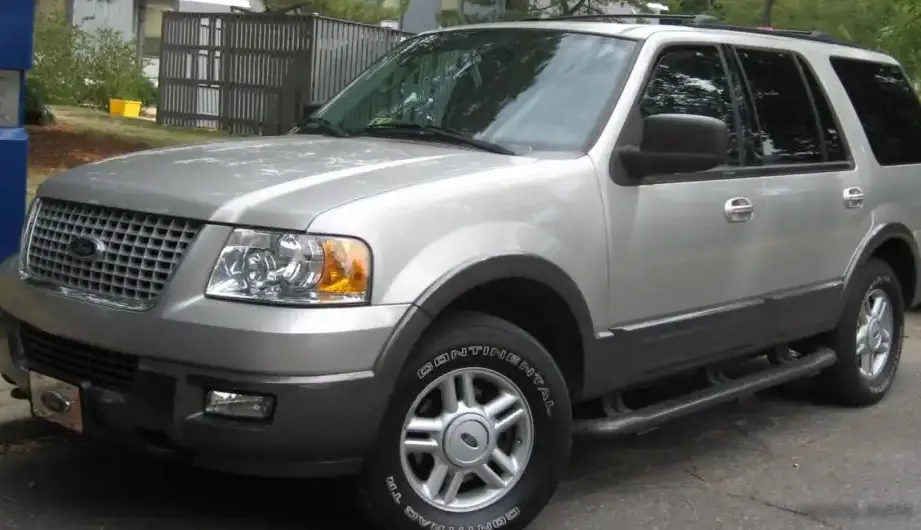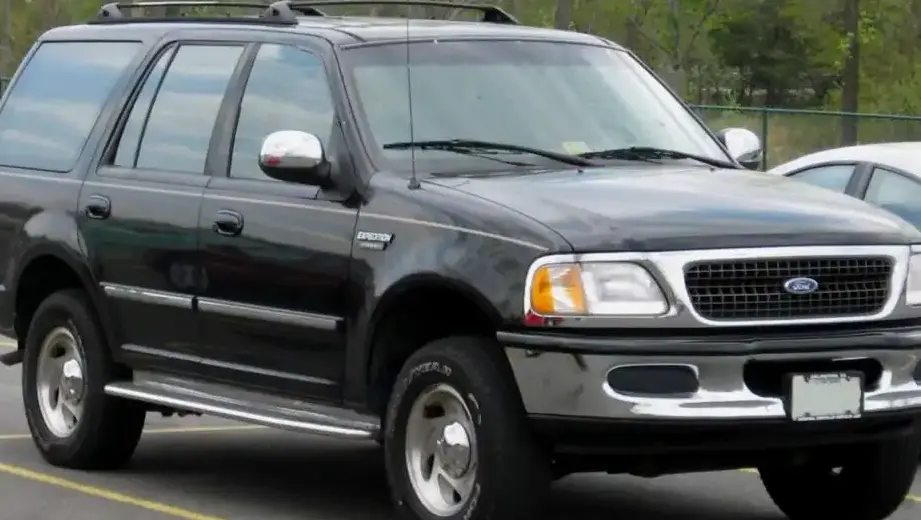
The Ford Expedition, introduced in 1997 as a 1997 model year vehicle, represented Ford’s entry into the burgeoning full-size SUV market. Replacing the Ford Bronco and mirroring the popular Chevrolet Tahoe and GMC Yukon, the first-generation Expedition (U173) was built on a modified Ford F-150 pickup truck chassis. The 5.4 i V8 16V XLT 4WD variant, produced from 1997 to 2003, occupied a significant position within the Expedition lineup, offering a balance of power, capability, and features aimed at families and those needing substantial towing capacity. This model year marked a shift towards more comfortable and family-oriented large SUVs, moving away from the more rugged, utilitarian focus of its predecessors.
Technical Specifications
| Brand | Ford |
| Model | Expedition |
| Generation | Expedition I (U173) |
| Type | 5.4 i V8 16V XLT 4WD (232 Hp) |
| Start of production | 1997 year |
| End of production | 2003 year |
| Powertrain Architecture | Internal Combustion engine |
| Body type | SUV |
| Seats | 5 |
| Doors | 5 |
| Fuel consumption (urban) | 18.1 l/100 km (13 US mpg, 15.6 UK mpg, 5.5 km/l) |
| Fuel consumption (extra urban) | 13.1 l/100 km (18 US mpg, 21.6 UK mpg, 7.6 km/l) |
| Fuel Type | Petrol (Gasoline) |
| Acceleration 0 – 100 km/h | 10 sec |
| Acceleration 0 – 62 mph | 10 sec |
| Acceleration 0 – 60 mph | 9.5 sec |
| Maximum speed | 180 km/h (111.85 mph) |
| Weight-to-power ratio | 10.2 kg/Hp, 98.3 Hp/tonne |
| Weight-to-torque ratio | 5.4 kg/Nm, 186.9 Nm/tonne |
| Power | 232 Hp @ 4250 rpm |
| Power per litre | 43 Hp/l |
| Torque | 441 Nm @ 3000 rpm (325.26 lb.-ft. @ 3000 rpm) |
| Engine layout | Front, Longitudinal |
| Engine Model/Code | Triton |
| Engine displacement | 5398 cm3 (329.41 cu. in.) |
| Number of cylinders | 8 |
| Engine configuration | V-engine |
| Cylinder Bore | 90.2 mm (3.55 in.) |
| Piston Stroke | 105.7 mm (4.16 in.) |
| Compression ratio | 9:1 |
| Number of valves per cylinder | 2 |
| Fuel injection system | Multi-port manifold injection |
| Engine aspiration | Naturally aspirated engine |
| Valvetrain | OHC |
| Engine oil capacity | 5.7 l (6.02 US qt | 5.02 UK qt) |
| Coolant capacity | 19.7 l (20.82 US qt | 17.33 UK qt) |
| Kerb Weight | 2360 kg (5202.91 lbs.) |
| Trunk (boot) space – maximum | 3350 l (118.3 cu. ft.) |
| Fuel tank capacity | 98 l (25.89 US gal | 21.56 UK gal) |
| Length | 5200 mm (204.72 in.) |
| Width | 2000 mm (78.74 in.) |
| Height | 1900 mm (74.8 in.) |
| Wheelbase | 3020 mm (118.9 in.) |
| Front track | 1660 mm (65.35 in.) |
| Rear (Back) track | 1660 mm (65.35 in.) |
| Drive wheel | All wheel drive (4×4) |
| Number of gears and type of gearbox | 4 gears, automatic transmission |
| Front suspension | Torsion |
| Rear suspension | Rigid axle suspension |
| Front brakes | Ventilated discs |
| Rear brakes | Disc |
| Assisting systems | ABS (Anti-lock braking system), Hydraulic Steering |
| Tires size | 265/70 R17 |
INTRODUCTION
The Ford Expedition I (U173) 5.4 i V8 16V XLT 4WD, produced between 1997 and 2003, was a cornerstone of Ford’s full-size SUV offerings. Built on the F-150 platform, it provided a more comfortable and refined experience compared to the truck it was based on. The “XLT” trim level represented a mid-range offering, balancing affordability with a respectable level of features. The 5.4-liter V8 engine paired with a four-speed automatic transmission was a popular combination, offering a good compromise between power and fuel economy for the time. This variant aimed to appeal to families and individuals needing a versatile vehicle capable of both daily driving and occasional towing or off-road adventures.
Powertrain & Engine Architecture
At the heart of the Expedition XLT 4WD was Ford’s 5.4-liter Triton V8 engine. This engine, designated as the engine code 460, was a three-valve-per-cylinder design featuring a 9:1 compression ratio. It utilized a multi-port fuel injection system, delivering fuel directly to each intake port for improved efficiency and power delivery. The overhead camshaft (OHC) valvetrain contributed to smoother operation and reduced maintenance compared to older pushrod designs. The engine produced 232 horsepower at 4250 rpm and 441 lb-ft of torque at 3000 rpm. The four-speed automatic transmission (4R70W) was chosen for its durability and ability to handle the engine’s torque output. This transmission featured electronic control for smoother shifting and improved fuel efficiency. The transmission’s gear ratios were optimized for both on-road cruising and towing, providing adequate power across a wide range of speeds.
Driving Characteristics
The 5.4L V8 and 4-speed automatic combination in the Expedition XLT 4WD delivered adequate, though not exhilarating, performance. Acceleration from 0-60 mph took around 9.5 seconds, which was typical for a full-size SUV of that era. The automatic transmission provided smooth shifts, but could sometimes feel hesitant during quick acceleration. Compared to the smaller 4.6L V8 offered in lower trims, the 5.4L provided noticeably more power, especially when towing or carrying a full load. However, it wasn’t as sporty or responsive as the later, higher-output versions of the 5.4L Triton engine. The 4WD system offered improved traction in inclement weather and on unpaved surfaces, making it a capable all-weather vehicle. The overall driving experience was characterized by a comfortable ride and a stable feel, thanks to the robust chassis and suspension.
Equipment & Trim Levels
The XLT trim level offered a good balance of features. Standard equipment typically included air conditioning, power windows and locks, a CD player, and cloth upholstery. The XLT also featured upgraded interior trim compared to the base models. Optional extras included leather upholstery, a power sunroof, upgraded sound systems, and a rear entertainment system. The Expedition XLT 4WD also offered a range of convenience features, such as keyless entry and a trip computer. The interior layout was designed with family use in mind, offering ample space for passengers and cargo. The third-row seating, while somewhat cramped for adults, provided additional seating capacity when needed.
Chassis & Braking
The Expedition’s chassis was based on the Ford F-150 pickup truck, providing a robust and durable foundation. The front suspension utilized a torsion bar setup, while the rear suspension featured a solid axle with leaf springs. This configuration provided a comfortable ride and good load-carrying capacity. The braking system consisted of ventilated discs on the front wheels and discs on the rear wheels. Anti-lock brakes (ABS) were standard, enhancing safety and control during emergency braking situations. The 4WD system was a part-time system, allowing the driver to switch between two-wheel drive and four-wheel drive as needed. The tires, typically 265/70 R17, were designed to provide good traction on both paved and unpaved surfaces.
Market Reception & Comparison
The Ford Expedition was well-received by critics and consumers alike. It quickly became a popular choice in the full-size SUV segment, challenging the dominance of Chevrolet and GMC. The 5.4L V8 engine was praised for its power and torque, making it a capable towing vehicle. However, fuel economy was a common criticism, as the Expedition was not particularly fuel-efficient. Compared to the 4.6L V8 offered in lower trims, the 5.4L provided a noticeable performance boost, but at the cost of slightly lower fuel economy. The Expedition also offered more interior space and cargo capacity than many of its competitors. Reliability was generally good, although some owners reported issues with the automatic transmission and the 4WD system.
Legacy
The first-generation Ford Expedition established the model as a major player in the full-size SUV market. The 5.4L Triton V8 engine, while later revised and improved, proved to be a durable and reliable powerplant. Today, well-maintained examples of the Expedition XLT 4WD are still found on the used car market, often appealing to buyers seeking an affordable and capable SUV. While fuel economy remains a concern, the Expedition’s spacious interior, towing capacity, and available 4WD system continue to make it a practical choice for families and those needing a versatile vehicle. The 5.4L engine, while known for potential spark plug issues in some years, generally holds up well with proper maintenance, making these Expeditions relatively affordable to keep running.