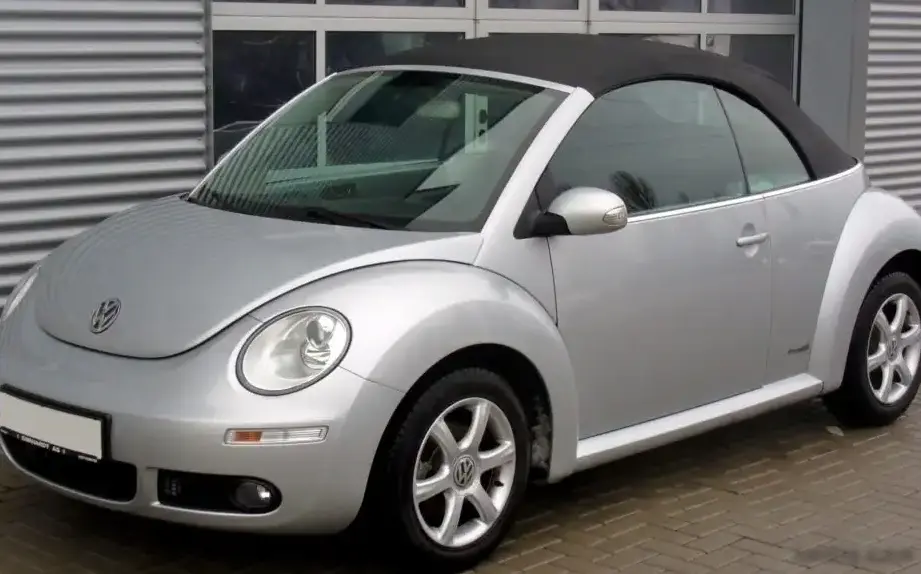
The Volkswagen New Beetle Convertible, particularly the facelifted version produced from 2005 to 2010, represented a continuation of the retro-inspired design that initially captivated buyers in the late 1990s. The 2.0-liter, 115 horsepower automatic variant occupied a middle ground within the New Beetle Convertible lineup, offering a balance between affordability, usability, and the open-air driving experience. This model was primarily aimed at the North American and European markets, where the convertible segment enjoyed consistent popularity. It built upon the foundation of the original New Beetle, utilizing the A5 (1HX0) platform, but with revised styling cues and updated mechanical components.
Technical Specifications
| Brand | Volkswagen |
| Model | Beetle |
| Generation | NEW Beetle Convertible (facelift 2005) |
| Type (Engine) | 2.0 (115 Hp) Automatic |
| Start of production | 2005 |
| End of production | 2010 |
| Powertrain Architecture | Internal Combustion engine |
| Body type | Cabriolet |
| Seats | 4 |
| Doors | 2 |
| Fuel consumption (urban) | 13.3 l/100 km (17.7 US mpg, 21.2 UK mpg) |
| Fuel consumption (extra urban) | 6.9 l/100 km (34.1 US mpg, 40.9 UK mpg) |
| Fuel consumption (combined) | 9.2 l/100 km (25.6 US mpg, 30.7 UK mpg) |
| CO2 emissions | 222 g/km |
| Fuel Type | Petrol (Gasoline) |
| Acceleration 0 – 100 km/h | 12.9 sec |
| Acceleration 0 – 62 mph | 12.9 sec |
| Acceleration 0 – 60 mph | 12.3 sec |
| Maximum speed | 181 km/h (112.47 mph) |
| Emission standard | Euro 4 |
| Weight-to-power ratio | 11.8 kg/Hp |
| Weight-to-torque ratio | 7.9 kg/Nm |
| Power | 115 Hp @ 5400 rpm |
| Torque | 172 Nm @ 3200 rpm (126.86 lb.-ft. @ 3200 rpm) |
| Engine layout | Front, Transverse |
| Engine Model/Code | AZJ, BER, BEV, BHP |
| Engine displacement | 1984 cm3 (121.07 cu. in.) |
| Number of cylinders | 4 |
| Engine configuration | Inline |
| Cylinder Bore | 82.5 mm (3.25 in.) |
| Piston Stroke | 92.8 mm (3.65 in.) |
| Compression ratio | 10.3:1 |
| Number of valves per cylinder | 4 |
| Fuel injection system | Multi-port manifold injection |
| Engine aspiration | Naturally aspirated |
| Engine oil capacity | 4 l (4.23 US qt | 3.52 UK qt) |
| Coolant capacity | 5 l (5.28 US qt | 4.4 UK qt) |
| Kerb Weight | 1355 kg (2987.26 lbs.) |
| Max. weight | 1830 kg (4034.46 lbs.) |
| Max load | 475 kg (1047.2 lbs.) |
| Trunk (boot) space – minimum | 201 l (7.1 cu. ft.) |
| Fuel tank capacity | 55 l (14.53 US gal | 12.1 UK gal) |
| Permitted trailer load with brakes (12%) | 1000 kg (2204.62 lbs.) |
| Permitted trailer load without brakes | 600 kg (1322.77 lbs.) |
| Permitted towbar download | 75 kg (165.35 lbs.) |
| Length | 4129 mm (162.56 in.) |
| Width | 1721 mm (67.76 in.) |
| Height | 1502 mm (59.13 in.) |
| Wheelbase | 2516 mm (99.06 in.) |
| Front track | 1507 mm (59.33 in.) |
| Rear track | 1487 mm (58.54 in.) |
| Ride height (ground clearance) | 130 mm (5.12 in.) |
| Drag coefficient (Cd) | 0.38 |
| Drivetrain Architecture | Front wheel drive |
| Number of gears and type of gearbox | 6 gears, automatic transmission |
| Front suspension | Independent type McPherson |
| Rear suspension | Semi-independent, coil spring |
| Front brakes | Ventilated discs |
| Rear brakes | Disc |
| Assisting systems | ABS (Anti-lock braking system) |
| Tires size | 195/65 R15 |
| Wheel rims size | 15 |
Powertrain & Engine Architecture
The 2005-2010 New Beetle Convertible 2.0-liter engine, identified by engine codes such as AZJ, BER, BEV, and BHP, was a naturally aspirated, inline-four cylinder gasoline engine. It featured multi-port fuel injection, a relatively simple and reliable system for its time. The engine’s 10.3:1 compression ratio was typical for a non-turbocharged engine of this era, balancing efficiency and performance. The valvetrain employed two valves per cylinder, contributing to a broad, usable powerband. The automatic transmission was a six-speed unit, designed to provide smooth shifts and enhance fuel economy compared to older automatic designs. This transmission was chosen to appeal to buyers prioritizing ease of use over outright performance.
Driving Characteristics
The 115 horsepower and 172 Nm (126.86 lb-ft) of torque delivered by the 2.0-liter engine, coupled with the six-speed automatic transmission, resulted in a driving experience geared towards comfortable cruising rather than spirited acceleration. Acceleration from 0-60 mph took approximately 12.3 seconds, and the top speed was around 112.47 mph. Compared to the more powerful (and often more expensive) trims, such as those equipped with a 1.8T turbo engine, this variant felt noticeably less responsive. The automatic transmission, while smooth, could sometimes feel hesitant during quick overtaking maneuvers. The gear ratios were tuned for fuel efficiency and relaxed driving, prioritizing comfort over aggressive performance.
Equipment & Trim Levels
The 2.0-liter automatic New Beetle Convertible typically came with a reasonable level of standard equipment. This included power windows, power locks, air conditioning, and a basic audio system. Interior upholstery was usually cloth, with optional leather available as an upgrade. Trim levels varied by market, but generally, this engine/transmission combination represented a mid-range offering. Optional extras included a sunroof, upgraded audio systems, alloy wheels, and heated front seats. The convertible top was manually operated on base models, with an optional power-operated top available.
Chassis & Braking
The New Beetle Convertible’s chassis utilized an independent McPherson strut suspension in the front and a semi-independent coil spring suspension in the rear. This setup provided a comfortable ride, although it wasn’t particularly sporty. Front brakes were ventilated discs, offering adequate stopping power, while rear brakes were solid discs. ABS (Anti-lock Braking System) was standard, enhancing safety. The relatively modest weight of the vehicle (approximately 1355 kg or 2987.26 lbs) helped to mitigate the effects of the engine’s limited power.
Market Reception & Comparison
Critics generally viewed the 2.0-liter automatic New Beetle Convertible as a sensible and practical choice for buyers seeking a stylish and comfortable open-top car. However, it was often criticized for its lack of outright performance compared to other trims. Fuel economy was considered average for its class, and reliability was generally good, although preventative maintenance was crucial. Compared to the 1.8T models, the 2.0-liter offered lower running costs but sacrificed performance. Against competitors like the Mazda MX-5 Miata, the New Beetle Convertible offered more interior space and a more comfortable ride, but lacked the Miata’s sporty handling.
Legacy
The 2.0-liter engine in the New Beetle Convertible proved to be a relatively durable and reliable unit when properly maintained. Today, these vehicles are often found on the used car market at affordable prices. Common issues include wear and tear on suspension components, and potential problems with the automatic transmission if not serviced regularly. The New Beetle Convertible, in all its variants, remains a popular choice for those seeking a retro-styled, fun-to-drive vehicle. The 2.0-liter automatic version, while not the most powerful, offers a good balance of affordability, usability, and classic New Beetle charm.