Technical Specifications
| Brand | Mercedes-Benz |
| Model | E-class |
| Generation | E-class (W212, facelift 2013) |
| Type | E 200 Natural Gas Drive (156 Hp) 7G-TRONIC PLUS |
| Start of production | 2013 |
| End of production | 2016 |
| Powertrain Architecture | Internal Combustion engine |
| Body type | Sedan |
| Seats | 5 |
| Doors | 4 |
| Fuel consumption (economy) – urban (NEDC) | 8.3-8.5 l/100 km (28.3 – 27.7 US mpg, 34 – 33.2 UK mpg, 12 – 11.8 km/l) |
| Fuel consumption (economy) – urban (CNG) (NEDC) | 5.8-5.9 kg/100 km |
| Fuel consumption (economy) – extra urban (NEDC) | 5.2-5.4 l/100 km (45.2 – 43.6 US mpg, 54.3 – 52.3 UK mpg, 19.2 – 18.5 km/l) |
| Fuel consumption (economy) – extra urban (CNG) (NEDC) | 3.4-3.6 kg/100 km |
| Fuel consumption (economy) – combined (NEDC) | 6.3-6.6 l/100 km (37.3 – 35.6 US mpg, 44.8 – 42.8 UK mpg, 15.9 – 15.2 km/l) |
| Fuel consumption (economy) – combined (CNG) (NEDC) | 4.3-4.4 kg/100 km |
| CO2 emissions (NEDC) | 147-153 g/km |
| CO2 emissions (CNG) (NEDC) | 116-120 g/km |
| Fuel Type | Petrol / CNG |
| Acceleration 0 – 100 km/h | 10.4 sec |
| Acceleration 0 – 62 mph | 10.4 sec |
| Acceleration 0 – 60 mph | 9.9 sec |
| Maximum speed | 220 km/h (136.7 mph) |
| Emission standard | Euro 6 |
| Weight-to-power ratio | 11 kg/Hp, 90.7 Hp/tonne |
| Weight-to-torque ratio | 6.4 kg/Nm, 157 Nm/tonne |
| Power | 156 Hp @ 5000 rpm |
| Power per litre | 78.4 Hp/l |
| Torque | 270 Nm @ 1250 rpm (199.14 lb.-ft. @ 1250 rpm) |
| Engine layout | Front, Longitudinal |
| Engine Model/Code | M 274.920 |
| Engine displacement | 1991 cm3 (121.5 cu. in.) |
| Number of cylinders | 4 |
| Engine configuration | Inline |
| Cylinder Bore | 83 mm (3.27 in.) |
| Piston Stroke | 92 mm (3.62 in.) |
| Compression ratio | 11:1 |
| Number of valves per cylinder | 4 |
| Fuel injection system | Direct injection |
| Engine aspiration | Turbocharger, Intercooler |
| Valvetrain | DOHC |
| Engine oil capacity | 6.3 l (6.66 US qt | 5.54 UK qt) |
| Coolant | 8.5 l (8.98 US qt | 7.48 UK qt) |
| Kerb Weight | 1720 kg (3791.95 lbs.) |
| Max. weight | 2300 kg (5070.63 lbs.) |
| Max load | 580 kg (1278.68 lbs.) |
| Trunk (boot) space – minimum | 400 l (14.13 cu. ft.) |
| Fuel tank capacity | 59 l (15.59 US gal | 12.98 UK gal) |
| CNG cylinder capacity | 20 kg |
| Max. roof load | 100 kg (220.46 lbs.) |
| Permitted trailer load with brakes (12%) | 1900 kg (4188.78 lbs.) |
| Permitted trailer load without brakes | 750 kg (1653.47 lbs.) |
| Permitted towbar download | 84 kg (185.19 lbs.) |
| Length | 4879 mm (192.09 in.) |
| Width | 1854 mm (72.99 in.) |
| Width including mirrors | 2071 mm (81.54 in.) |
| Height | 1474 mm (58.03 in.) |
| Wheelbase | 2874 mm (113.15 in.) |
| Front track | 1598 mm (62.91 in.) |
| Rear (Back) track | 1614 mm (63.54 in.) |
| Front overhang | 849 mm (33.43 in.) |
| Rear overhang | 1156 mm (45.51 in.) |
| Drag coefficient (Cd) | 0.26 |
| Minimum turning circle (turning diameter) | 11.28 m (37.01 ft.) |
| Drivetrain Architecture | The Internal combustion engine (ICE) drives the rear wheels of the vehicle. |
| Drive wheel | Rear wheel drive |
| Number of gears and type of gearbox | 7 gears, automatic transmission G-TRONIC PLUS |
| Front suspension | Coil spring, Independent multi-link suspension, Transverse stabilizer, Air Suspension – Optional |
| Rear suspension | Independent multi-link spring suspension with stabilizer, Air Suspension – Optional |
| Front brakes | Ventilated discs |
| Rear brakes | Disc |
| Assisting systems | ABS (Anti-lock braking system) |
| Steering type | Steering rack and pinion |
| Power steering | Electric Steering |
| Tires size | 225/55 R16 |
| Wheel rims size | 7.5J x 16 |
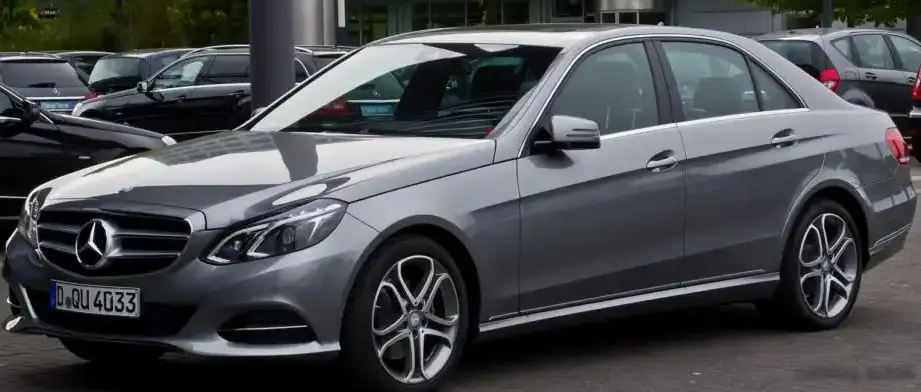
The Mercedes-Benz E 200 Natural Gas Drive, launched in 2013 as part of the W212 facelift, offered a bi-fuel solution for drivers seeking to reduce their environmental impact. Built on the foundation of the popular W212 E-Class, this variant distinguished itself through its ability to run on either gasoline or Compressed Natural Gas (CNG). The W212 generation, produced from 2009 to 2016, represented a significant evolution of the E-Class, incorporating advanced technology and a refined driving experience. The NGD model was primarily aimed at the European market, where CNG infrastructure was more developed and government incentives favored alternative fuel vehicles. It provided a compromise between conventional petrol power and the growing demand for more sustainable transportation options.
Powertrain & Engine Architecture
At the heart of the E 200 NGD lies the M274.920 2.0-liter inline-four cylinder engine. This engine is a member of Mercedes-Benz’s modular engine family, featuring direct fuel injection and a single turbocharger with an intercooler. The engine code signifies its displacement and configuration. The M274 engine family is known for its efficiency and relatively smooth operation. The direct injection system precisely meters fuel into the combustion chambers, optimizing combustion and reducing emissions. The turbocharger boosts power output, compensating for the smaller displacement. The 7G-TRONIC PLUS seven-speed automatic transmission, a staple of Mercedes-Benz vehicles, was the sole transmission option. This transmission is renowned for its smooth and responsive shifts, contributing to both fuel efficiency and driving comfort. The CNG system is integrated into the vehicle, with a 20 kg capacity CNG tank typically located in the spare wheel well, reducing trunk space. The vehicle automatically switches between petrol and CNG depending on fuel availability and driver demand.
Driving Characteristics
The E 200 NGD delivers a respectable, though not particularly sporty, driving experience. With 156 horsepower and 270 Nm (199 lb-ft) of torque, acceleration from 0 to 100 km/h (0-62 mph) takes around 10.4 seconds. The 7G-TRONIC PLUS transmission is well-matched to the engine, providing smooth gear changes and helping to keep the engine in its optimal power band. When running on CNG, power output is slightly reduced compared to petrol mode, resulting in a marginally slower acceleration. The automatic transmission’s gear ratios are tuned for fuel efficiency and comfort, rather than outright performance. Compared to the more powerful E 250 or E 350 models, the E 200 NGD feels less responsive, particularly during overtaking maneuvers. However, the readily available torque at low RPMs makes it suitable for everyday driving. The ride quality, typical of the W212 E-Class, is comfortable and refined, absorbing bumps and imperfections in the road effectively.
Equipment & Trim Levels
The E 200 NGD generally came equipped with a solid level of standard features, reflecting its position as a mid-range offering within the E-Class lineup. Standard equipment typically included automatic climate control, a multi-function steering wheel, power-adjustable front seats, and an audio system with Bluetooth connectivity. Interior upholstery was typically a combination of fabric and leatherette, with full leather options available as an upgrade. Optional extras included a sunroof, navigation system, premium sound system, and advanced driver-assistance systems such as lane keeping assist and blind spot monitoring. The dashboard layout and interior design were consistent with other W212 facelift models, featuring a clean and elegant aesthetic. Trim levels varied slightly depending on the market, but generally offered a range of customization options to suit individual preferences.
Chassis & Braking
The E 200 NGD utilizes a conventional chassis setup for a rear-wheel-drive sedan. The front suspension features coil springs and an independent multi-link design, while the rear suspension employs an independent multi-link spring suspension. Optional air suspension was available, providing an even more comfortable ride and adjustable ride height. The braking system consists of ventilated discs at the front and solid discs at the rear, providing adequate stopping power for the vehicle’s weight and performance. Anti-lock Braking System (ABS) is standard, enhancing safety and stability during emergency braking. The steering is a rack-and-pinion system with electric power assistance, offering precise and responsive steering feel.
Market Reception & Comparison
The E 200 NGD received mixed reviews from automotive critics. While praised for its environmental credentials and fuel efficiency, it was often criticized for its relatively modest performance. Compared to the petrol-powered E 200 or E 250 models, the NGD offered similar fuel economy in combined driving, but with a noticeable reduction in power. The availability of CNG refueling stations was a significant limitation, particularly outside of Europe. However, for drivers who had access to CNG infrastructure, the E 200 NGD offered a cost-effective and environmentally friendly alternative to conventional petrol vehicles. Its fuel economy, particularly when running on CNG, was a key selling point.
Legacy
The Mercedes-Benz E 200 Natural Gas Drive represents an interesting chapter in the E-Class’s history, showcasing Mercedes-Benz’s early efforts to develop alternative fuel vehicles. While not a mainstream success, it demonstrated the feasibility of running a luxury sedan on CNG. On the used car market, the E 200 NGD is relatively rare, and its value is often lower than comparable petrol-powered models. The longevity of the M274 engine is generally good, but the CNG system requires regular maintenance to ensure reliable operation. The availability of parts for the CNG system may become a challenge in the future. Despite its limitations, the E 200 NGD remains a unique and intriguing option for environmentally conscious drivers seeking a comfortable and refined luxury sedan.