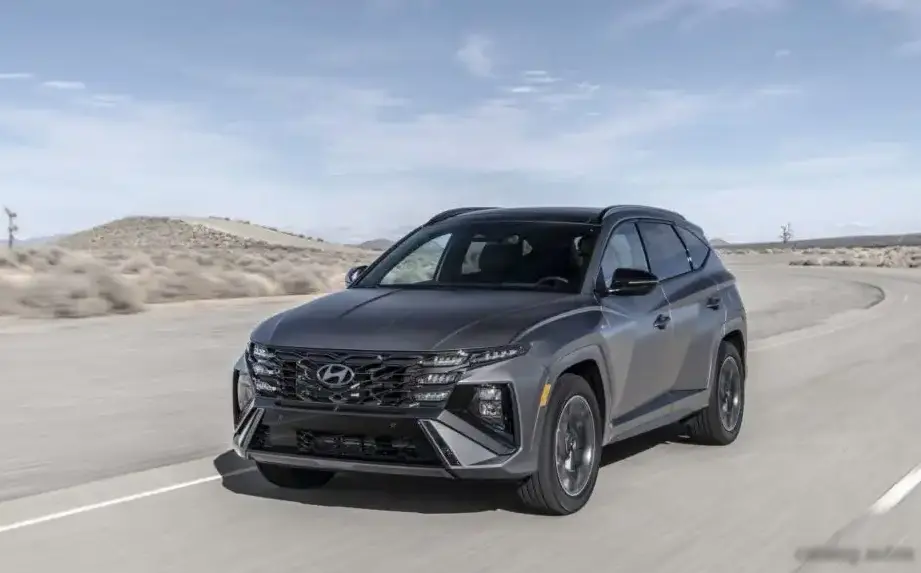
The Hyundai Tucson IV (facelift, introduced in March 2024) 1.6T Plug-in Hybrid HTRAC AWD Automatic represents a significant step in Hyundai’s commitment to electrified powertrains and all-wheel-drive capability within the popular Tucson compact SUV range. Positioned as a premium offering within the fourth-generation Tucson lineup, this variant combines a turbocharged gasoline engine with an electric motor and a substantial battery pack, offering both all-electric driving range and the flexibility of a conventional hybrid. It builds upon the success of the Tucson IV, which debuted in 2021, addressing growing consumer demand for fuel efficiency and reduced emissions without sacrificing practicality or performance. The “HTRAC” designation signifies Hyundai’s all-wheel-drive system, enhancing traction and stability in various driving conditions.
Technical Specifications
| Brand | Hyundai |
| Model | Tucson |
| Generation | Tucson IV (facelift 2024) |
| Type (Engine) | 1.6T (268 Hp) Plug-in Hybrid HTRAC AWD Automatic |
| Start of production | March, 2024 |
| Powertrain Architecture | PHEV (Plug-in Hybrid Electric Vehicle) |
| Body type | SUV |
| Seats | 5 |
| Doors | 5 |
| Fuel Type | Petrol / electricity |
| Emission standard | SULEV30 |
| Gross battery capacity | 13.8 kWh |
| Battery voltage | 360 V |
| Battery technology | Lithium-ion (Li-Ion) |
| Battery location | Below the floor, under the rear seats |
| Electric motor power | 98 Hp @ 2300-3600 rpm |
| Electric motor Torque | 304 Nm @ 2200 rpm (224.22 lb.-ft. @ 2200 rpm) |
| Electric motor location | Between the combustion engine and the transmission |
| Electric motor type | Synchronous |
| System power | 268 Hp |
| System torque | 350 Nm (258.15 lb.-ft.) |
| Power | 178 Hp @ 5500 rpm |
| Power per litre | 111.4 Hp/l |
| Torque | 264 Nm @ 1500-4500 rpm (194.72 lb.-ft. @ 1500-4500 rpm) |
| Engine layout | Front, Transverse |
| Engine Model/Code | Smartstream/G4FP |
| Engine displacement | 1598 cm3 (97.52 cu. in.) |
| Number of cylinders | 4 |
| Engine configuration | Inline |
| Cylinder Bore | 75.6 mm (2.98 in.) |
| Piston Stroke | 89 mm (3.5 in.) |
| Compression ratio | 10.5:1 |
| Number of valves per cylinder | 4 |
| Fuel injection system | Direct injection |
| Engine aspiration | Turbocharger, Intercooler |
| Valvetrain | DOHC, CVVD |
| Engine oil capacity | 4.8 l (5.07 US qt | 4.22 UK qt) |
| Coolant | 7.8 l (8.24 US qt | 6.86 UK qt) |
| Trunk (boot) space – minimum | 903 l (31.89 cu. ft.) |
| Trunk (boot) space – maximum | 1877 l (66.29 cu. ft.) |
| Fuel tank capacity | 42 l (11.1 US gal | 9.24 UK gal) |
| Max. roof load | 100 kg (220.46 lbs.) |
| Permitted trailer load with brakes (12%) | 907 kg (1999.59 lbs.) |
| Permitted trailer load without brakes | 748 kg (1649.06 lbs.) |
| Length | 4641 mm (182.72 in.) |
| Width | 1864 mm (73.39 in.) |
| Height | 1684 mm (66.3 in.) |
| Wheelbase | 2756 mm (108.5 in.) |
| Front track | 1615-1621 mm (63.58 – 63.82 in.) |
| Rear (Back) track | 1623-1628 mm (63.9 – 64.09 in.) |
| Front overhang | 904 mm (35.59 in.) |
| Rear overhang | 980 mm (38.58 in.) |
| Ride height (ground clearance) | 211 mm (8.31 in.) |
| Drag coefficient (Cd) | 0.33 |
| Minimum turning circle (turning diameter) | 11.8 m (38.71 ft.) |
| Drivetrain Architecture | ICE and electric motor drive front wheels, rear drive via clutch |
| Drive wheel | All wheel drive (4×4) |
| Number of gears and type of gearbox | 6 gears, automatic transmission |
| Front suspension | Independent, McPherson with coil spring and anti-roll bar |
| Rear suspension | Independent multi-link spring suspension with stabilizer |
| Front brakes | Ventilated discs, 325×30 mm |
| Rear brakes | Disc, 300×10 mm |
| Assisting systems | ABS (Anti-lock braking system) |
| Steering type | Steering rack and pinion |
| Power steering | Electric Steering |
| Wheel rims size | 17; 19 |
Powertrain & Engine Architecture
At the heart of the Tucson PHEV lies the Smartstream G4FP 1.6-liter turbocharged four-cylinder gasoline engine. This engine utilizes direct injection and Hyundai’s Continuously Variable Valve Duration (CVVD) technology, optimizing valve timing for improved efficiency and performance. The turbocharger provides a noticeable boost in power, delivering 178 horsepower and 194.72 lb-ft of torque. Coupled with this is a 98 hp electric motor, powered by a 13.8 kWh lithium-ion battery pack located under the rear seats. The combined system output reaches 268 horsepower and 258.15 lb-ft of torque. The powertrain employs a six-speed automatic transmission, specifically tuned to work seamlessly with both the gasoline engine and the electric motor. The electric motor is integrated between the engine and the transmission, allowing for smooth transitions between electric, hybrid, and gasoline power modes.
Driving Characteristics
The 1.6T Plug-in Hybrid HTRAC AWD Automatic Tucson offers a refined and versatile driving experience. In all-electric mode, it provides a quiet and emission-free range suitable for daily commutes. The electric motor delivers instant torque, resulting in brisk acceleration from a standstill. When the battery is depleted or requires assistance, the gasoline engine seamlessly kicks in, providing ample power for highway cruising and overtaking. The HTRAC all-wheel-drive system enhances stability and traction, particularly in inclement weather conditions. Compared to the standard gasoline-powered Tucson, the PHEV variant offers a more responsive and refined driving experience, thanks to the electric motor’s assistance. While not as sporty as some competitors, the Tucson PHEV prioritizes comfort and efficiency. The six-speed automatic transmission provides smooth gear changes, although it may not be as quick-shifting as some dual-clutch transmissions found in other vehicles.
Equipment & Trim Levels
The 1.6T Plug-in Hybrid HTRAC AWD Automatic trim typically comes well-equipped with standard features such as leather upholstery, heated and ventilated front seats, a large touchscreen infotainment system with navigation, a premium sound system, and a suite of advanced driver-assistance systems (ADAS) including adaptive cruise control, lane-keeping assist, and automatic emergency braking. Optional extras may include a panoramic sunroof, a digital instrument cluster, and a head-up display. The interior design emphasizes a modern and minimalist aesthetic, with high-quality materials and a user-friendly layout.
Chassis & Braking
The Tucson PHEV utilizes an independent suspension setup, with McPherson struts at the front and a multi-link system at the rear. This configuration provides a comfortable ride quality and good handling characteristics. The HTRAC all-wheel-drive system actively distributes torque between the front and rear wheels, optimizing traction and stability. The braking system consists of ventilated discs at the front and solid discs at the rear, providing adequate stopping power. Anti-lock brakes (ABS) and electronic stability control (ESC) are standard features, enhancing safety and control.
Market Reception & Comparison
The Hyundai Tucson PHEV has been generally well-received by automotive critics, praised for its fuel efficiency, comfortable ride, and spacious interior. Compared to other plug-in hybrid SUVs in its class, the Tucson PHEV offers a competitive all-electric range and a generous amount of standard features. Its fuel economy is significantly better than that of the standard gasoline-powered Tucson, making it an attractive option for environmentally conscious buyers. Reliability ratings have been positive, with Hyundai consistently ranking well in consumer surveys. However, some critics have noted that the infotainment system can be complex to use and that the overall driving experience is not as engaging as some sportier competitors.
Legacy
The Hyundai Tucson IV 1.6T Plug-in Hybrid HTRAC AWD Automatic represents a pivotal moment in Hyundai’s transition towards electrification. Its combination of fuel efficiency, all-wheel-drive capability, and advanced technology has made it a popular choice among buyers seeking a practical and environmentally friendly SUV. As the used car market matures, these models are expected to hold their value well, thanks to their fuel-saving potential and Hyundai’s reputation for reliability. The powertrain’s long-term durability remains to be fully assessed, but early indications suggest that it is a robust and dependable system. The Tucson PHEV has established itself as a significant player in the growing plug-in hybrid segment, paving the way for future electrified models from Hyundai.