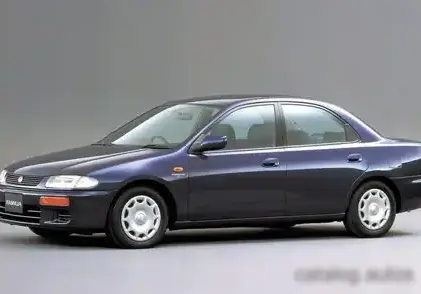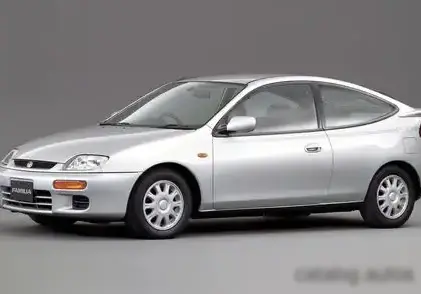
The Mazda Familia Wagon 2.0i, produced between 2002 and 2004, was a practical and relatively sporty offering in the compact station wagon segment. Part of the broader Familia (known as the Mazda 3 in many markets) lineage, this variant aimed to balance space, fuel efficiency, and enjoyable driving dynamics. Positioned as a mid-range trim within the Familia Wagon lineup, the 2.0i offered a performance step up compared to the smaller-displacement engines, while remaining more accessible than potential future performance-oriented models. It primarily served the Japanese domestic market (JDM) and select export markets, providing a versatile vehicle for families and individuals needing cargo capacity.
Technical Specifications
| Brand | Mazda |
| Model | Familia |
| Generation | Familia Wagon |
| Type (Engine) | 2.0 i (160 Hp) |
| Start of production | 2002 |
| End of production | 2004 |
| Powertrain Architecture | Internal Combustion engine |
| Body type | Station wagon (estate) |
| Seats | 5 |
| Doors | 5 |
| Fuel Type | Petrol (Gasoline) |
| Power | 160 Hp @ 7000 rpm |
| Power per litre | 86.7 Hp/l |
| Torque | 157 Nm @ 4500 rpm |
| Torque (lb.-ft.) | 115.8 lb.-ft. @ 4500 rpm |
| Engine layout | Front, Transverse |
| Engine Model/Code | BP-ZE |
| Engine displacement | 1845 cm3 |
| Engine displacement (cu. in.) | 112.59 cu. in. |
| Number of cylinders | 4 |
| Engine configuration | Inline |
| Cylinder Bore | 83 mm |
| Cylinder Bore (in.) | 3.27 in. |
| Piston Stroke | 85 mm |
| Piston Stroke (in.) | 3.35 in. |
| Compression ratio | 9:1 |
| Number of valves per cylinder | 4 |
| Fuel injection system | Multi-port manifold injection |
| Engine aspiration | Naturally aspirated engine |
| Valvetrain | DOHC |
| Max. weight | 1170 kg |
| Max. weight (lbs.) | 2579.41 lbs. |
| Fuel tank capacity | 50 l |
| Fuel tank capacity (US gal) | 13.21 US gal |
| Fuel tank capacity (UK gal) | 11 UK gal |
| Length | 4200 mm |
| Length (in.) | 165.35 in. |
| Width | 1695 mm |
| Width (in.) | 66.73 in. |
| Height | 1420 mm |
| Height (in.) | 55.91 in. |
| Wheelbase | 2610 mm |
| Wheelbase (in.) | 102.76 in. |
| Front track | 1470 mm |
| Front track (in.) | 57.87 in. |
| Rear track | 1470 mm |
| Rear track (in.) | 57.87 in. |
| Drivetrain Architecture | The Internal combustion engine (ICE) drives the front wheels of the vehicle. |
| Drive wheel | Front wheel drive |
| Front brakes | Ventilated discs |
| Rear brakes | Drum |
Powertrain & Engine Architecture
The heart of the Familia Wagon 2.0i is the BP-ZE engine, a 1.845-liter (112.59 cubic inches) inline-four cylinder gasoline engine. This engine utilizes a naturally aspirated configuration and a multi-port fuel injection system, delivering a respectable 160 horsepower at 7000 rpm and 157 Nm (115.8 lb.-ft.) of torque at 4500 rpm. The BP-ZE features a double overhead camshaft (DOHC) valvetrain, contributing to its relatively high output for its displacement. The engine’s 9:1 compression ratio was a common specification for naturally aspirated engines of this era, balancing performance and fuel efficiency. The engine was transversely mounted in the front of the vehicle, driving the front wheels. Mazda’s BP-series engines were known for their durability and responsiveness, and the BP-ZE continued this tradition. The multi-port fuel injection system, while not as advanced as direct injection, provided reliable and efficient fuel delivery for the engine’s output.
Driving Characteristics
The Familia Wagon 2.0i offered a noticeable improvement in performance over the lower-displacement engine options available in the Familia Wagon range. While not a sports car, the 160 hp engine provided adequate power for everyday driving and overtaking maneuvers. The front-wheel-drive configuration and the automatic transmission, while offering convenience, did result in some torque steer under hard acceleration. The automatic transmission, typically a four-speed unit, was geared for fuel economy and smooth operation rather than outright performance. Compared to a manual transmission equipped model, the automatic version would have exhibited slightly slower acceleration times. The gear ratios were optimized for comfortable cruising and efficient city driving. The suspension, tuned for comfort, provided a reasonably compliant ride, although it wasn’t particularly sporty. Body roll was present during cornering, but remained controlled enough for typical driving conditions. The steering was light and easy to use, making it well-suited for urban environments.
Equipment & Trim Levels
The 2.0i trim level typically included features such as power windows, power door locks, and air conditioning as standard equipment. Interior upholstery was generally cloth, with options for upgraded materials available. The dashboard layout was functional and straightforward, prioritizing ease of use. Optional extras could include an upgraded audio system, alloy wheels, and a sunroof. Some models also offered features like a rear wiper and a more advanced climate control system. The Familia Wagon 2.0i aimed to provide a comfortable and well-equipped interior without the premium price tag of higher-end trims. The overall interior design was typical of Japanese cars from the early 2000s, focusing on practicality and durability.
Chassis & Braking
The Familia Wagon 2.0i utilized a MacPherson strut front suspension and a torsion beam rear suspension. This setup provided a good balance of ride comfort and handling. The front brakes were ventilated discs, offering adequate stopping power, while the rear brakes were drum brakes, a cost-saving measure common in this class of vehicle. The chassis was designed to maximize interior space while maintaining reasonable structural rigidity. Stabilizer bars were included to reduce body roll during cornering, enhancing handling stability. The steering system was a rack-and-pinion setup, providing precise and responsive steering feel. The suspension components were designed for longevity and minimal maintenance.
Market Reception & Comparison
The Mazda Familia Wagon 2.0i was generally well-received by critics as a practical and reliable family vehicle. It offered a good level of equipment for its price and provided a comfortable driving experience. Compared to other station wagons in its class, such as the Toyota Corolla Wagon or the Nissan Sunny Wagon, the Familia Wagon 2.0i stood out with its slightly more engaging driving dynamics and stylish exterior design. Fuel economy was competitive, averaging around 7-8 liters per 100 kilometers (30-35 mpg) in mixed driving conditions. Reliability was generally good, with the BP-ZE engine proving to be a durable and long-lasting unit. Owners often praised the vehicle’s spacious interior and its ability to handle both passengers and cargo with ease. It was seen as a sensible and practical choice for families and individuals needing a versatile vehicle.
Legacy
The Mazda Familia Wagon 2.0i, while not a particularly rare or collectible vehicle today, remains a popular choice among those seeking a practical and affordable used car. The BP-ZE engine is known for its reliability and relatively low maintenance costs. Parts availability is generally good, and the vehicle’s simple mechanical design makes it relatively easy to repair. The Familia Wagon 2.0i represents a solid example of a Japanese compact station wagon from the early 2000s, offering a blend of practicality, reliability, and reasonable performance. It’s a testament to Mazda’s engineering prowess and their commitment to building durable and dependable vehicles. Today, well-maintained examples can still provide years of reliable service, making it a worthwhile option for budget-conscious buyers.