Technical Specifications
| Brand | Ford |
| Model | S-MAX |
| Generation | S-MAX II |
| Type | 2.0 TDCi (210 Hp) PowerShift S&S 7 Seat |
| Start of production | 2015 |
| End of production | 2018 |
| Powertrain Architecture | Internal Combustion engine |
| Body type | MPV |
| Seats | 7 |
| Doors | 5 |
| Fuel consumption (urban) | 6.3 l/100 km (37.3 US mpg, 44.8 UK mpg, 15.9 km/l) |
| Fuel consumption (extra urban) | 5.1 l/100 km (46.1 US mpg, 55.4 UK mpg, 19.6 km/l) |
| Fuel consumption (combined) | 5.5 l/100 km (42.8 US mpg, 51.4 UK mpg, 18.2 km/l) |
| CO2 emissions | 144 g/km |
| Fuel Type | Diesel |
| Acceleration 0 – 100 km/h | 8.8 sec |
| Acceleration 0 – 62 mph | 8.8 sec |
| Acceleration 0 – 60 mph | 8.4 sec |
| Maximum speed | 218 km/h (135.46 mph) |
| Emission standard | Euro 6 |
| Weight-to-power ratio | 8.4 kg/Hp, 118.9 Hp/tonne |
| Weight-to-torque ratio | 3.9 kg/Nm, 254.8 Nm/tonne |
| Power | 210 Hp @ 3750 rpm |
| Power per litre | 105.2 Hp/l |
| Torque | 450 Nm @ 2000-2250 rpm (331.9 lb.-ft. @ 2000-2250 rpm) |
| Engine layout | Front, Transverse |
| Engine Model/Code | T9CB, T9CC |
| Engine displacement | 1997 cm3 (121.86 cu. in.) |
| Number of cylinders | 4 |
| Engine configuration | Inline |
| Cylinder Bore | 85 mm (3.35 in.) |
| Piston Stroke | 88 mm (3.46 in.) |
| Compression ratio | 16:1 |
| Number of valves per cylinder | 4 |
| Fuel injection system | Diesel Commonrail |
| Engine aspiration | BiTurbo, Intercooler |
| Valvetrain | DOHC |
| Engine oil capacity | 5.6 l (5.92 US qt | 4.93 UK qt) |
| Coolant | 8.2 l (8.66 US qt | 7.21 UK qt) |
| Kerb Weight | 1766 kg (3893.36 lbs.) |
| Max. weight | 2575 kg (5676.9 lbs.) |
| Max load | 809 kg (1783.54 lbs.) |
| Trunk (boot) space – minimum | 285 l (10.06 cu. ft.) |
| Trunk (boot) space – maximum | 2020 l (71.34 cu. ft.) |
| Fuel tank capacity | 70 l (18.49 US gal | 15.4 UK gal) |
| Length | 4796 mm (188.82 in.) |
| Width | 1916 mm (75.43 in.) |
| Width including mirrors | 2137 mm (84.13 in.) |
| Height | 1655 mm (65.16 in.) |
| Wheelbase | 2849 mm (112.17 in.) |
| Front track | 1606 mm (63.23 in.) |
| Rear (Back) track | 1606 mm (63.23 in.) |
| Ride height (ground clearance) | 128-150 mm (5.04 – 5.91 in.) |
| Minimum turning circle | 12 m (39.37 ft.) |
| Drivetrain Architecture | Front wheel drive |
| Number of gears | 6 |
| Gearbox type | Automatic transmission PowerShift |
| Front suspension | Independent, type McPherson with coil spring and anti-roll bar |
| Rear suspension | Independent coil spring |
| Front brakes | Ventilated discs |
| Rear brakes | Disc |
| Assisting systems | ABS (Anti-lock braking system) |
| Steering type | Steering rack and pinion |
| Tires size | 235/55 R17; 235/50 R18; 245/45 R19 |
| Wheel rims size | 7.5J x 17; 7.5J x 18; 8J x 19 |
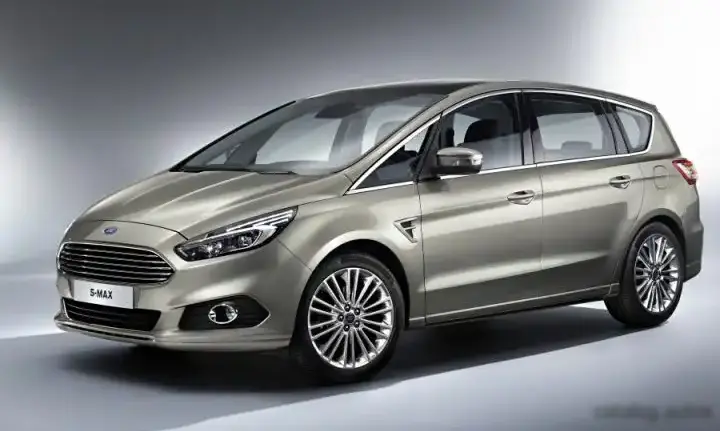
The Ford S-MAX II 2.0 TDCi 210 PowerShift is a five-door, seven-seat MPV that was part of the second generation of the S-MAX, launched in 2015. Built on the Ford C240 platform (an evolution of the previous generation’s platform), it aimed to provide a more sophisticated and dynamic driving experience compared to its predecessor. This particular variant, equipped with the 2.0-liter TDCi diesel engine producing 210 horsepower and a six-speed PowerShift dual-clutch transmission, occupied a sweet spot in the lineup, offering a balance between performance, fuel economy, and practicality. It was positioned above the lower-powered diesel options and below the more expensive, higher-specification trims.
Powertrain & Engine Architecture
The heart of this S-MAX variant is the 2.0-liter TDCi diesel engine, specifically the T9CB or T9CC engine code depending on the exact production date and market. This engine features a common-rail direct injection system, delivering fuel at extremely high pressure for optimized combustion. Crucially, it employs a bi-turbocharger setup – a small turbocharger for quick response at low engine speeds and a larger turbocharger for increased power at higher RPMs. This configuration helps mitigate turbo lag and provides a broad torque curve. The engine also incorporates an intercooler to cool the intake air, further enhancing performance. The PowerShift six-speed dual-clutch transmission (DCT) is a key component, offering quicker and smoother gear changes compared to a traditional automatic transmission. It operates with two separate clutches, pre-selecting the next gear for seamless shifts. The Start & Stop system, denoted by the ‘S&S’ in the model name, automatically shuts off the engine when the vehicle is stationary to improve fuel efficiency.
Driving Characteristics
The 210 hp 2.0 TDCi PowerShift S-MAX delivers a respectable driving experience for an MPV. Acceleration from 0-60 mph takes around 8.4 seconds, and it reaches a top speed of 135 mph. The bi-turbo setup provides ample torque – 450 Nm (331.9 lb-ft) – available from 2000-2250 rpm, making it feel responsive in everyday driving situations, even when fully loaded with passengers and luggage. The PowerShift transmission contributes to a more engaging driving experience than a conventional automatic, although some drivers have reported occasional low-speed jerkiness, a common characteristic of early DCT implementations. Compared to the lower-powered 1.5 TDCi versions, this 2.0 TDCi offers significantly more performance. It also feels more refined than the 1.0 EcoBoost petrol engine, which can feel strained under heavy load. The S-MAX’s chassis is well-tuned, providing a comfortable ride without sacrificing handling agility.
Equipment & Trim Levels
The 2.0 TDCi 210 PowerShift S-MAX typically came equipped with a generous level of standard features. These included air conditioning, alloy wheels, a touchscreen infotainment system with Bluetooth connectivity, and a suite of safety features such as ABS, ESP, and multiple airbags. Higher trim levels, such as Titanium and Vignale, added features like leather upholstery, heated seats, a panoramic sunroof, and advanced driver-assistance systems like adaptive cruise control and lane-keeping assist. Optional extras included a rear-seat entertainment system, a premium sound system, and parking sensors.
Chassis & Braking
The S-MAX II utilizes an independent suspension setup on both the front and rear axles. The front suspension employs McPherson struts with a coil spring and anti-roll bar, while the rear features an independent multi-link suspension. This configuration provides a good balance between ride comfort and handling. Braking duties are handled by ventilated discs on the front wheels and solid discs on the rear. ABS (Anti-lock Braking System) and ESP (Electronic Stability Program) are standard features, enhancing safety and control.
Market Reception & Comparison
The Ford S-MAX II 2.0 TDCi 210 PowerShift was generally well-received by automotive critics. It was praised for its spacious interior, comfortable ride, and engaging driving dynamics. The 2.0 TDCi engine was considered a good compromise between performance and fuel economy, although some reviewers noted the occasional quirks of the PowerShift transmission. Compared to rivals like the Volkswagen Sharan and Citroën Grand C4 Picasso, the S-MAX offered a more driver-focused experience. Fuel economy figures of around 42.8 US mpg (combined) were competitive for its class. Reliability reports suggest that the engine itself is generally robust, but the PowerShift transmission has been known to experience issues in some cases, requiring careful maintenance and potential clutch pack replacements.
Legacy
The Ford S-MAX II 2.0 TDCi 210 PowerShift remains a popular choice in the used car market. Its combination of practicality, performance, and relatively good fuel economy makes it an attractive option for families. However, potential buyers should be aware of the potential reliability concerns surrounding the PowerShift transmission and ensure that it has been properly maintained. The S-MAX II represents a high point in Ford’s MPV development, offering a compelling blend of style, functionality, and driving enjoyment. While MPVs have declined in popularity in recent years, the S-MAX II continues to hold its own as a versatile and capable vehicle.