
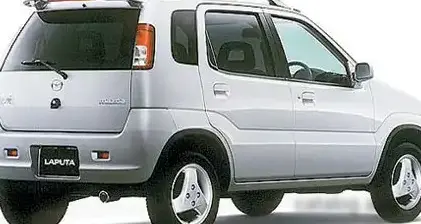
The Mazda Laputa, produced between 1998 and 2006, was a supermini hatchback designed to offer affordable and practical transportation, primarily targeted at the Japanese domestic market (JDM). The 0.7 i 12V 2WD Turbo variant, equipped with a turbocharged three-cylinder engine and a four-speed automatic transmission, represented an entry-level offering within the Laputa range. It aimed to provide a balance of fuel efficiency and ease of use for urban commuters. This generation, internally designated as the YF series, was notable for its compact dimensions and focus on maximizing interior space within a small footprint.
Technical Specifications
| Brand | Mazda |
| Model | Laputa |
| Generation | Laputa |
| Type (Engine) | 0.7 i 12V 2WD Turbo (60 Hp) |
| Start of production | 1998 |
| End of production | 2006 |
| Powertrain Architecture | Internal Combustion engine |
| Body type | Hatchback |
| Seats | 5 |
| Doors | 5 |
| Fuel Type | Petrol (Gasoline) |
| Weight-to-power ratio | 13.5 kg/Hp, 74.1 Hp/tonne |
| Weight-to-torque ratio | 9.8 kg/Nm, 102.5 Nm/tonne |
| Power | 60 Hp @ 6000 rpm |
| Power per litre | 91.2 Hp/l |
| Torque | 83 Nm @ 3000 rpm, 61.22 lb.-ft. @ 3000 rpm |
| Engine layout | Front, Transverse |
| Engine displacement | 658 cm3, 40.15 cu. in. |
| Number of cylinders | 3 |
| Engine configuration | Inline |
| Cylinder Bore | 68 mm, 2.68 in. |
| Piston Stroke | 60.4 mm, 2.38 in. |
| Compression ratio | 8.9:1 |
| Number of valves per cylinder | 4 |
| Fuel injection system | Multi-port manifold injection |
| Engine aspiration | Turbocharger |
| Valvetrain | OHC |
| Kerb Weight | 810 kg, 1785.74 lbs |
| Max. weight | 1030 kg, 2270.76 lbs |
| Max load | 220 kg, 485.02 lbs |
| Fuel tank capacity | 30 l, 7.93 US gal | 6.6 UK gal |
| Length | 3355 mm, 132.09 in. |
| Width | 1475 mm, 58.07 in. |
| Height | 1550 mm, 61.02 in. |
| Wheelbase | 2360 mm, 92.91 in. |
| Front track | 1280 mm, 50.39 in. |
| Rear (Back) track | 1280 mm, 50.39 in. |
| Minimum turning circle | 9.2 m, 30.18 ft. |
| Drivetrain Architecture | The Internal combustion engine (ICE) drives the front wheels of the vehicle. |
| Drive wheel | Front wheel drive |
| Number of gears and type of gearbox | 4 gears, automatic transmission |
| Front suspension | Coil spring |
| Rear suspension | Coil spring |
| Front brakes | Ventilated discs |
| Rear brakes | Drum |
| Assisting systems | ABS (Anti-lock braking system) |
| Steering type | Steering rack and pinion |
| Power steering | Hydraulic Steering |
| Tires size | 165/70 R14 81 S |
| Wheel rims size | 4.5J x 14 ET 50 |
Powertrain & Engine Architecture
The heart of the Laputa 0.7 i Turbo was the F6A engine, a 658cc inline three-cylinder petrol engine. This engine utilized a single overhead camshaft (OHC) valvetrain and a multi-port fuel injection system. The addition of a turbocharger was crucial in boosting power output to 60 horsepower, a significant increase over naturally aspirated versions of the same engine. The engine code for this variant is often found as F6A-T. The turbocharger was a small unit, designed for quick spool-up and improved low-end torque, rather than outright peak power. The four-speed automatic transmission was a conventional hydraulic unit, chosen for its simplicity and cost-effectiveness. It wasn’t known for particularly quick shifts, but it provided smooth operation suitable for city driving.
Driving Characteristics
The 0.7 i Turbo automatic Laputa offered modest performance. Acceleration was adequate for urban environments, but overtaking on highways required careful planning. The automatic transmission, while smooth, had relatively long gear ratios, prioritizing fuel economy over spirited driving. Compared to the five-speed manual version, the automatic suffered a noticeable performance deficit. The turbocharger did provide a useful boost in the mid-range, making it feel more responsive than its displacement would suggest. However, the overall driving experience was geared towards practicality and ease of use, rather than driving enjoyment. The weight of the vehicle, at around 810 kg, helped to mitigate the low horsepower somewhat.
Equipment & Trim Levels
The 0.7 i Turbo typically represented a base or mid-range trim level within the Laputa lineup. Standard equipment generally included power steering, air conditioning, and basic audio system. Interior upholstery was typically cloth, with a simple dashboard layout. Optional extras could include alloy wheels, upgraded audio systems, and power windows. The Laputa was not known for lavish features; its appeal lay in its affordability and functionality. Safety features were also basic, typically limited to ABS brakes and seatbelts.
Chassis & Braking
The Laputa utilized a simple chassis design, with coil springs and a torsion beam rear suspension. This setup prioritized cost-effectiveness and space efficiency. Front brakes were ventilated discs, providing adequate stopping power, while the rear brakes were drums, a common cost-saving measure in this class of vehicle. The steering was a rack and pinion system with hydraulic assistance, offering light and easy steering feel. The relatively narrow tires (165/70 R14) contributed to fuel efficiency but limited grip in cornering.
Market Reception & Comparison
The Laputa 0.7 i Turbo was generally well-received in Japan as an affordable and practical city car. Critics praised its compact size, fuel efficiency, and ease of driving. However, the limited power output and basic interior were points of criticism. Compared to other kei cars and superminis in the Japanese market, the Laputa offered a good balance of features and price. The turbocharged engine provided a noticeable advantage over naturally aspirated competitors in terms of performance, but it came at the cost of slightly higher fuel consumption. The automatic transmission was seen as a convenient option for urban drivers, but it sacrificed some of the responsiveness offered by the manual gearbox.
Legacy
The Mazda Laputa, and specifically the 0.7 i Turbo automatic variant, has become a relatively affordable and accessible used car in recent years. The F6A engine, while small, is generally considered to be reliable, provided it has been properly maintained. Common issues include turbocharger wear and potential oil leaks. The automatic transmission is also generally durable, but regular fluid changes are essential. Today, the Laputa is often seen as a charming and economical option for first-time car buyers or those seeking a simple and reliable city runabout. Its compact size and fuel efficiency continue to make it a practical choice, even in the modern automotive landscape. The Laputa represents a period of innovative design from Mazda, focused on maximizing space and efficiency in a small package.
