
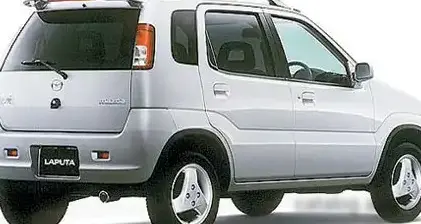
The Mazda Laputa, produced between 1998 and 2006, was a supermini hatchback designed to offer affordable and practical transportation, primarily targeted at the Japanese domestic market (JDM). This generation, known internally as the Laputa, represented a shift towards more contemporary styling and a focus on maximizing interior space within a compact footprint. The 0.7 i 12V Turbo variant, equipped with a 64 horsepower engine and a four-speed automatic transmission, served as an entry-level offering, prioritizing fuel efficiency and ease of use over outright performance. It occupied the lower end of the Laputa lineup, positioned below the slightly larger-engined and often manually-equipped models.
Technical Specifications
| Brand | Mazda |
| Model | Laputa |
| Generation | Laputa |
| Type (Engine) | 0.7 i 12V Turbo (64 Hp) |
| Start of production | 1998 |
| End of production | 2006 |
| Powertrain Architecture | Internal Combustion engine |
| Body type | Hatchback |
| Seats | 5 |
| Doors | 5 |
| Fuel Type | Petrol (Gasoline) |
| Weight-to-power ratio | 12.2 kg/Hp, 82.1 Hp/tonne |
| Weight-to-torque ratio | 7.4 kg/Nm, 135.9 Nm/tonne |
| Power | 64 Hp @ 6500 rpm |
| Power per litre | 97.3 Hp/l |
| Torque | 106 Nm @ 3500 rpm, 78.18 lb.-ft. @ 3500 rpm |
| Engine layout | Front, Transverse |
| Engine displacement | 658 cm3, 40.15 cu. in. |
| Number of cylinders | 3 |
| Engine configuration | Inline |
| Cylinder Bore | 68 mm, 2.68 in. |
| Piston Stroke | 60.4 mm, 2.38 in. |
| Compression ratio | 8.4:1 |
| Number of valves per cylinder | 4 |
| Fuel injection system | Multi-port manifold injection |
| Engine aspiration | Turbocharger |
| Valvetrain | DOHC |
| Kerb Weight | 780 kg, 1719.61 lbs |
| Max. weight | 1000 kg, 2204.62 lbs |
| Max load | 220 kg, 485.02 lbs |
| Fuel tank capacity | 30 l, 7.93 US gal | 6.6 UK gal |
| Length | 3395 mm, 133.66 in. |
| Width | 1475 mm, 58.07 in. |
| Height | 1530 mm, 60.24 in. |
| Wheelbase | 2360 mm, 92.91 in. |
| Front track | 1290 mm, 50.79 in. |
| Rear (Back) track | 1285 mm, 50.59 in. |
| Minimum turning circle | 9.2 m, 30.18 ft. |
| Drivetrain Architecture | The Internal combustion engine (ICE) drives the front wheels of the vehicle. |
| Drive wheel | Front wheel drive |
| Number of gears | 4 gears, automatic transmission |
| Front suspension | Coil spring |
| Rear suspension | Coil spring |
| Front brakes | Ventilated discs |
| Rear brakes | Drum |
| Assisting systems | ABS (Anti-lock braking system) |
| Steering type | Steering rack and pinion |
| Power steering | Hydraulic Steering |
| Tires size | 165/60 R15 77 H |
| Wheel rims size | 4.5J x 15 ET 50 |
Powertrain & Engine Architecture
The heart of the Laputa 0.7 i Turbo was the F6A engine, a 658cc inline-three cylinder petrol engine. This engine utilized a single overhead camshaft (SOHC) design, although some sources indicate a DOHC configuration, and was equipped with a turbocharger to boost power output. The turbocharger was relatively small, designed to provide a modest increase in power and torque without significantly impacting fuel economy. Fuel delivery was managed by a multi-port fuel injection system. The engine’s 8.4:1 compression ratio was a compromise between efficiency and performance. The four-speed automatic transmission was a conventional hydraulic unit, chosen for its simplicity and cost-effectiveness. It wasn’t known for particularly quick shifts, but it provided smooth operation suitable for urban driving.
Driving Characteristics
The 0.7 i Turbo Laputa, with its 64 horsepower, wasn’t designed for spirited driving. Acceleration was modest, and overtaking required careful planning. The automatic transmission, while convenient, further dulled performance, with relatively wide gear ratios prioritizing fuel economy over responsiveness. However, the turbocharger did provide a noticeable boost in low-end torque, making it reasonably drivable in city traffic. Compared to the naturally aspirated versions of the Laputa, the turbo model offered a more relaxed driving experience at highway speeds, although it still struggled with steep inclines. The manual transmission variants, even with the same engine, felt noticeably more engaging and quicker due to the driver having more control over the gear selection.
Equipment & Trim Levels
The 0.7 i Turbo trim typically included basic amenities such as power steering, central locking, and electric windows. Air conditioning was often an optional extra. Interior upholstery was typically cloth, with a simple dashboard layout. Higher trim levels, available with larger engines, offered features like alloy wheels, upgraded audio systems, and more luxurious interior materials. The focus of the 0.7 i Turbo was affordability, so it was generally equipped with the essentials.
Chassis & Braking
The Laputa featured a relatively simple chassis design, with coil springs and a torsion beam rear suspension. The front suspension utilized MacPherson struts. Braking was comprised of ventilated discs on the front wheels and drum brakes on the rear. ABS (Anti-lock Braking System) was standard, providing an added layer of safety. The suspension was tuned for comfort rather than handling, resulting in a soft ride quality. The relatively light weight of the vehicle helped to compensate for the modest braking performance.
Market Reception & Comparison
The Laputa 0.7 i Turbo was generally well-received in Japan as an economical and practical city car. Critics praised its fuel efficiency and compact size, making it ideal for navigating crowded urban environments. However, its lack of power and somewhat basic interior were points of criticism. Compared to other kei cars and superminis in the Japanese market, the Laputa offered a good balance of features and affordability. The larger-engined Laputa models, particularly those with manual transmissions, were favored by drivers seeking more performance. The 0.7 i Turbo appealed to buyers prioritizing fuel economy and ease of use.
Legacy
The Mazda Laputa, while not a particularly groundbreaking vehicle, played a significant role in Mazda’s lineup during the late 1990s and early 2000s. The 0.7 i Turbo powertrain, while not known for its longevity or high performance, proved to be reasonably reliable with proper maintenance. Today, these vehicles are relatively rare outside of Japan, and well-maintained examples are sought after by enthusiasts of JDM cars. The Laputa’s focus on maximizing interior space within a small footprint influenced subsequent Mazda models, and its emphasis on fuel efficiency remains relevant in today’s automotive landscape. The F6A engine, while simple, is relatively easy to work on, making it a popular choice for budget-conscious owners.
