
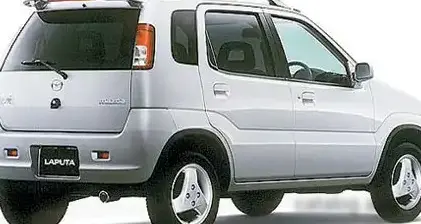
The Mazda Laputa 0.7i 12V, producing 55 horsepower, was a subcompact hatchback manufactured by Mazda between 1998 and 2006. Positioned as an entry-level vehicle, particularly in the Japanese domestic market (JDM), the Laputa aimed to provide affordable and efficient transportation. It represented Mazda’s attempt to cater to the “kei car” segment, though it didn’t fully conform to kei car regulations, placing it slightly above in terms of size and engine displacement. The Laputa shared its platform with the Autozam Scrum Wagon and Suzuki Wagon R+, reflecting a collaborative effort between these Japanese automakers. This variant, with its small displacement engine and modest power output, was specifically targeted at urban commuters and first-time car buyers.
Technical Specifications
| Brand | Mazda |
| Model | Laputa |
| Generation | Laputa |
| Type (Engine) | 0.7i 12V (55 Hp) |
| Start of production | 1998 year |
| End of production | 2006 year |
| Powertrain Architecture | Internal Combustion engine |
| Body type | Hatchback |
| Seats | 5 |
| Doors | 5 |
| Fuel Type | Petrol (Gasoline) |
| Weight-to-power ratio | 13.6 kg/Hp, 73.3 Hp/tonne |
| Weight-to-torque ratio | 12.3 kg/Nm, 81.3 Nm/tonne |
| Power | 55 Hp @ 6500 rpm |
| Power per litre | 83.7 Hp/l |
| Torque | 61 Nm @ 4000 rpm, 44.99 lb.-ft. @ 4000 rpm |
| Engine layout | Front, Transverse |
| Engine displacement | 657 cm3, 40.09 cu. in. |
| Number of cylinders | 3 |
| Engine configuration | Inline |
| Cylinder Bore | 68 mm, 2.68 in. |
| Piston Stroke | 60.4 mm, 2.38 in. |
| Compression ratio | 10.5:1 |
| Number of valves per cylinder | 4 |
| Fuel injection system | Multi-port manifold injection |
| Engine aspiration | Naturally aspirated engine |
| Valvetrain | DOHC |
| Kerb Weight | 750 kg, 1653.47 lbs |
| Max. weight | 970 kg, 2138.48 lbs |
| Max load | 220 kg, 485.02 lbs |
| Fuel tank capacity | 30 l, 7.93 US gal | 6.6 UK gal |
| Length | 3395 mm, 133.66 in |
| Width | 1475 mm, 58.07 in |
| Height | 1545 mm, 60.83 in |
| Wheelbase | 2360 mm, 92.91 in |
| Front track | 1295 mm, 50.98 in |
| Rear (Back) track | 1290 mm, 50.79 in |
| Minimum turning circle | 9.2 m, 30.18 ft |
| Drivetrain Architecture | The Internal combustion engine (ICE) drives the front wheels of the vehicle. |
| Drive wheel | Front wheel drive |
| Number of gears and type of gearbox | 5 gears, manual transmission |
| Front suspension | Coil spring |
| Rear suspension | Coil spring |
| Front brakes | Disc |
| Rear brakes | Drum |
| Assisting systems | ABS (Anti-lock braking system) |
| Steering type | Steering rack and pinion |
| Power steering | Hydraulic Steering |
| Tires size | 165/70 R14 81 S |
| Wheel rims size | 4.5J x 14 ET 50 |
Powertrain & Engine Architecture
The heart of the Laputa 0.7i 12V is a 657cc inline-three cylinder engine. This engine, designated with various codes depending on the specific market, utilized a double overhead camshaft (DOHC) valvetrain operating four valves per cylinder. The multi-port fuel injection system, while relatively simple by modern standards, provided adequate fuel delivery for the engine’s modest power output. The 12-valve configuration (four valves per cylinder) was a key feature, contributing to improved breathing and efficiency compared to older two-valve designs. The engine’s small displacement and relatively high compression ratio (10.5:1) were aimed at maximizing fuel economy. The five-speed manual transmission was the standard offering, designed to keep the engine operating within its optimal power band. The transmission’s gear ratios were tuned for acceleration in urban environments, prioritizing usability over outright speed.
Driving Characteristics
The Laputa 0.7i 12V was not designed for performance. With only 55 horsepower, acceleration was leisurely, and highway merging required careful planning. The five-speed manual transmission helped to extract the most from the engine, but the limited torque (61 Nm or 45 lb-ft) meant frequent downshifting was necessary, especially when encountering hills or carrying a full load. Compared to other Laputa variants, such as those with larger engines, this version felt significantly underpowered. However, its lightweight construction (750 kg or 1653 lbs) mitigated some of the performance deficit. The steering was light and responsive, making it easy to maneuver in tight city streets. The suspension, while basic, provided a reasonably comfortable ride on smooth surfaces.
Equipment & Trim Levels
The Laputa 0.7i 12V was typically offered with a fairly basic level of equipment, reflecting its position as an entry-level vehicle. Standard features generally included power steering, central locking, and an AM/FM radio. Air conditioning was often an optional extra. Interior upholstery was typically cloth, and the dashboard featured a simple, functional design. Higher trim levels, if available, might have included features such as power windows, alloy wheels, and a more sophisticated audio system. The focus was on providing essential features at an affordable price point.
Chassis & Braking
The Laputa’s chassis was a typical monocoque construction, prioritizing lightweight and rigidity. The front suspension utilized coil springs, while the rear suspension also employed coil springs. The front brakes were disc brakes, providing adequate stopping power for the vehicle’s weight and performance. However, the rear brakes were drum brakes, a cost-saving measure that reflected the vehicle’s budget-oriented nature. An Anti-lock Braking System (ABS) was often included as standard equipment, enhancing safety by preventing wheel lockup during hard braking. The steering system was a rack and pinion setup, providing precise and responsive steering feel.
Market Reception & Comparison
The Mazda Laputa 0.7i 12V received mixed reviews. Critics praised its fuel efficiency and affordability but criticized its lack of power and basic interior. Compared to other small hatchbacks available at the time, the Laputa offered a competitive price but lacked the refinement and performance of some of its rivals. The 1.0L and 1.3L engine options offered in other Laputa trims provided a noticeable improvement in performance, but at a higher cost. The Laputa’s fuel economy was a key selling point, making it an attractive option for budget-conscious buyers. Reliability was generally good, although the small engine was prone to wear and tear if not properly maintained.
Legacy
The Mazda Laputa 0.7i 12V, while not a groundbreaking vehicle, played a role in Mazda’s efforts to cater to the affordable transportation market. Today, these vehicles are relatively rare, particularly in good condition. The 0.7L engine, while economical, requires diligent maintenance to prevent issues. In the used car market, the Laputa 0.7i 12V is often sought after by enthusiasts looking for a unique and affordable classic Japanese car. Its simplicity and lightweight construction make it a relatively easy vehicle to maintain and repair. However, potential buyers should be aware of the engine’s limitations and the availability of spare parts.
