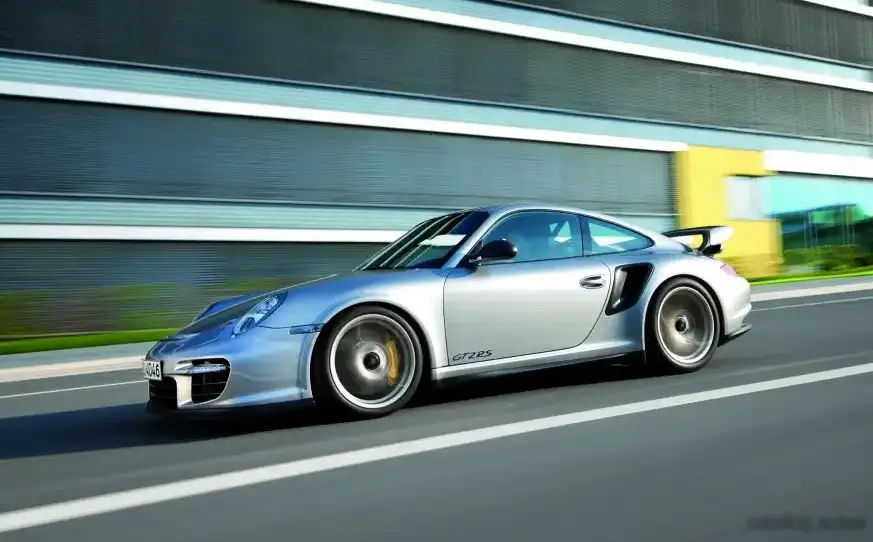
The Porsche 911 GT2 RS 3.6 (620 Hp) represents the pinnacle of performance within the 997 generation of the iconic 911. Produced from 2010 to 2012, this limited-production model was designed as a track-focused, street-legal sports car, building upon the already capable 997.2 facelift. It served as Porsche’s answer to competitors offering high-performance grand tourers, emphasizing raw power and aggressive aerodynamics. The GT2 RS was positioned as the most extreme variant of the 911 at the time, exceeding the capabilities of the standard Carrera, S, and even the Turbo models.
Technical Specifications
| Brand | Porsche |
| Model | 911 |
| Generation | 911 (997, facelift 2008) |
| Type (Engine) | GT2 RS 3.6 (620 Hp) |
| Start of production | 2010 |
| End of production | 2012 |
| Powertrain Architecture | Internal Combustion engine |
| Body type | Coupe |
| Seats | 2 |
| Doors | 2 |
| Fuel consumption (economy) – urban | 17.9 l/100 km (13.1 US mpg, 15.8 UK mpg, 5.6 km/l) |
| Fuel consumption (economy) – extra urban | 8.7 l/100 km (27 US mpg, 32.5 UK mpg, 11.5 km/l) |
| Fuel consumption (economy) – combined | 11.9 l/100 km (19.8 US mpg, 23.7 UK mpg, 8.4 km/l) |
| CO2 emissions | 284 g/km |
| Fuel Type | Petrol (Gasoline) |
| Acceleration 0 – 100 km/h | 3.5 sec |
| Acceleration 0 – 62 mph | 3.5 sec |
| Acceleration 0 – 60 mph | 3.3 sec |
| Maximum speed | 330 km/h (205.05 mph) |
| Weight-to-power ratio | 2.2 kg/Hp, 452.6 Hp/tonne |
| Weight-to-torque ratio | 2 kg/Nm, 510.9 Nm/tonne |
| Power | 620 Hp @ 2250-5500 rpm |
| Power per litre | 172.2 Hp/l |
| Torque | 700 Nm (516.29 lb.-ft.) |
| Engine layout | Rear, Longitudinal |
| Engine Model/Code | M97.70 |
| Engine displacement | 3600 cm3 (219.69 cu. in.) |
| Number of cylinders | 6 |
| Engine configuration | Boxer |
| Cylinder Bore | 100 mm (3.94 in.) |
| Piston Stroke | 76.6 mm (3.02 in.) |
| Compression ratio | 9:1 |
| Number of valves per cylinder | 4 |
| Fuel injection system | Direct injection |
| Engine aspiration | Turbocharger, Intercooler |
| Valvetrain | DOHC |
| Engine oil capacity | 8 l (8.45 US qt | 7.04 UK qt) |
| Coolant | 28 l (29.59 US qt | 24.64 UK qt) |
| Kerb Weight | 1370 kg (3020.33 lbs.) |
| Max. weight | 1680 kg (3703.77 lbs.) |
| Max load | 310 kg (683.43 lbs.) |
| Trunk (boot) space – maximum | 105 l (3.71 cu. ft.) |
| Fuel tank capacity | 90 l (23.78 US gal | 19.8 UK gal) |
| Length | 4469 mm (175.94 in.) |
| Width | 1852 mm (72.91 in.) |
| Width including mirrors | 1952 mm (76.85 in.) |
| Height | 1285 mm (50.59 in.) |
| Wheelbase | 2350 mm (92.52 in.) |
| Drag coefficient (Cd) | 0.34 |
| Minimum turning circle | 10.9 m (35.76 ft.) |
| Drivetrain Architecture | Rear wheel drive |
| Number of gears and type of gearbox | 6 gears, manual transmission |
| Front suspension | Independent type McPherson |
| Rear suspension | Independent multi-link suspension |
| Front brakes | Ventilated discs, 380 mm |
| Rear brakes | Ventilated discs, 350 mm |
| Assisting systems | ABS (Anti-lock braking system) |
| Steering type | Steering rack and pinion |
| Power steering | Hydraulic Steering |
| Tires size | 245/35 ZR19; 325/30 ZR19 |
| Wheel rims size | 9J x 19; 12J x 19 |
Powertrain & Engine Architecture
The heart of the GT2 RS is the M97.70 engine, a 3.6-liter twin-turbocharged flat-six. This engine is a direct descendant of the powerplant used in Porsche’s racing programs, modified for road use. Key features include direct fuel injection, ensuring precise fuel delivery and optimized combustion. The engine utilizes a dry-sump lubrication system, crucial for maintaining oil supply during the extreme cornering forces experienced on a track. The twin turbochargers, with variable turbine geometry, provide minimal turbo lag and a broad torque curve. The 6-speed manual transmission was specifically chosen for its robustness and driver engagement, prioritizing performance over convenience. The engine produces 620 horsepower at 2250-5500 rpm and 700 Nm (516 lb-ft) of torque, delivering exhilarating acceleration.
Driving Characteristics
The GT2 RS delivers a visceral driving experience. The combination of the powerful engine and rear-wheel drive necessitates respect and skill. Acceleration is brutal, with 0-60 mph achieved in approximately 3.3 seconds. The manual transmission requires precise shifting, but rewards the driver with complete control. The suspension is firm, prioritizing handling over comfort, and the steering is incredibly responsive. Compared to the standard 997 Carrera or even the Turbo, the GT2 RS feels significantly more raw and focused. The lack of all-wheel drive makes it more challenging to drive at the limit, but also more rewarding for experienced drivers. The gear ratios are optimized for acceleration, but the car is also capable of comfortable cruising at highway speeds.
Equipment & Trim Levels
The GT2 RS was sparsely equipped, reflecting its track-focused nature. Standard features included a lightweight interior with carbon fiber bucket seats, a Clubsport package (including a roll cage and six-point harness), and Porsche Ceramic Composite Brakes (PCCB). Air conditioning and a navigation system were available as optional extras, but many owners opted to forgo these to save weight. The interior was primarily Alcantara and carbon fiber, minimizing weight and maximizing a sporty feel. Exterior styling included a prominent rear wing, aggressive front and rear bumpers, and unique alloy wheels.
Chassis & Braking
The chassis of the GT2 RS was extensively modified to enhance performance. It featured a wider track than the standard 911, along with stiffer springs and dampers. The rear suspension geometry was optimized for improved traction. The Porsche Ceramic Composite Brakes (PCCB) provided exceptional stopping power and resistance to fade, essential for track use. The braking system utilized six-piston calipers at the front and four-piston calipers at the rear, acting on ventilated discs measuring 380mm and 350mm respectively. The car also featured an adjustable stabilizer bars to fine-tune the handling characteristics.
Market Reception & Comparison
The Porsche 911 GT2 RS was widely praised by automotive journalists for its incredible performance and track capabilities. Critics lauded its raw power, precise handling, and engaging driving experience. However, its firm ride and lack of everyday practicality were also noted. Compared to other high-performance cars of the time, such as the Nissan GT-R and the Ferrari 458 Italia, the GT2 RS offered a more focused and visceral driving experience. While the GT-R offered superior all-weather performance and the Ferrari provided more luxurious appointments, the GT2 RS stood out as a pure, uncompromising sports car. Fuel economy, while not a primary concern for buyers of this vehicle, was relatively poor at around 19.8 US mpg combined.
Legacy
The 997 GT2 RS has become a highly sought-after collector’s item. Its limited production run and exceptional performance have ensured its place in Porsche history. The M97.70 engine, while powerful, requires diligent maintenance, particularly regarding the turbochargers and cooling system. However, with proper care, the powertrain is known to be relatively reliable. Today, well-maintained examples command high prices on the used car market, reflecting their desirability and rarity. The GT2 RS set a new benchmark for track-focused sports cars, influencing the development of subsequent Porsche models and inspiring a generation of driving enthusiasts.