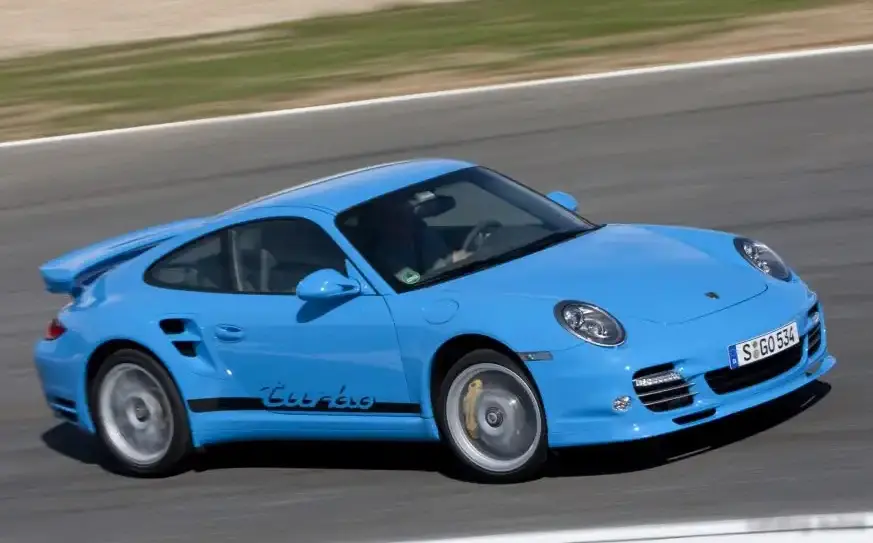
The Porsche 911 Turbo (997, facelift) with the 3.8-liter twin-turbocharged engine producing 500 horsepower was a performance flagship of the 997 generation, manufactured from 2009 to 2011. Representing the pinnacle of the 997.2 series, this variant built upon the already successful 997 platform, offering significantly increased power and performance compared to naturally aspirated models. It sat at the very top of the 911 lineup, positioned as a more focused and capable alternative to the Carrera and Carrera S models, and a precursor to the even more potent 991 Turbo that followed.
Technical Specifications
| Brand | Porsche |
| Model | 911 |
| Generation | 911 (997, facelift 2008) |
| Type (Engine) | Turbo 3.8 (500 Hp) |
| Start of production | 2009 |
| End of production | 2011 |
| Powertrain Architecture | Internal Combustion engine |
| Body type | Coupe |
| Seats | 4 |
| Doors | 2 |
| Fuel consumption (economy) – urban | 16.5 l/100 km (14.3 US mpg, 17.1 UK mpg, 6.1 km/l) |
| Fuel consumption (economy) – extra urban | 8.3 l/100 km (28.3 US mpg, 34 UK mpg, 12 km/l) |
| Fuel consumption (economy) – combined | 11.6 l/100 km (20.3 US mpg, 24.4 UK mpg, 8.6 km/l) |
| CO2 emissions | 272 g/km |
| Fuel Type | Petrol (Gasoline) |
| Acceleration 0 – 100 km/h | 3.7 sec |
| Acceleration 0 – 62 mph | 3.7 sec |
| Acceleration 0 – 60 mph | 3.5 sec |
| Maximum speed | 312 km/h (193.87 mph) |
| Emission standard | Euro 5 |
| Weight-to-power ratio | 3.1 kg/Hp, 318.5 Hp/tonne |
| Weight-to-torque ratio | 2.4 kg/Nm, 414 Nm/tonne |
| Power | 500 Hp @ 6000-6500 rpm |
| Power per litre | 131.6 Hp/l |
| Torque | 650 Nm @ 1950-5000 rpm (479.42 lb.-ft. @ 1950-5000 rpm) |
| Engine layout | Front, Longitudinal |
| Engine Model/Code | MA1.70 |
| Engine displacement | 3800 cm3 (231.89 cu. in.) |
| Number of cylinders | 6 |
| Engine configuration | Boxer |
| Compression ratio | 9.8:1 |
| Number of valves per cylinder | 4 |
| Fuel injection system | Direct injection |
| Engine aspiration | Turbocharger, Intercooler |
| Engine oil capacity | 8 l (8.45 US qt | 7.04 UK qt) |
| Coolant | 29 l (30.64 US qt | 25.52 UK qt) |
| Kerb Weight | 1570 kg (3461.26 lbs.) |
| Max. weight | 1935 kg (4265.94 lbs.) |
| Max load | 365 kg (804.69 lbs.) |
| Trunk (boot) space – maximum | 105 l (3.71 cu. ft.) |
| Fuel tank capacity | 67 l (17.7 US gal | 14.74 UK gal) |
| Length | 4450 mm (175.2 in.) |
| Width | 1852 mm (72.91 in.) |
| Width including mirrors | 1952 mm (76.85 in.) |
| Height | 1300 mm (51.18 in.) |
| Wheelbase | 2350 mm (92.52 in.) |
| Drag coefficient (Cd) | 0.31 |
| Minimum turning circle | 10.9 m (35.76 ft.) |
| Drive wheel | All wheel drive (4×4) |
| Number of gears and type of gearbox | 6 gears, manual transmission |
| Front suspension | Independent type McPherson |
| Rear suspension | Independent multi-link suspension |
| Front brakes | Ventilated discs, 350 mm |
| Rear brakes | Ventilated discs, 350 mm |
| Assisting systems | ABS (Anti-lock braking system) |
| Steering type | Steering rack and pinion |
| Power steering | Hydraulic Steering |
| Tires size | 235/35 ZR19; 305/30 ZR19 |
| Wheel rims size | 8.5J x 19; 11J x 19 |
Powertrain & Engine Architecture
The heart of the 997.2 Turbo is the MA1.70 engine, a 3.8-liter twin-turbocharged flat-six. This engine represents a significant evolution of the previous 3.6-liter turbo engine, featuring direct fuel injection (DFI) and revised turbochargers with variable turbine geometry (VTG). DFI allowed for more precise fuel delivery, improving both power and efficiency. The VTG turbochargers minimized turbo lag, providing near-instantaneous throttle response. The engine produces 500 horsepower at 6,000-6,500 rpm and a substantial 650 Nm (479 lb-ft) of torque between 1,950 and 5,000 rpm. The engine’s boxer configuration contributes to a lower center of gravity, enhancing handling. The standard transmission was a six-speed manual, although a seven-speed Porsche Doppelkupplung (PDK) dual-clutch transmission was also available as an option. The PDK offered incredibly fast and smooth gear changes, further improving performance.
Driving Characteristics
The 997.2 Turbo delivers breathtaking acceleration. The 0-60 mph sprint takes just 3.5 seconds with the manual transmission, and even less with the PDK. The all-wheel-drive system provides exceptional traction, allowing the car to put its power down effectively even in challenging conditions. While the power is immense, the engine is surprisingly tractable for everyday driving. The VTG turbochargers minimize lag, making the power delivery smooth and linear. Compared to the naturally aspirated 911 Carrera models, the Turbo offers a significantly more powerful and refined driving experience. The manual transmission provides a more engaging experience for purists, while the PDK offers unparalleled speed and convenience.
Equipment & Trim Levels
The 997.2 Turbo came standard with a comprehensive list of features, including a sport exhaust system, adaptive suspension management (PASM), and a limited-slip rear differential. The interior featured sport seats upholstered in leather, along with aluminum trim and a Bose sound system. Optional extras included carbon fiber interior trim, a navigation system, and adaptive cruise control. The Turbo also benefited from unique exterior styling cues, including wider fenders, a rear wing, and larger brakes.
Chassis & Braking
The 997.2 Turbo features a sophisticated chassis designed to handle its immense power. The suspension utilizes Porsche Active Suspension Management (PASM), which electronically adjusts the damping characteristics to optimize ride comfort and handling. The car is equipped with ventilated disc brakes at all four corners, providing exceptional stopping power. Larger brake rotors and calipers were standard compared to the Carrera models. The all-wheel-drive system distributes power between the front and rear axles, enhancing traction and stability.
Market Reception & Comparison
The 997.2 Turbo was widely praised by automotive critics for its exceptional performance, handling, and refinement. It was consistently ranked among the fastest and most capable sports cars on the market. Compared to the naturally aspirated 911 Carrera models, the Turbo offered a significant performance upgrade, but at a substantial price premium. The Turbo also faced competition from other high-performance sports cars, such as the Audi R8 and the Nissan GT-R. However, the 911 Turbo’s unique combination of performance, luxury, and everyday usability set it apart from its rivals.
Legacy
The 997.2 Turbo remains a highly sought-after sports car in the used car market. Its robust powertrain and sophisticated engineering have proven to be reliable over time. While maintenance costs can be higher than those of more mainstream sports cars, the 911 Turbo offers a unique and rewarding driving experience that continues to appeal to enthusiasts. The 997.2 Turbo represents a high point in the evolution of the 911, and it remains a benchmark for performance and luxury in the sports car segment.