
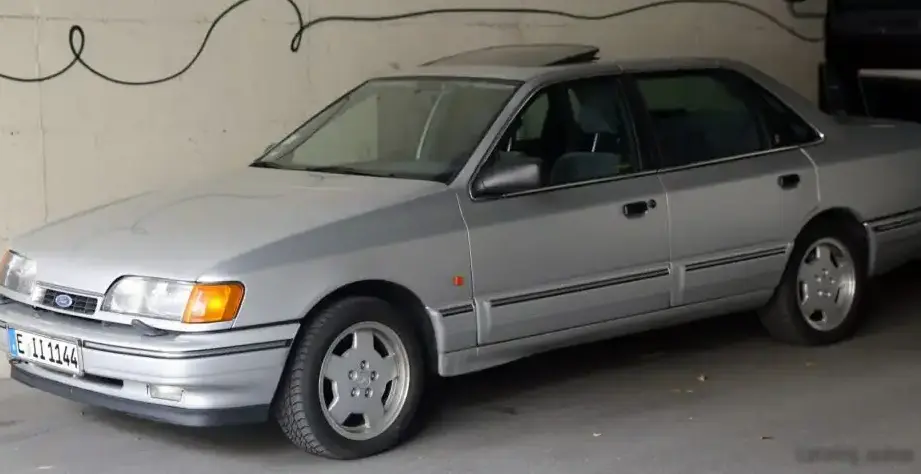
The Ford Scorpio I, produced between 1989 and 1992, represented a significant step forward for Ford’s executive car offerings in Europe. Replacing the Granada, the Scorpio aimed to blend spaciousness, comfort, and a more modern design. The 2.0i variant, powered by the N9D engine producing 120 horsepower, occupied a middle ground in the Scorpio lineup, offering a balance between performance and affordability. It was positioned as a more accessible option compared to the higher-specification 2.9i V6 models, while providing more power than the base 1.8L engine. This model was primarily targeted at fleet buyers and private customers seeking a comfortable and reliable family saloon.
Technical Specifications
| Brand | Ford |
| Model | Scorpio |
| Generation | Scorpio I (GAE, GGE) |
| Type (Engine) | 2.0i (120 Hp) |
| Start of production | 1989 |
| End of production | 1992 |
| Powertrain Architecture | Internal Combustion engine |
| Body type | Sedan |
| Seats | 5 |
| Doors | 4 |
| Fuel Type | Petrol (Gasoline) |
| Acceleration 0 – 100 km/h | 11.2 sec |
| Acceleration 0 – 62 mph | 11.2 sec |
| Acceleration 0 – 60 mph | 10.6 sec |
| Maximum speed | 202 km/h (125.52 mph) |
| Weight-to-power ratio | 10.5 kg/Hp, 95.2 Hp/tonne |
| Weight-to-torque ratio | 7.4 kg/Nm, 135.7 Nm/tonne |
| Power | 120 Hp @ 5600 rpm |
| Power per litre | 60.1 Hp/l |
| Torque | 171 Nm @ 2500 rpm (126.12 lb.-ft. @ 2500 rpm) |
| Engine layout | Front, Longitudinal |
| Engine Model/Code | N9D |
| Engine displacement | 1998 cm3 (121.93 cu. in.) |
| Number of cylinders | 4 |
| Engine configuration | Inline |
| Cylinder Bore | 86 mm (3.39 in.) |
| Piston Stroke | 86 mm (3.39 in.) |
| Number of valves per cylinder | 4 |
| Fuel injection system | Multi-port manifold injection |
| Engine aspiration | Naturally aspirated engine |
| Valvetrain | DOHC |
| Engine oil capacity | 4.5 l (4.76 US qt | 3.96 UK qt) |
| Coolant | 8.1 l (8.56 US qt | 7.13 UK qt) |
| Kerb Weight | 1260 kg (2777.82 lbs.) |
| Fuel tank capacity | 70 l (18.49 US gal | 15.4 UK gal) |
| Length | 4744 mm (186.77 in.) |
| Width | 1766 mm (69.53 in.) |
| Height | 1450 mm (57.09 in.) |
| Wheelbase | 2761 mm (108.7 in.) |
| Minimum turning circle | 10.4 m (34.12 ft.) |
| Drivetrain Architecture | Rear wheel drive |
| Drive wheel | Rear wheel drive |
| Number of gears | 5 gears, manual transmission |
| Front brakes | Ventilated discs |
| Rear brakes | Disc |
| Steering type | Steering rack and pinion |
| Power steering | Hydraulic Steering |
Powertrain & Engine Architecture
The heart of the Scorpio 2.0i was the Ford N9D engine, a 1998cc inline-four cylinder unit. This engine featured multi-port fuel injection and a double overhead camshaft (DOHC) valvetrain, contributing to its relatively smooth power delivery. The N9D was a development of Ford’s earlier ‘Pinto’ engine family, but with significant improvements in refinement and efficiency. The engine produced 120 horsepower at 5600 rpm and 171 Nm (126.12 lb-ft) of torque at 2500 rpm. The five-speed manual transmission was standard, providing a good balance between acceleration and fuel economy. The engine was mounted longitudinally in the front of the vehicle, driving the rear wheels – a configuration typical of larger European saloons of the era.
Driving Characteristics
The 2.0i Scorpio offered a comfortable and composed driving experience. While not overtly sporty, the engine provided sufficient power for relaxed cruising and overtaking. The five-speed manual transmission allowed drivers to keep the engine in its optimal power band. Compared to the more powerful 2.9i V6, the 2.0i felt less strained during acceleration, but naturally lacked the V6’s outright punch. The rear-wheel-drive layout contributed to balanced handling, although the Scorpio’s size and weight meant it wasn’t a particularly nimble car. The gear ratios were tuned for fuel efficiency and comfortable highway driving, rather than aggressive acceleration.
Equipment & Trim Levels
The Scorpio 2.0i typically came equipped with features such as central locking, electric front windows, and a basic stereo system. Higher trim levels offered options like air conditioning, power-assisted steering, and upgraded upholstery. Interior trim generally consisted of cloth seats, with options for velour or leather available at extra cost. The dashboard layout was functional and straightforward, with clear instrumentation. The Scorpio was designed with practicality in mind, offering a spacious interior and a large boot (trunk).
Chassis & Braking
The Scorpio I utilized a traditional body-on-frame construction, providing a robust and durable chassis. The front suspension featured independent MacPherson struts, while the rear suspension employed a live axle with coil springs. Braking was provided by ventilated discs at the front and solid discs at the rear. Power-assisted steering was often included as standard or an optional extra, making the car easier to maneuver in tight spaces. Stabilizer bars were fitted to both the front and rear axles to reduce body roll during cornering.
Market Reception & Comparison
The Scorpio 2.0i was generally well-received by automotive critics as a practical and comfortable family saloon. It was praised for its spacious interior, good ride quality, and reasonable fuel economy. However, some critics noted that the 2.0i engine could feel underpowered when the car was fully loaded. Compared to the 2.9i V6, the 2.0i offered a more affordable entry point into the Scorpio range, but at the expense of performance. The 1.8L version was even more economical but lacked the punch of the 2.0i. In terms of reliability, the N9D engine was generally considered to be durable, although regular maintenance was essential.
Legacy
The Ford Scorpio I, including the 2.0i variant, remains a relatively uncommon sight on the roads today. While not as sought-after as some classic Ford models, the Scorpio has gained a following among enthusiasts who appreciate its spaciousness, comfort, and rear-wheel-drive layout. The N9D engine, while not a high-performance unit, is known for its reliability and relatively simple construction, making it easier to maintain. In the used car market, well-maintained examples of the Scorpio 2.0i can still provide a comfortable and affordable classic car experience. The Scorpio represented a bold attempt by Ford to compete in the executive car segment, and the 2.0i variant offered a practical and accessible option for buyers seeking a spacious and reliable family saloon.
