
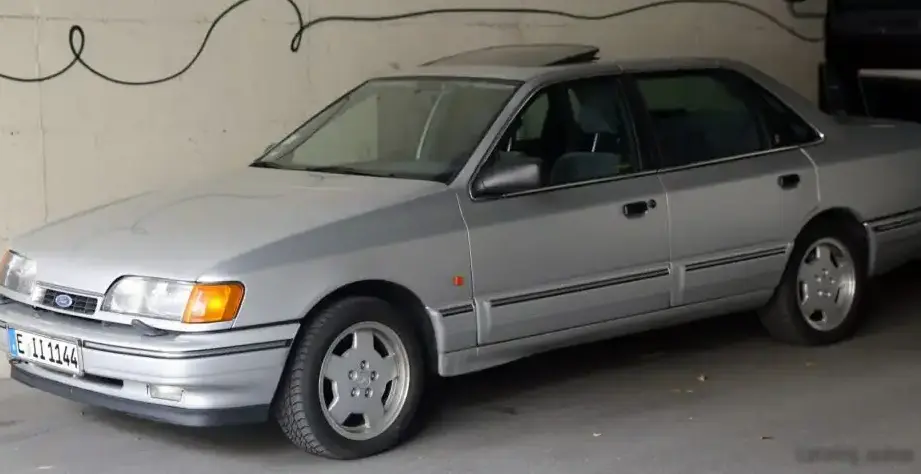
The Ford Scorpio I 2.4i CAT, produced between 1988 and 1992, represented a significant step forward for Ford’s executive car offerings in Europe. Positioned as a more sophisticated and spacious alternative to the Ford Granada it replaced, the Scorpio aimed to compete with vehicles like the Opel Senator and BMW 5 Series. The 2.4i CAT variant, equipped with a 2.4-liter V6 engine and catalytic converter, served as a mid-range offering within the Scorpio I lineup, balancing performance with fuel efficiency and emissions compliance. It was a key model in establishing the Scorpio’s presence in the upper-midsize segment.
Technical Specifications
| Brand | Ford |
| Model | Scorpio |
| Generation | Scorpio I (GAE, GGE) |
| Type (Engine) | 2.4i CAT (125 Hp) |
| Start of production | 1988 |
| End of production | 1992 |
| Powertrain Architecture | Internal Combustion engine |
| Body type | Sedan |
| Seats | 5 |
| Doors | 4 |
| Fuel Type | Petrol (Gasoline) |
| Acceleration 0 – 100 km/h | 11 sec |
| Acceleration 0 – 62 mph | 11 sec |
| Acceleration 0 – 60 mph | 10.5 sec |
| Maximum speed | 200 km/h (124.27 mph) |
| Weight-to-power ratio | 10.4 kg/Hp, 96.5 Hp/tonne |
| Weight-to-torque ratio | 7.1 kg/Nm, 140.5 Nm/tonne |
| Power | 125 Hp @ 5800 rpm |
| Power per litre | 52.2 Hp/l |
| Torque | 182 Nm @ 3500 rpm (134.24 lb.-ft. @ 3500 rpm) |
| Engine layout | Front, Longitudinal |
| Engine Model/Code | ARD |
| Engine displacement | 2394 cm3 (146.09 cu. in.) |
| Number of cylinders | 6 |
| Engine configuration | V-engine |
| Cylinder Bore | 84 mm (3.31 in.) |
| Piston Stroke | 72 mm (2.83 in.) |
| Number of valves per cylinder | 2 |
| Fuel injection system | Multi-port manifold injection |
| Engine aspiration | Naturally aspirated engine |
| Valvetrain | OHC |
| Engine oil capacity | 4.3 l (4.54 US qt | 3.78 UK qt) |
| Coolant | 8.5 l (8.98 US qt | 7.48 UK qt) |
| Kerb Weight | 1295 kg (2854.99 lbs.) |
| Fuel tank capacity | 70 l (18.49 US gal | 15.4 UK gal) |
| Length | 4744 mm (186.77 in.) |
| Width | 1766 mm (69.53 in.) |
| Height | 1450 mm (57.09 in.) |
| Wheelbase | 2761 mm (108.7 in.) |
| Minimum turning circle | 10.4 m (34.12 ft.) |
| Drivetrain Architecture | Rear wheel drive |
| Number of gears and type of gearbox | 5 gears, manual transmission |
| Front brakes | Ventilated discs |
| Rear brakes | Disc |
| Steering type | Steering rack and pinion |
Powertrain & Engine Architecture
The heart of the Scorpio I 2.4i CAT was the Ford ARD engine, a 2.4-liter, 60-degree V6. This engine utilized a cast iron block with an aluminum cylinder head, a common configuration for Ford’s V6 engines of the era. The “CAT” designation indicates the presence of a catalytic converter, a crucial component for meeting increasingly stringent emissions regulations in Europe. Fuel delivery was managed by a Bosch multi-port fuel injection system, providing precise fuel metering for improved efficiency and reduced emissions. The engine featured a single overhead camshaft (OHC) design operating two valves per cylinder. This configuration offered a good balance between simplicity, reliability, and performance. The 5-speed manual transmission was the standard offering, providing drivers with full control over the engine’s power.
Driving Characteristics
The 2.4i CAT Scorpio offered a comfortable and refined driving experience, prioritizing smoothness over outright performance. With 125 horsepower and 182 Nm (134 lb-ft) of torque, acceleration to 60 mph took around 10.5 seconds, which was adequate for the time but not particularly sporty. The rear-wheel-drive layout provided balanced handling, although it wasn’t as nimble as front-wheel-drive competitors. The 5-speed manual transmission allowed for effective engine utilization, but the gear ratios were geared towards relaxed cruising rather than aggressive acceleration. Compared to the higher-output 2.9-liter V6 Scorpio, the 2.4i felt noticeably less powerful, especially when fully loaded or tackling steep inclines. However, it offered superior fuel economy and lower running costs.
Equipment & Trim Levels
The 2.4i CAT trim generally included features such as central locking, electric windows, and a basic stereo system. Interior upholstery was typically cloth, with options for upgraded velour or leather available at extra cost. Dashboard design was functional and straightforward, with clear instrumentation. Optional extras included air conditioning, a sunroof, and upgraded sound systems. The Scorpio I aimed for a comfortable and well-equipped interior, although it didn’t quite reach the luxury levels of some of its German rivals. The trim level often dictated the availability of features like power steering and alloy wheels.
Chassis & Braking
The Scorpio I utilized a MacPherson strut front suspension and a multi-link rear suspension, providing a comfortable ride and reasonable handling. The 2.4i CAT models typically featured ventilated disc brakes at the front and solid disc brakes at the rear. Steering was via a rack and pinion system, offering precise control. Stabilizer bars were fitted to both the front and rear axles to reduce body roll during cornering. The suspension setup was tuned for comfort, prioritizing a smooth ride over sporty handling. The braking system was adequate for the car’s weight and performance, but lacked the stopping power of more modern systems.
Market Reception & Comparison
The Scorpio I 2.4i CAT was generally well-received by automotive critics as a comfortable and practical executive car. It was praised for its spacious interior, smooth ride, and relatively fuel-efficient engine. However, it was often criticized for its somewhat bland styling and lack of sporting character. Compared to the 2.9-liter V6 Scorpio, the 2.4i offered better fuel economy (around 25-30 mpg) but significantly less performance. The 2.4i also proved to be more reliable than some of the more complex and powerful engine options in the Scorpio lineup. It appealed to buyers who prioritized comfort, practicality, and value for money over outright performance.
Legacy
The Ford Scorpio I 2.4i CAT, while not a groundbreaking vehicle, played an important role in establishing Ford’s presence in the executive car market. The ARD V6 engine proved to be a durable and reliable powerplant, and many examples are still on the road today. The 2.4i CAT variant remains a relatively affordable classic car, appealing to enthusiasts who appreciate its comfortable ride, spacious interior, and classic 1980s styling. Parts availability can be a challenge, but the engine’s simplicity and robustness contribute to its long-term reliability. The Scorpio I, and particularly the 2.4i CAT, represents a significant chapter in Ford’s European automotive history.
