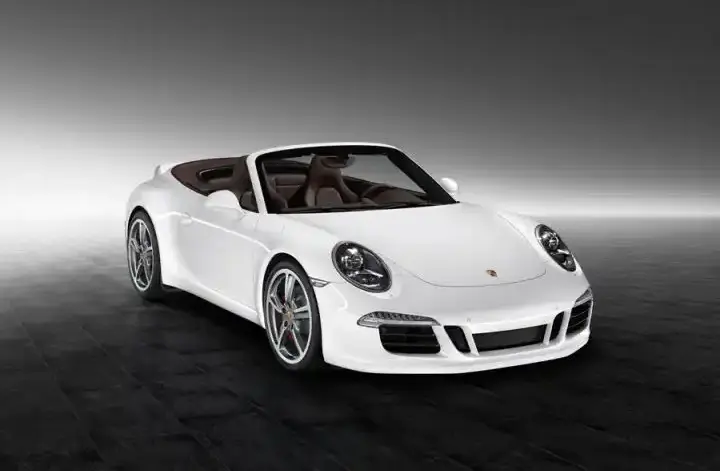
The Porsche 911 Cabriolet (991) Carrera 4 GTS 3.8, equipped with the dual-clutch Porsche Doppelkupplung (PDK) transmission, represented a compelling blend of performance and open-air driving pleasure within the broader 991 generation of the iconic 911. Produced from 2014 to 2015, this variant occupied a premium position in the 911 Cabriolet lineup, bridging the gap between the standard Carrera models and the more focused, track-oriented GT3. It was designed to appeal to drivers seeking exhilarating performance with the added versatility of all-wheel drive and the enjoyment of top-down motoring.
Technical Specifications
| Brand | Porsche |
| Model | 911 |
| Generation | 911 Cabriolet (991) |
| Type (Engine) | Carrera 4 GTS 3.8 (430 Hp) PDK |
| Start of production | 2014 |
| End of production | 2015 |
| Powertrain Architecture | Internal Combustion engine |
| Body type | Cabriolet |
| Seats | 4 |
| Doors | 2 |
| Fuel consumption (economy) – urban | 12.5 l/100 km (18.8 US mpg, 22.6 UK mpg, 8 km/l) |
| Fuel consumption (economy) – extra urban | 7.1 l/100 km (33.1 US mpg, 39.8 UK mpg, 14.1 km/l) |
| Fuel consumption (economy) – combined | 9.2 l/100 km (25.6 US mpg, 30.7 UK mpg, 10.9 km/l) |
| CO2 emissions | 214 g/km |
| Fuel Type | Petrol (Gasoline) |
| Acceleration 0 – 100 km/h | 4.2 sec |
| Acceleration 0 – 62 mph | 4.2 sec |
| Acceleration 0 – 60 mph | 4.0 sec (Calculated) |
| Maximum speed | 301 km/h (187.03 mph) |
| Emission standard | Euro 6 |
| Weight-to-power ratio | 3.6 kg/Hp, 275.6 Hp/tonne |
| Weight-to-torque ratio | 3.5 kg/Nm, 282.1 Nm/tonne |
| Power | 430 Hp @ 7500 rpm |
| Power per litre | 113.2 Hp/l |
| Torque | 440 Nm @ 5750 rpm (324.53 lb.-ft. @ 5750 rpm) |
| Engine layout | Rear, Longitudinal |
| Engine Model/Code | MA1.01 |
| Engine displacement | 3800 cm3 (231.89 cu. in.) |
| Number of cylinders | 6 |
| Engine configuration | Boxer |
| Cylinder Bore | 102 mm (4.02 in.) |
| Piston Stroke | 77.5 mm (3.05 in.) |
| Compression ratio | 12.5:1 |
| Number of valves per cylinder | 4 |
| Fuel injection system | Direct injection |
| Engine aspiration | Naturally aspirated engine |
| Engine oil capacity | 7.5 l (7.93 US qt | 6.6 UK qt) |
| Coolant | 26.3 l (27.79 US qt | 23.14 UK qt) |
| Kerb Weight | 1560 kg (3439.21 lbs.) |
| Max. weight | 1955 kg (4310.04 lbs.) |
| Max load | 395 kg (870.83 lbs.) |
| Trunk (boot) space – minimum | 285 l (10.06 cu. ft.) |
| Fuel tank capacity | 68 l (17.96 US gal | 14.96 UK gal) |
| Length | 4509 mm (177.52 in.) |
| Width | 1852 mm (72.91 in.) |
| Height | 1294 mm (50.94 in.) |
| Wheelbase | 2450 mm (96.46 in.) |
| Front track | 1538 mm (60.55 in.) |
| Rear (Back) track | 1560 mm (61.42 in.) |
| Drag coefficient (Cd) | 0.30 |
| Drive wheel | All wheel drive (4×4) |
| Number of gears and type of gearbox | 7 gears, automatic transmission PDK |
| Front suspension | Independent type McPherson |
| Rear suspension | Independent multi-link suspension |
| Front brakes | Ventilated discs |
| Rear brakes | Ventilated discs |
| Assisting systems | ABS (Anti-lock braking system) |
| Steering type | Steering rack and pinion |
| Tires size | 245/35 ZR20; 305/30 ZR20 |
| Wheel rims size | 9J x 20; 11.5J x 20 |
INTRODUCTION
The 991-generation Porsche 911, launched in 2011, represented a significant evolution of the iconic sports car. The Carrera 4 GTS, introduced in 2014, further refined the formula, offering increased power, enhanced handling, and a more aggressive aesthetic. The Cabriolet version combined these attributes with the open-air experience, making it a desirable option for drivers who wanted both performance and enjoyment. The “4” designation indicates Porsche’s all-wheel drive system, providing enhanced traction and stability, particularly in inclement weather. The PDK transmission, a seven-speed dual-clutch unit, offered incredibly fast and smooth gear changes, contributing to the car’s impressive acceleration and overall driving experience.
Powertrain & Engine Architecture
At the heart of the 911 Carrera 4 GTS Cabriolet lies the MA1.01 engine, a 3.8-liter naturally aspirated flat-six (boxer) engine. This engine produced 430 horsepower at 7,500 rpm and 440 Nm (324.53 lb-ft) of torque at 5,750 rpm. The engine featured direct fuel injection, optimizing combustion efficiency and power delivery. The boxer configuration, with its horizontally opposed cylinders, contributes to a low center of gravity, enhancing stability and handling. The PDK transmission is a sophisticated dual-clutch system that essentially combines two manual gearboxes into one, allowing for incredibly quick and seamless shifts. It operates in both automatic and manual modes, with paddle shifters mounted on the steering wheel for driver control. The transmission’s programming is tailored to the GTS model, prioritizing performance and responsiveness.
Driving Characteristics
The 911 Carrera 4 GTS Cabriolet with PDK delivers a thrilling driving experience. The combination of all-wheel drive and the powerful engine provides exceptional grip and acceleration. The PDK transmission allows for lightning-fast gear changes, keeping the engine in its optimal power band. Compared to the standard Carrera Cabriolet, the GTS offers a noticeably more engaging and responsive driving experience. While the manual transmission offered a more visceral connection for some drivers, the PDK provided superior acceleration and convenience. The all-wheel drive system inspires confidence in various driving conditions, making the GTS a capable and enjoyable car year-round.
Equipment & Trim Levels
The Carrera 4 GTS Cabriolet came standard with a generous array of features, including a power-retractable soft top, sport seats, a sport exhaust system, and Porsche’s Communication Management (PCM) system with navigation. Interior trim options included leather upholstery in various colors, along with carbon fiber accents. Optional extras included adaptive sport seats with memory function, a Bose audio system, and Porsche Dynamic Chassis Control (PDCC), which further enhances handling by actively managing body roll. The GTS trim also included unique exterior styling elements, such as wider rear fenders, a sport design front fascia, and blacked-out exterior trim.
Chassis & Braking
The 991-generation 911 features a lightweight chassis construction, utilizing aluminum and high-strength steel. The suspension system consists of independent McPherson struts at the front and a multi-link setup at the rear. The GTS model benefits from a slightly lowered ride height and stiffer springs and dampers compared to the standard Carrera. The braking system consists of ventilated discs at all four corners, providing ample stopping power. Porsche’s ABS (Anti-lock Braking System) and Porsche Stability Management (PSM) systems further enhance safety and control.
Market Reception & Comparison
The 911 Carrera 4 GTS Cabriolet was well-received by automotive critics, who praised its performance, handling, and overall driving experience. It was often lauded as a sweet spot in the 911 lineup, offering a compelling balance of performance and everyday usability. Compared to the 911 Carrera S Cabriolet, the GTS provided a noticeable increase in power and a more aggressive character. Compared to the more focused GT3, the GTS offered a greater degree of comfort and refinement. Fuel economy was respectable for a high-performance sports car, with combined fuel consumption rated at 9.2 l/100 km (25.6 US mpg).
Legacy
The 991 Carrera 4 GTS Cabriolet remains a highly sought-after model in the used car market. The MA1.01 engine is known for its reliability, provided it receives regular maintenance. The PDK transmission has also proven to be durable and dependable. These cars are often appreciated by enthusiasts for their combination of performance, style, and open-air driving enjoyment. As a relatively rare and desirable variant, the 991 Carrera 4 GTS Cabriolet is likely to hold its value well in the years to come, continuing to provide a thrilling driving experience for its owners.