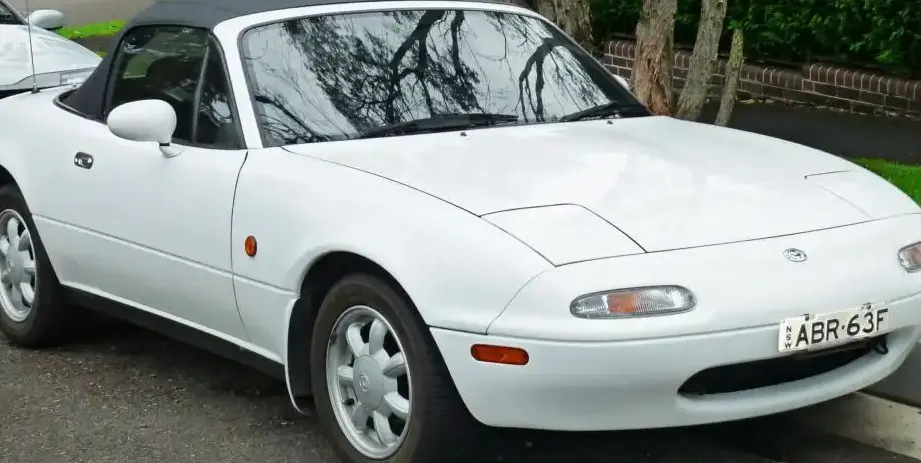
Technical Specifications
| Brand | Mazda |
| Model | MX-5 |
| Generation | MX-5 II (NB) |
| Type (Engine) | 1.6 i 16V (125 Hp) |
| Start of production | 1998 |
| End of production | 2005 |
| Powertrain Architecture | Internal Combustion engine |
| Body type | Roadster |
| Seats | 2 |
| Doors | 2 |
| Fuel consumption (urban) | 10.8 l/100 km (21.8 US mpg) |
| Fuel consumption (extra urban) | 6.6 l/100 km (35.6 US mpg) |
| Fuel consumption (combined) | 8.1 l/100 km (29 US mpg) |
| Fuel Type | Petrol (Gasoline) |
| Acceleration 0 – 100 km/h | 9.7 sec |
| Acceleration 0 – 62 mph | 9.7 sec |
| Acceleration 0 – 60 mph | 9.2 sec |
| Maximum speed | 191 km/h (118.68 mph) |
| Weight-to-power ratio | 8.3 kg/Hp |
| Weight-to-torque ratio | 7.3 kg/Nm |
| Power | 125 Hp @ 6500 rpm |
| Power per litre | 78.2 Hp/l |
| Torque | 142 Nm @ 5000 rpm (104.73 lb.-ft. @ 5000 rpm) |
| Engine layout | Front, Longitudinal |
| Engine displacement | 1598 cm3 (97.52 cu. in.) |
| Number of cylinders | 4 |
| Engine configuration | Inline |
| Cylinder Bore | 78 mm (3.07 in.) |
| Piston Stroke | 83.6 mm (3.29 in.) |
| Compression ratio | 9.4:1 |
| Number of valves per cylinder | 4 |
| Fuel injection system | Multi-port manifold injection |
| Engine aspiration | Naturally aspirated engine |
| Valvetrain | DOHC |
| Kerb Weight | 1035 kg (2281.78 lbs.) |
| Max. weight | 1255 kg (2766.8 lbs.) |
| Max load | 220 kg (485.02 lbs.) |
| Trunk (boot) space – minimum | 145 l (5.12 cu. ft.) |
| Fuel tank capacity | 50 l (13.21 US gal | 11 UK gal) |
| Length | 3975 mm (156.5 in.) |
| Width | 1680 mm (66.14 in.) |
| Height | 1220 mm (48.03 in.) |
| Wheelbase | 2265 mm (89.17 in.) |
| Front track | 1405 mm (55.31 in.) |
| Rear (Back) track | 1430 mm (56.3 in.) |
| Minimum turning circle | 9.7 m (31.82 ft.) |
| Drivetrain Architecture | Rear wheel drive |
| Drive wheel | Rear wheel drive |
| Number of gears | 5 gears, manual transmission |
| Front suspension | Double wishbone |
| Rear suspension | Coil spring |
| Front brakes | Ventilated discs |
| Rear brakes | Disc |
| Assisting systems | ABS (Anti-lock braking system) |
| Steering type | Steering rack and pinion |
| Power steering | Hydraulic Steering |
| Tires size | 185/60 R14 82 H |
| Wheel rims size | 5.5J x 14 ET 40 |
The NB MX-5, launched in 1998, built upon the success of the original NA model, refining the formula with improved rigidity, safety features, and a more modern aesthetic. The 1.6L engine variant, while less common in North America, was a significant offering in Europe and Asia. It represented a more accessible entry point to MX-5 ownership, prioritizing fuel efficiency and nimble handling over outright power. The NB generation, built on the 1HX0 platform, continued the MX-5’s tradition of providing an engaging, affordable, and thoroughly enjoyable roadster experience.
Powertrain & Engine Architecture
The heart of the 1.6 i 16V is the Mazda B6ZE engine, a naturally aspirated, inline-four cylinder powerplant. This engine, part of the Mazda B-series, utilizes a multi-port fuel injection system for precise fuel delivery. The engine features a double overhead camshaft (DOHC) valvetrain, operating 16 valves (four per cylinder) to optimize airflow and enhance performance. The 1.6L engine produced 125 horsepower at 6500 rpm and 142 Nm (104.73 lb-ft) of torque at 5000 rpm. The engine’s longitudinal mounting and rear-wheel-drive configuration contribute to the MX-5’s balanced handling characteristics. The standard transmission for this variant was a 5-speed manual, although a 4-speed automatic transmission was also available, albeit less common and generally considered to diminish the driving experience.
Driving Characteristics
The 1.6L MX-5 NB offered a distinctly different driving experience compared to its 1.8L sibling. While the 1.8L provided more immediate acceleration, the 1.6L’s lighter weight resulted in a more responsive and agile feel. The 5-speed manual transmission provided precise gear changes, allowing drivers to fully exploit the engine’s powerband. The automatic transmission, while offering convenience, noticeably dulled the car’s responsiveness. The gear ratios were tuned for efficiency and everyday usability, rather than outright performance. In real-world driving, the 1.6L MX-5 was best enjoyed on winding roads, where its nimble handling and balanced chassis shone. It wasn’t a car built for straight-line speed, but rather for engaging driving dynamics.
Equipment & Trim Levels
The 1.6L MX-5 NB typically came equipped with a relatively basic, yet functional, set of features. Standard equipment generally included power steering, central locking, electric windows, and a basic audio system. Interior upholstery was typically cloth, with a simple and functional dashboard layout. Optional extras included air conditioning, alloy wheels, a leather steering wheel, and a limited-slip differential (LSD). Trim levels varied depending on the market, but generally offered incremental upgrades in terms of comfort and convenience features. The focus remained on providing a pure driving experience, with minimal distractions.
Chassis & Braking
The NB MX-5 featured a double wishbone suspension setup at the front and a coil spring setup at the rear, providing a comfortable yet sporty ride. The chassis was significantly reinforced compared to the NA model, improving rigidity and handling precision. Braking duties were handled by ventilated discs at the front and solid discs at the rear. Anti-lock braking system (ABS) was standard, enhancing safety. The relatively light weight of the 1.6L model contributed to its excellent braking performance. Stabilizer bars were fitted front and rear, further enhancing handling stability.
Market Reception & Comparison
The 1.6L MX-5 NB received generally positive reviews, particularly for its affordability and engaging driving dynamics. Critics praised its nimble handling and fuel efficiency, but noted that it lacked the outright power of the 1.8L models. Compared to the 1.8L, the 1.6L offered a more economical option, appealing to budget-conscious buyers and those prioritizing handling over speed. The 1.8L models were often seen as the more desirable choice for those seeking a more powerful and refined driving experience. However, the 1.6L’s lower purchase price and running costs made it a popular choice for first-time sports car buyers.
Legacy
The Mazda MX-5 NB 1.6L has proven to be a remarkably reliable and durable sports car. The B6ZE engine is known for its longevity, and with proper maintenance, can provide many years of trouble-free service. Today, the NB MX-5 remains a popular choice in the used car market, prized for its affordability, engaging driving dynamics, and classic roadster styling. While not as highly sought after as the NA or NC generations, the NB 1.6L offers a compelling entry point into the world of Mazda’s iconic roadster, providing a pure and enjoyable driving experience at an accessible price point. Parts availability remains good, making it a relatively easy car to maintain and repair.