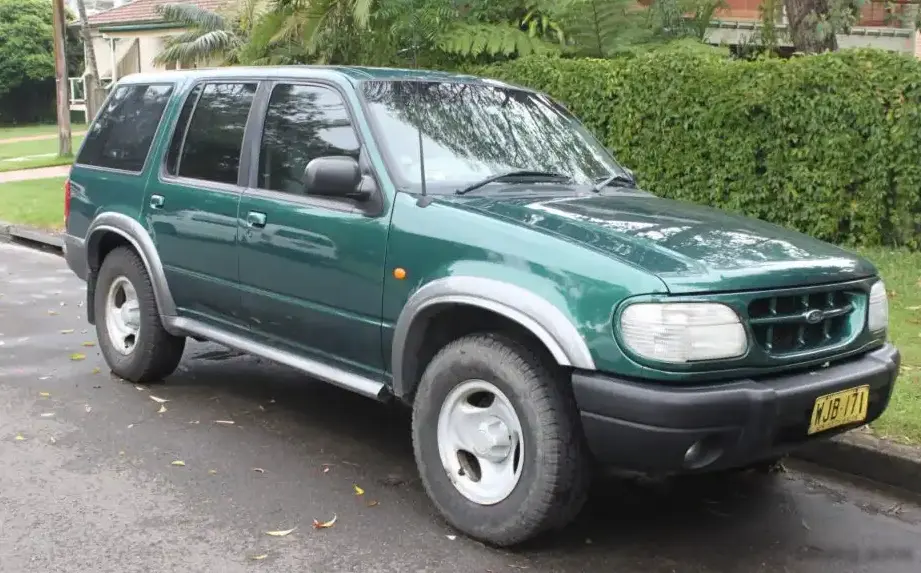
The Ford Explorer II, specifically the 4.0 V6 4WD variant producing 155 horsepower, represents a significant iteration in Ford’s popular SUV lineage. Produced from 1995 to 2003, this second-generation Explorer (designated as the Explorer II internally) aimed to provide a larger, more capable vehicle than its predecessor, catering to families and those requiring increased cargo space and towing capacity. It was positioned as a mid-range offering within the Explorer lineup, slotting between the base 4.0L 2WD models and the higher-spec trims with optional features and packages. This generation moved the Explorer towards a more rounded and modern aesthetic, while retaining the rugged body-on-frame construction that defined its appeal.
Technical Specifications
| Brand | Ford |
| Model | Explorer |
| Generation | Explorer II |
| Type (Engine) | 4.0 V6 4WD (155 Hp) |
| Start of production | 1995 year |
| End of production | 2003 year |
| Powertrain Architecture | Internal Combustion engine |
| Body type | SUV |
| Seats | 5 |
| Doors | 3/5 |
| Fuel Type | Petrol (Gasoline) |
| Maximum speed | 177 km/h (109.98 mph) |
| Weight-to-power ratio | 11.2 kg/Hp, 89.3 Hp/tonne |
| Weight-to-torque ratio | 5.8 kg/Nm, 171.7 Nm/tonne |
| Power | 155 Hp @ 4200 rpm |
| Power per litre | 39.2 Hp/l |
| Torque | 298 Nm @ 2400 rpm (219.79 lb.-ft. @ 2400 rpm) |
| Engine layout | Front, Longitudinal |
| Engine displacement | 3958 cm3 (241.53 cu. in.) |
| Number of cylinders | 6 |
| Engine configuration | V-engine |
| Cylinder Bore | 100 mm (3.94 in.) |
| Piston Stroke | 84 mm (3.31 in.) |
| Compression ratio | 9:1 |
| Number of valves per cylinder | 2 |
| Fuel injection system | Multi-port manifold injection |
| Engine aspiration | Naturally aspirated engine |
| Engine oil capacity | 4.7 l (4.97 US qt | 4.14 UK qt) |
| Coolant | 7.4 l (7.82 US qt | 6.51 UK qt) |
| Kerb Weight | 1736 kg (3827.22 lbs.) |
| Trunk (boot) space – minimum | 767 l (27.09 cu. ft.) |
| Trunk (boot) space – maximum | 1270 l (44.85 cu. ft.) |
| Fuel tank capacity | 72 l (19.02 US gal | 15.84 UK gal) |
| Length | 4429 mm (174.37 in.) |
| Width | 1783 mm (70.2 in.) |
| Height | 1714 mm (67.48 in.) |
| Wheelbase | 2593 mm (102.09 in.) |
| Front track | 1480 mm (58.27 in.) |
| Rear (Back) track | 1480 mm (58.27 in.) |
| Drive wheel | All wheel drive (4×4) |
| Number of gears and type of gearbox | 5 gears, manual transmission |
| Front suspension | Coil spring |
| Rear suspension | Leaf spring |
| Front brakes | Disc |
| Rear brakes | Drum |
| Assisting systems | ABS (Anti-lock braking system) |
| Steering type | Steering rack and pinion |
| Power steering | Hydraulic Steering |
| Tires size | 225/70 R15 |
Powertrain & Engine Architecture
The heart of this Explorer II variant is the 4.0-liter Cologne V6 engine. This engine, internally designated as the 4.0L OHV, is a naturally aspirated, 90-degree V6. It utilizes a cast iron block and aluminum cylinder heads. The engine employs a multi-port fuel injection system, delivering fuel directly to each intake port for improved efficiency and power delivery. The valvetrain consists of two valves per cylinder, operated by a single overhead camshaft. The 155 horsepower output is achieved at 4200 rpm, while peak torque of 298 Nm (219.79 lb-ft) arrives at 2400 rpm. This engine was known for its relatively simple design and robust construction. The five-speed manual transmission was a common pairing, offering drivers more control over gear selection and engine braking.
Driving Characteristics
The 4.0L V6 with the five-speed manual transmission in the Explorer II provided a reasonably capable driving experience. Acceleration was adequate for everyday driving, but not particularly sporty. The engine’s torque curve provided sufficient power for merging onto highways and passing other vehicles, though it required downshifting for quicker responses. The manual transmission allowed for a more engaging driving experience compared to the available automatic option. The 4WD system provided enhanced traction in inclement weather and on unpaved surfaces. However, the Explorer II’s body-on-frame construction resulted in a less refined ride compared to more modern unibody SUVs. The leaf spring rear suspension, while durable, contributed to a somewhat bouncy ride, especially when unladen.
Equipment & Trim Levels
The 1995-2003 Explorer II 4.0L 4WD typically came standard with features like air conditioning, power windows and locks, and an AM/FM stereo. Interior upholstery was typically cloth, with optional leather available on higher trim levels. The dashboard layout was functional and straightforward, prioritizing usability over aesthetics. Optional extras included a CD player, upgraded sound system, sunroof, and alloy wheels. The 4WD system was a key feature, often bundled with other off-road oriented equipment. Safety features were relatively basic for the era, including ABS and driver and passenger airbags.
Chassis & Braking
The Explorer II utilized a traditional body-on-frame construction, providing a robust and durable platform. The front suspension consisted of coil springs, while the rear suspension employed leaf springs. This configuration prioritized load-carrying capacity and durability over ride comfort. The braking system featured disc brakes on the front wheels and drum brakes on the rear. ABS was standard, enhancing braking performance and stability. The steering system was a hydraulic power rack-and-pinion setup, providing reasonable steering feel and responsiveness. The tires were typically 225/70 R15, offering a balance of on-road comfort and off-road capability.
Market Reception & Comparison
The Explorer II 4.0L 4WD was generally well-received by consumers seeking a capable and affordable SUV. Critics praised its spacious interior, strong engine, and available 4WD system. However, some criticized its ride quality and handling, which were not as refined as those of newer unibody SUVs. Compared to the base 4.0L 2WD Explorer, the 4WD version offered significantly improved traction and off-road capability. Compared to the V8-powered Explorer, the 4.0L V6 offered better fuel economy but less overall power. The 4.0L engine was also considered more reliable than some of the later, more complex engine options offered in the Explorer lineup.
Legacy
The Ford Explorer II 4.0L V6 4WD has proven to be a relatively reliable and durable vehicle. The 4.0L engine is known for its longevity, and with proper maintenance, can reach high mileage. The simple design of the engine and transmission makes it relatively easy and affordable to repair. Today, these Explorers are often found in the used car market at affordable prices, making them a popular choice for those seeking a budget-friendly SUV. While not as technologically advanced as modern SUVs, the Explorer II 4.0L 4WD remains a capable and practical vehicle, particularly for those who need a robust and reliable 4×4.