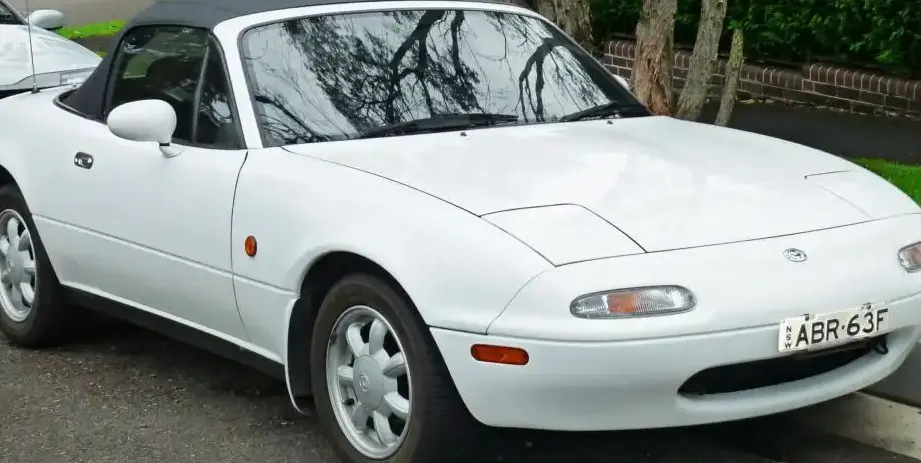
The Mazda MX-5 NB (second generation), produced from 1998 to 2005, represented a significant evolution of the iconic roadster. While retaining the core principles of lightweight, rear-wheel drive fun, the NB introduced a more refined and modern aesthetic compared to its NA predecessor. The 1.8 Turbo variant, available primarily in select markets including Europe and Japan between 2004 and 2005, was a relatively rare and performance-focused iteration of the NB, positioned as the top-tier offering before the introduction of the NC generation. It aimed to deliver a more potent driving experience while maintaining the MX-5’s celebrated handling balance.
Technical Specifications
| Brand | Mazda |
| Model | MX-5 |
| Generation | MX-5 II (NB) |
| Type (Engine) | 1.8 Turbo (172 Hp) |
| Start of production | 2004 |
| End of production | 2005 |
| Powertrain Architecture | Internal Combustion engine |
| Body type | Roadster |
| Seats | 2 |
| Doors | 2 |
| Fuel consumption (combined) | 8.2 l/100 km (28.7 US mpg, 34.4 UK mpg, 12.2 km/l) |
| Fuel Type | Petrol (Gasoline) |
| Weight-to-power ratio | 6.5 kg/Hp, 153.6 Hp/tonne |
| Weight-to-torque ratio | 5.4 kg/Nm, 186.6 Nm/tonne |
| Power | 172 Hp @ 6000 rpm |
| Power per litre | 93.5 Hp/l |
| Torque | 209 Nm @ 5500 rpm (154.15 lb.-ft. @ 5500 rpm) |
| Engine layout | Front, Longitudinal |
| Engine Model/Code | BP-ZET(RS) |
| Engine displacement | 1839 cm3 (112.22 cu. in.) |
| Number of cylinders | 4 |
| Engine configuration | Inline |
| Cylinder Bore | 83 mm (3.27 in.) |
| Piston Stroke | 85 mm (3.35 in.) |
| Compression ratio | 9.5:1 |
| Number of valves per cylinder | 4 |
| Fuel injection system | Multi-port manifold injection |
| Engine aspiration | Turbocharger, Intercooler |
| Valvetrain | DOHC |
| Engine oil capacity | 3.8 l (4.02 US qt | 3.34 UK qt) |
| Coolant | 6.2 l (6.55 US qt | 5.46 UK qt) |
| Kerb Weight | 1120 kg (2469.18 lbs.) |
| Fuel tank capacity | 48 l (12.68 US gal | 10.56 UK gal) |
| Length | 3965 mm (156.1 in.) |
| Width | 1680 mm (66.14 in.) |
| Height | 1235 mm (48.62 in.) |
| Wheelbase | 2265 mm (89.17 in.) |
| Ride height (ground clearance) | 130 mm (5.12 in.) |
| Minimum turning circle | 10.4 m (34.12 ft.) |
| Drivetrain Architecture | Rear wheel drive |
| Number of gears and type of gearbox | 6 gears, manual transmission |
| Front suspension | Double wishbone |
| Rear suspension | Double wishbone |
| Front brakes | Ventilated discs |
| Rear brakes | Disc |
| Assisting systems | ABS (Anti-lock braking system) |
| Steering type | Steering rack and pinion |
| Power steering | Hydraulic Steering |
| Tires size | 205/40 R17 |
| Wheel rims size | 7J x 17 |
Powertrain & Engine Architecture
The heart of the 1.8 Turbo MX-5 NB is the BP-ZET(RS) engine, a 1.8-liter inline-four cylinder powerplant. This engine builds upon the foundation of the BP-ZE engine found in other NB MX-5s, but adds a Mitsubishi TD04HL-13C turbocharger with an intercooler. The addition of forced induction significantly boosted power output. The engine utilizes multi-port fuel injection and a double overhead camshaft (DOHC) valvetrain, contributing to its responsive nature. The turbocharger provides a noticeable increase in torque, particularly in the mid-range, enhancing acceleration. The engine’s oil capacity is 3.8 liters, and it requires a coolant volume of 6.2 liters. The 6-speed manual transmission was the only transmission option offered with this engine, designed to handle the increased power and torque.
Driving Characteristics
The 1.8 Turbo MX-5 NB delivers a markedly different driving experience compared to the naturally aspirated versions. The turbocharger introduces a degree of turbo lag, but once it spools up, the acceleration is considerably more forceful. The 6-speed manual transmission allows drivers to keep the engine within its optimal power band. While the naturally aspirated models excel in smooth, linear power delivery, the turbo variant offers a more exciting, albeit slightly less predictable, power curve. The increased torque makes overtaking easier and provides a more engaging experience on winding roads. The weight distribution remains excellent, maintaining the MX-5’s renowned handling balance, but the added power requires more respect from the driver.
Equipment & Trim Levels
The 1.8 Turbo MX-5 NB typically came well-equipped, reflecting its position as the range-topping model. Standard features included power windows, power steering, air conditioning, and a leather-wrapped steering wheel. Many examples also featured alloy wheels, a limited-slip differential, and upgraded suspension components. Interior upholstery was typically leather or a high-quality cloth. Optional extras included a Bose sound system, a hardtop roof, and various cosmetic enhancements. The dashboard layout was consistent with other NB MX-5s, but the turbo model often featured unique badging and trim details.
Chassis & Braking
The chassis of the 1.8 Turbo MX-5 NB remained largely unchanged from other NB models, retaining the double wishbone suspension setup at both the front and rear. However, some examples featured slightly stiffer springs and dampers to better manage the increased power. The braking system consisted of ventilated discs at the front and solid discs at the rear, supplemented by an Anti-lock Braking System (ABS). The steering utilized a rack and pinion system with hydraulic power assistance, providing precise and responsive control. The car rode on 205/40 R17 tires mounted on 7J x 17 inch alloy wheels.
Market Reception & Comparison
The 1.8 Turbo MX-5 NB was generally well-received by automotive critics, who praised its increased performance and engaging driving experience. However, some noted the turbo lag and the slightly less refined nature of the engine compared to the naturally aspirated models. Compared to the standard 1.8-liter MX-5, the turbo variant offered a significant power boost, but at the cost of slightly increased fuel consumption. It also commanded a higher price tag. Compared to other sports cars of the era, the MX-5 NB 1.8 Turbo offered a unique combination of affordability, reliability, and driving enjoyment.
Legacy
The 1.8 Turbo MX-5 NB remains a sought-after model among enthusiasts. The BP-ZET(RS) engine is generally considered to be robust and reliable, provided it is properly maintained. Regular oil changes and careful driving are essential to prevent turbocharger issues. Today, these cars are increasingly collectible, and well-maintained examples can command premium prices in the used car market. The 1.8 Turbo represents a high point in the NB MX-5’s evolution, offering a thrilling and rewarding driving experience that continues to appeal to sports car fans.